“Two pairs and a free eye exam.” If you’ve seen the America’s Best commercials, that pitch is burned into your memory. The advertised price is real — around $80–$130 — but it applies to a specific lineup of frames, and the upsells are where the total can quietly double.
America’s Best Contacts & Eyeglasses is a value-focused chain built around that two-pair deal. It’s genuinely one of the cheapest ways to get glasses in the U.S. if you stick to the included options. Here’s exactly what you get and what costs extra.
America’s Best Price Breakdown
| Item | Cost |
|---|---|
| Two-pair deal + free exam | $80–$130 |
| Standalone eye exam (no purchase) | ~$59 |
| Upgrade to premium frames | +$30–$100 each |
| Progressive lenses | +$100–$200 |
| Anti-reflective coating | +$40–$70 |
| High-index lenses | +$50–$100 |
| Photochromic (Transitions) | +$90–$130 |
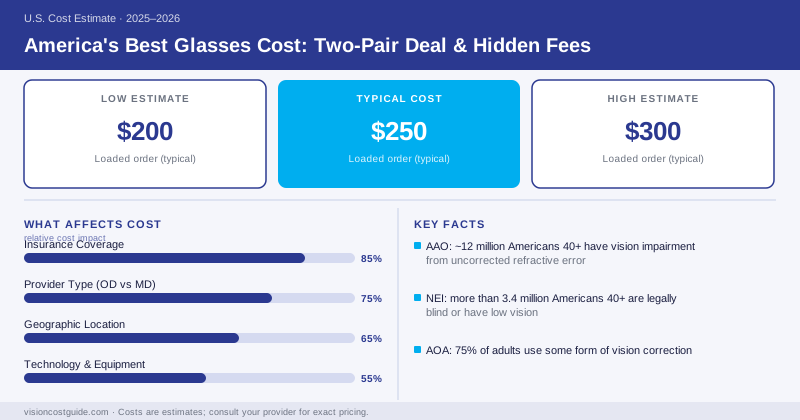
| Loaded order (typical) | $200–$300 |
The two-pair deal is the real draw. For roughly the price of a single basic pair elsewhere, you get two complete pairs plus an exam. The Vision Council’s 2024 figures put the average U.S. complete pair near $250 — so two pairs for under $130 is a striking value, as long as you understand the fine print.
What the Deal Actually Includes
The included package covers two frames from a designated selection plus single-vision lenses with the free exam. That’s it. The moment you want progressives, a coating, thinner high-index lenses, or a frame outside the deal lineup, you’re paying extra. None of that is a scam — it’s just how the loss-leader pricing works. Walk in knowing which upgrades you actually need.
The $80–$130 two-pair deal is legitimate but covers basic single-vision lenses and select frames only. If you need progressive lenses, AR coating, or high-index lenses, expect $200–$300. Even loaded, it’s still cheaper than most mall optical chains — just don’t expect the headline price if your needs are complex.
The Free Exam Catch
The exam is free only with the two-pair purchase. On its own, it’s about $59. The American Optometric Association recommends a comprehensive eye exam every one to two years for healthy adults, so if you’re due anyway, bundling it with the glasses deal is efficient. Just remember the “free” exam is contingent on buying the package.
Where America’s Best Fits
It’s ideal for budget-conscious shoppers, families needing multiple pairs, kids who break glasses often, and anyone who wants a backup pair without paying twice. The two-pair structure is perfect for “one for everyday, one for the car” or a spare. It’s less ideal if you want designer frames, a wide style selection, or premium lens tech — those push you out of the deal pricing fast.
Be ready to say no at the counter. Like most value chains, America’s Best trains staff to recommend upgrades — premium coatings, high-index, photochromic. Some are worth it, many aren’t for a mild prescription. A basic anti-reflective coating is usually a smart add for screen users, but decline upgrades you don’t need or the “two pairs for $80” can turn into a $250 bill.
How It Compares
Against mall chains like LensCrafters, America’s Best wins enormously on price. Against warehouse clubs (Costco, Sam’s Club), it’s competitive and doesn’t require a membership. Against online glasses retailers, online can match or beat the per-pair price, but America’s Best includes the exam and in-person fitting in one stop.
Bottom Line
America’s Best costs $80–$130 for two pairs plus an exam — one of the best value deals in U.S. eyewear — but upgrades can push a loaded order to $200–$300. Stick to the included frames and basic lenses and the savings are excellent. Need fancier lenses or frames? Compare against warehouse optical and learn how to get cheap eyeglasses before you commit to every counter upsell.
Frequently Asked Questions
The signature deal is two pairs of glasses plus a free eye exam for around $80–$130, depending on current promotions and frame selection from the included lineup.
The exam is free only when you buy the two-pair package. A standalone eye exam without a purchase typically costs around $59.
Premium frames, progressive lenses, anti-reflective coating, high-index lenses, and photochromic options cost extra. A loaded order can climb to $200–$300 despite the low advertised price.