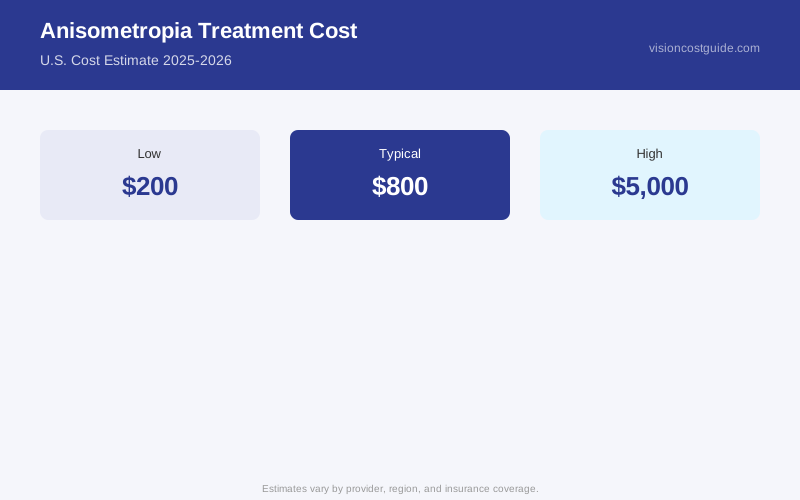
What does ocular anisometropia treatment actually cost long-term — and is it worth correcting in adults, or only in children? It’s one of the questions that rarely gets a straight answer in a 15-minute eye appointment.
Anisometropia means your two eyes have significantly different prescriptions. One eye might need -1.50D and the other -4.50D. Or one is farsighted while the other is nearsighted. At low differences, this is barely noticeable. At differences of 2 diopters or more, the brain struggles to merge the two differently-sized images into one, causing eyestrain, headaches, and in children, amblyopia (lazy eye) development.
Who Has It and Why It Matters
The prevalence of clinically significant anisometropia (1 diopter or more) is approximately 5–10% of the adult population, according to data cited by the National Eye Institute. In children, undetected anisometropia is one of the leading preventable causes of amblyopia — which is why pediatric eye screening matters.
In adults, it usually develops from unequal myopia progression, after cataract surgery in one eye (where the IOL power is slightly imperfect), or from corneal disease affecting one eye’s curvature. The symptoms range from none at all (the brain suppresses one eye) to significant headaches, eye fatigue, and double vision.
The Treatment Decision Tree
Treatment approach depends on the degree of difference and your age:
- Less than 1D difference: Often no treatment needed, or standard glasses handle it.
- 1–3D difference: Glasses work but may cause image size disparity (aniseikonia). Contacts are usually a better optical solution.
- 3D+ difference: Glasses become problematic for most patients. Contacts strongly preferred.
- Children under 10 with significant anisometropia: Immediate treatment plus amblyopia therapy — this is time-sensitive.
Treatment Costs Compared
| Treatment Option | One-Time Cost | Annual Cost | Best For |
|---|---|---|---|
| Glasses (standard lenses) | $200–$600 | $0 (until Rx changes) | Mild anisometropia (under 2D) |
| Glasses (high-Rx, digitally surfaced) | $400–$900 | $0 | Moderate anisometropia |
| Soft contact lenses (daily) | $500–$800/year | $500–$800 | Moderate-severe |
| Scleral lenses | $1,500–$4,500 initial | $200–$500 maintenance | Irregular cornea cases |
| LASIK/LASEK | $4,000–$6,000 (both eyes) | $0 | Mild-moderate myopic anisometropia |
| PRK | $3,000–$5,000 (both eyes) | $0 | LASIK-ineligible corneas |
| Lens-based surgery (RLE) | $5,000–$10,000 | $0 | High prescriptions, presbyopia |
Glasses: Cheap but Optically Limited
Standard eyeglasses correct the prescription in each eye. The problem: high-power lenses magnify or minify the image seen by each eye differently. When one eye’s lens is significantly stronger, the brain receives two differently-sized retinal images — a condition called aniseikonia — which can cause worse headaches than not wearing correction at all.
A general guideline: glasses are comfortable for most people with up to 2–2.5D of difference between eyes. Beyond that, glasses technically correct the prescription but the aniseikonia makes them uncomfortable to wear full-time. Digitally surfaced lenses with iseikonic modifications can help reduce image size disparity — but they cost $400–$800 for the lens pair alone.
If you have more than 2D difference between eyes and glasses feel uncomfortable — headaches within an hour, eye fatigue, reluctance to wear them — aniseikonia is likely the issue, not the prescription itself. Ask for an iseikonic evaluation. Your optician can order lenses with modified base curves and center thickness to equalize image sizes. This requires a specialist, costs more, and not every optical lab offers it. An alternative: switch to contact lenses for full-time wear, which virtually eliminate aniseikonia because the correction sits directly on the eye.
Contact Lenses: The Preferred Optical Solution
Contact lenses correct anisometropia with minimal aniseikonia because they move with the eye and eliminate the prismatic effect of off-axis viewing through spectacle lenses. For most anisometropia patients with 2D+ difference, contacts are optically superior to glasses.
Soft daily disposables: $500–$800/year. Standard soft lenses work for most anisometropic prescriptions.
Toric soft lenses: Required if astigmatism is significant in either eye — add $100–$200/year.
Rigid gas-permeable (RGP) lenses: Better optical quality for irregular corneas. $300–$600 for the lenses (longer-lasting), but take weeks to adapt to.
Scleral lenses: For anisometropia caused by keratoconus or corneal irregularity (one eye significantly more affected), sclerals vault over the cornea entirely. They’re expensive initially ($1,500–$4,500 for fitting and lenses), but they’re often the only solution that gives comfortable, clear vision.
Surgical Options
For adults with stable prescriptions who want a permanent solution, refractive surgery is worth evaluating.
LASIK: Works well for anisometropia where both eyes are within correctable range (typically -8 to -10D of myopia, up to +4–5D of hyperopia). The surgeon can correct both eyes to the same target (both plano for distance) or intentionally leave a small difference for monovision. Cost: $2,000–$3,000/eye, $4,000–$6,000 total.
PRK: Same optical results as LASIK, recommended when corneal thickness is insufficient for LASIK flap creation. Longer recovery (2–4 weeks for vision to stabilize vs. 1–2 days with LASIK). Similar price range.
Refractive Lens Exchange (RLE): For higher prescriptions or patients over 45 (who are developing presbyopia anyway), replacing the natural lens with an IOL is an option. Particularly useful when one eye has a high prescription outside LASIK’s range. Cost: $3,500–$5,000/eye.
Surgical correction of anisometropia requires careful planning. A surgeon who corrects both eyes to emmetropia (zero prescription) is eliminating anisometropia — but the brain still needs time to adapt if it’s been suppressing one eye for years. Some adult patients with long-standing anisometropia and suppression experience diplopia (double vision) immediately after surgery as the suppressed eye “wakes up.” Discuss this possibility explicitly before surgery, especially if one eye has been significantly weaker since childhood.
Amblyopia Treatment in Children: Time-Sensitive and Non-Negotiable
In children, anisometropia-induced amblyopia must be treated aggressively. The visual system is plastic until approximately age 7–10 — after that, untreated amblyopia becomes permanent.
Treatment typically involves:
- Full correction of the anisometropia (glasses or contacts): $200–$400/pair
- Patching or atropine penalization of the better eye to force the weaker eye to work: $0 (patching) or $50–$200/month (atropine drops)
- Frequent monitoring: every 2–4 weeks initially, then monthly — $100–$250/visit
- Vision therapy (in some cases): $200–$600/month
The American Academy of Ophthalmology estimates that amblyopia affects 2–3% of children in the U.S. Anisometropia is the most common cause. Treatment in early childhood is inexpensive and effective. Treatment attempted after age 10 is less effective and the visual loss more likely to be permanent.
Long-Term Cost Perspective
For most adults, anisometropia management is a decades-long commitment. Contacts at $500–$800/year over 20 years costs $10,000–$16,000. LASIK at $5,000 one-time looks very different on that timeline — especially since the correction is permanent and the cost is HSA/FSA-eligible.
Run the math for your own situation, factor in your prescription stability, and don’t let the sticker shock of surgery prevent you from doing the comparison.