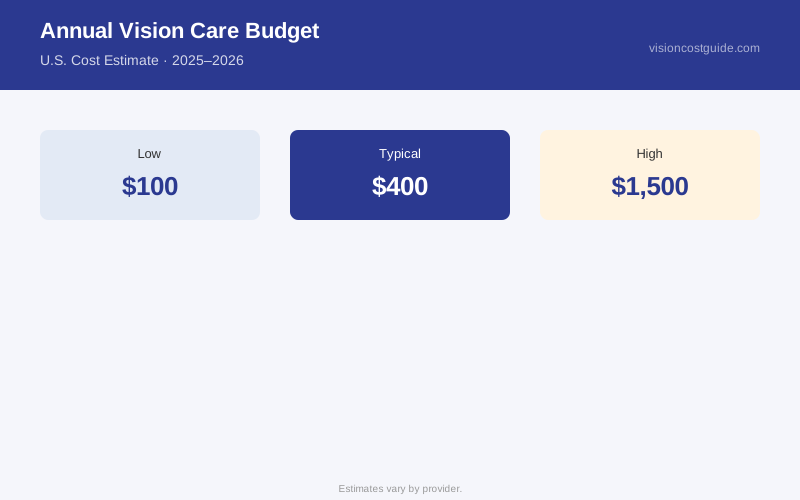
What does vision care actually cost per year? Not what insurance covers in theory — what leaves your wallet? The answer depends heavily on whether you wear glasses, contacts, or both; whether your prescription is stable; and how proactive you are about eye health. But the range is wide: a young adult with stable mild myopia might spend $80/year. A presbyopic adult with dry eye on specialty contacts might spend $1,800. Here’s how to build an honest budget.
National Averages: What Americans Actually Spend
The Vision Council’s 2024 consumer spending data shows that Americans who purchase vision correction products spend an average of $350–$550 per year out of pocket, after insurance. Contact lens wearers tend to spend more than glasses-only wearers; adults 45+ spend significantly more as presbyopia adds complexity and cost.
The NEI (National Eye Institute) reports that uncorrected vision problems cost the US economy over $145 billion annually in lost productivity and medical costs — a figure that underscores why routine vision care investment is typically cost-effective.
Annual Cost by Vision Correction Type
| Correction Type | Annual Eye Exam | Lenses/Contacts | Frames | Extras | Estimated Annual Total |
|---|---|---|---|---|---|
| No correction needed | $80–$150 | — | — | — | $80–$150 |
| Single vision glasses only | $80–$150 | $80–$250 (new pair every 2 yrs, amortized) | — | Coatings, adjustments | $120–$280 |
| Contact lenses (daily disposable) | $120–$200 | $400–$900 | — | Backup glasses | $550–$1,100+ |
| Contact lenses (monthly, 2-week) | $120–$200 | $150–$400 | — | Solution, backup | $280–$650 |
| Bifocal/progressive glasses | $120–$200 | $150–$400 (amortized) | — | Extras | $200–$500 |
| Contacts + glasses | $120–$200 | $600–$1,200 combined | — | — | $720–$1,400 |
| Specialty contacts (scleral, toric, multifocal) | $200–$400 | $800–$2,000 | — | Fitting, solution | $1,000–$2,400 |
These are out-of-pocket estimates. With average vision insurance, subtract $150–$300 from most categories.
Life Stage Breakdown
Young adults (18–40), stable prescription: Budget range: $100–$500/year
- If glasses-only with a stable prescription, a new pair every 2 years costs $150–$400; amortized to ~$75–$200/year plus the annual exam.
- Contact lens wearers spend $350–$700/year for the contacts themselves plus the fitting exam.
- Many young adults skip annual exams — not recommended, but common. The AOA recommends annual exams for contact lens wearers and every 2 years for glasses-only wearers with no risk factors.
Adults 40–55 (presbyopia onset): Budget range: $250–$800/year
- Progressive lenses or reading glasses added to the mix. A quality progressive pair runs $400–$800 every 2 years ($200–$400/year amortized).
- Reading glasses for occasional use: $10–$50/year (OTC) or $100–$200/year (prescription).
- Computer glasses or anti-fatigue lenses: additional $150–$400 every 2 years.
- This decade is when vision care costs typically jump most significantly.
Adults 55+: Budget range: $300–$1,000+/year
- Annual exams strongly recommended — risk of glaucoma, macular degeneration, diabetic retinopathy, and cataract rises substantially.
- Multiple pairs (distance, reading, computer) common.
- Specialty dry eye treatment: $100–$400/year.
- Potential monitoring for retinal or optic nerve conditions adds imaging costs ($50–$200/year).
Two adults (40s), two children (8, 12):
| Person | Annual Exam | Lenses/Contacts | Extras | Annual Total |
|---|---|---|---|---|
| Adult 1 (glasses, progressive) | $150 | $200 (amortized) | AR coating, adjustments | $380 |
| Adult 2 (contacts + backup glasses) | $150 | $600 | Solution | $780 |
| Child 1 (glasses, myopia) | $130 | $150 (amortized) | Polycarbonate, myopia monitoring | $340 |
| Child 2 (no correction) | $100 | — | — | $100 |
| Family total | $1,600/year |
With a family vision plan ($800–$1,200/year premium), actual out-of-pocket might drop to $600–$900. Without insurance, the full $1,600 is realistic. Most FSA/HSA contributions of $500–$1,000 cover a meaningful portion of the uncovered remainder.
Where People Overpay (and How to Stop)
Unnecessary annual lens replacement. If your prescription hasn’t changed and your lenses are in good shape, you don’t need new glasses every year. Most insurers cover new lenses every 12–24 months — coverage doesn’t equal necessity.
Lens upgrades you don’t need. Anti-reflective coating: yes, worth it. Blue light add-on on top of AR: probably not necessary for most people (existing AR filters some already). Premium branded AR ($120) vs. standard AR ($40): the difference is real for heavy users, marginal for occasional ones.
Contact lens overordering. Monthly lenses reworn past their replacement schedule save money but increase infection risk — a corneal ulcer costs far more to treat than the contacts you were trying to save. But buying a full year’s supply during a rebate period is legitimate savings of $50–$120.
Skipping comparison pricing. An independent eye exam ($80–$150) plus online glasses ($20–$200) often beats a chain optical’s “exam included” package by $100–$300. You have the right to take your prescription anywhere.
Contact lens prescriptions expire — typically after 1–2 years depending on state law and your prescriber. Buying contact lenses without a valid prescription is illegal in the US and puts you at real clinical risk, as your prescription may have changed. The annual contact lens fitting exam isn’t just an insurance requirement — it includes an assessment of lens fit, corneal health, and prescription accuracy that protects long-term eye health.
How to Reduce Annual Costs Without Cutting Corners
- Use FSA or HSA funds — exams, contacts, glasses, and many dry eye treatments are eligible. Set contribution to match expected spend.
- Buy a year’s supply of contacts during manufacturer rebate periods — typically $50–$120 back on annual supply purchases.
- Order backup glasses online — a $20–$50 Zenni pair for desk use or travel spares is one of the best vision care values available.
- Get your PD measured at your exam — record it, and use it for online orders without paying the optician markup.
- Ask about generic eye drops for routine dry eye management — Systane vs. Refresh vs. store brand delivers equivalent relief at half the price.
- Schedule exams strategically — many FSA plans require use-it-or-lose-it spending before year-end. Scheduling exams in November–December maximizes benefit use.