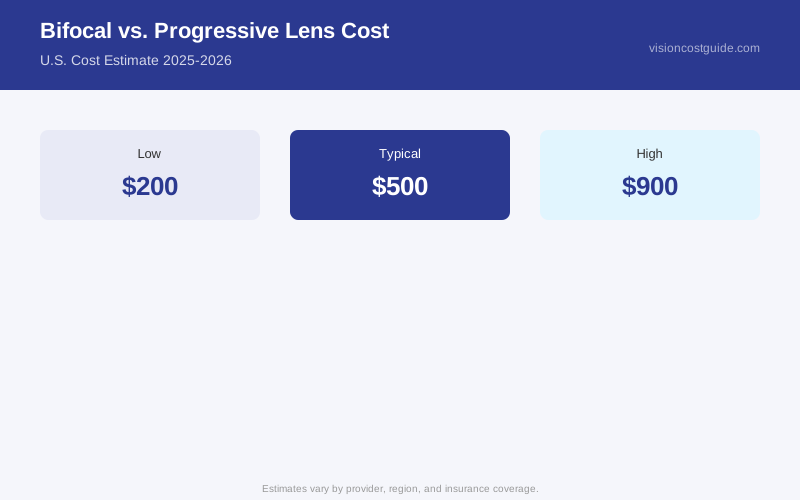
Most people assume progressives are just expensive bifocals with better marketing. That’s not entirely wrong — but it’s not the whole story. The price difference is real ($100–$350 for bifocals vs. $200–$800+ for progressives), and whether it’s worth it depends on factors your optician probably won’t mention unless you ask.
Here’s what the price buys you, where bifocals still win, and how to avoid overpaying for either.
The Core Difference
Both lens types solve the same problem: presbyopia, the age-related loss of near-focus flexibility that typically starts around age 40–45. The American Academy of Ophthalmology (AAO) estimates that nearly everyone develops presbyopia by their mid-40s, affecting an estimated 128 million Americans as of 2024 projections.
Bifocals divide the lens into two distinct zones — distance on top, reading on bottom — with a visible line separating them. It’s a simple, proven design that’s been around since Benjamin Franklin’s era.
Progressives (also called no-line bifocals or PALs — progressive addition lenses) blend distance, intermediate, and near zones without a visible line. They’re manufactured with a corridor of gradually changing power from top to bottom.
The intermediate zone — computer distance, roughly 20–24 inches — is what bifocals don’t have. It’s also what progressives make or break over.
What You’re Paying For
| Lens Type | Low End | Mid Range | Premium | What Drives the Price |
|---|---|---|---|---|
| Bifocal (flat-top 28) | $100 | $200 | $350 | Standard design, minimal variation |
| Bifocal (executive/full-segment) | $120 | $220 | $380 | Wider reading zone |
| Standard progressive | $200 | $350 | $500 | Basic PAL design |
| Mid-tier progressive | $300 | $500 | $650 | Wider corridors, less distortion |
| Premium progressive | $450 | $650 | $900+ | Digitally surfaced, frame-specific |
| Occupational progressive | $250 | $450 | $650 | Optimized for near/mid only |
Progressive lens pricing is driven primarily by the manufacturing process. Standard PALs use conventional surfacing with fixed design parameters. Premium PALs use digital free-form surfacing — the lens is machined to your exact prescription, pupillary distance measurements, and frame dimensions. The result is a wider usable corridor and less peripheral distortion. Expect to pay $150–$250 more for digitally surfaced lenses.
Where Bifocals Still Win
Bifocals aren’t obsolete. Here’s where they legitimately outperform progressives:
Reading-heavy jobs. If you spend most of your workday reading paperwork or physical books, the wide flat-top reading zone of a bifocal gives you a large, undistorted reading field. Progressives have a narrow near zone that some readers find frustrating.
Outdoor and physical work. Progressives require head-tilt adjustments to use the correct zone — something most wearers adapt to, but some never fully do. Workers on ladders or in physical jobs often prefer the predictable two-zone split.
After progressive failure. If you’ve genuinely tried progressives for 6–8 weeks and can’t adapt, bifocals work. Roughly 10–15% of new progressive wearers don’t adapt successfully — though the problem is often fitting or wrong measurements, not the lens design itself.
Cost-conscious patients. If you’re on a budget and primarily need distance + reading, bifocals at $150–$250 for a complete pair do the job without compromise on optical quality.
Most progressive adaptation failures trace back to poor fitting measurements, not the lens design. Three measurements matter most: pupillary distance (PD) — ideally measured as monocular PD for each eye, not just the total; seg height (where your pupil sits relative to the bottom of the frame); and pantoscopic tilt (the forward angle of the frame on your face). Cheap online progressives often use estimated measurements. If you’re spending $400+ on progressive lenses, insist that your fitting measurements are taken with a digital pupillometer while you’re wearing the actual frames you’re buying — not done by estimation.
The Total Cost Picture
Lens price is only one part of the eyeglass equation. A $300 progressive lens in a $50 frame vs. a $100 bifocal lens in a $300 frame can end up at similar totals. Consider the full pair cost:
Complete pair with bifocal lenses: $200–$550 depending on frame and any add-on coatings
Complete pair with standard progressives: $350–$800
Complete pair with premium progressives: $500–$1,200+
Anti-reflective coating is worth adding to either lens type — it costs $50–$150 but meaningfully improves contrast, especially in low light. It’s nearly essential for progressives.
Insurance Coverage
Most vision insurance plans cover bifocals or standard progressives with a co-pay or allowance toward the lens. Progressive lens upgrades typically require an additional out-of-pocket fee even with insurance.
Common scenarios:
- VSP, EyeMed, and similar plans typically cover lenses at around $60–$120 after co-pay for standard single vision or bifocal
- Standard progressives may be covered at a set allowance; premium progressives require additional payment
- Insurance usually covers one complete pair every 1–2 years
Use your flexible spending account (FSA) or health savings account (HSA) for vision purchases — both lenses and frames qualify.
“Progressive” is not a legally defined term — different manufacturers make progressives of wildly different quality. Ask specifically whether the lenses are conventionally surfaced or digitally (free-form) surfaced. If your optician can’t answer this, that’s a sign to ask more questions before committing to a $600 lens purchase.
Who Should Choose Which
Bifocals work well if you: Are new to multifocal lenses and want predictability; work outdoors or do physical labor; primarily need distance + reading with minimal computer time; want the most affordable option.
Progressives work well if you: Spend significant time at a computer (intermediate distance); care about cosmetics and don’t want the visible line; already wear progressives successfully; want one pair that handles all distances.
Occupational progressives are a third option worth knowing about: they’re optimized for near and intermediate distances (computer + desk work) with limited distance correction. They’re not for driving — but for office workers who struggle with standard progressive distortion at reading and computer distances, they’re often transformative. Cost is similar to mid-tier standard progressives.
The Bottom Line
The price difference between bifocals and progressives isn’t hype — it reflects real differences in manufacturing complexity. But more expensive isn’t automatically better for your situation. If you’ve been told you “should” upgrade to progressives without a clear explanation of why they’d suit your life better, ask for that explanation.
Your prescription, your daily tasks, your budget, and your tolerance for adaptation all matter. The right lens is the one that keeps you seeing comfortably throughout your day — not the most expensive one available.