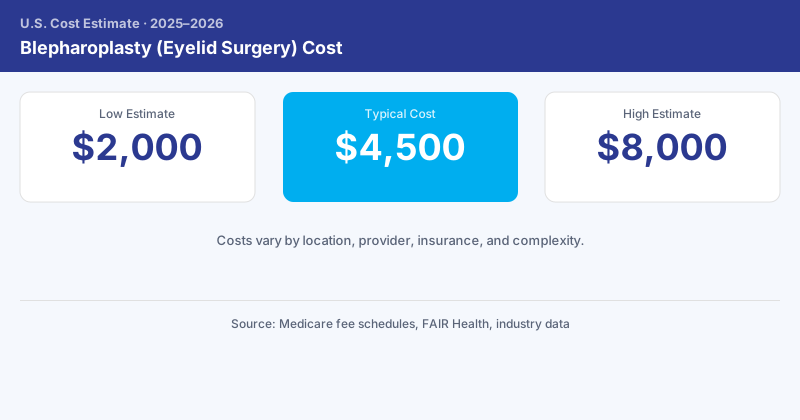
The $7,800 quote you just got for eyelid surgery isn’t necessarily for a vanity procedure. For a significant number of patients — particularly those over 60 — drooping upper eyelids aren’t just an aesthetic concern. They block the top of the visual field, cause fatigue from constant brow-lifting, and can genuinely impair driving and reading. That changes both the medical justification and the insurance math.
Here’s what blepharoplasty actually costs, when insurance steps in, and how to know which category you’re in.
What You’ll Pay: Upper vs. Lower Eyelid Surgery
The two procedures are priced differently and have completely different insurance profiles. Upper and lower lids can be done together — “four-lid blepharoplasty” — or staged separately.
| Procedure | Typical Cost Range | Setting | Anesthesia |
|---|---|---|---|
| Upper blepharoplasty (bilateral) | $3,000–$6,500 | Office or ASC | Local ± oral sedation |
| Lower blepharoplasty (bilateral) | $4,000–$8,500 | ASC | IV sedation |
| Four-lid blepharoplasty | $6,500–$14,000 | ASC | IV sedation or general |
| Functional upper bleph (insurance) | $300–$2,000 out-of-pocket | ASC | Local ± sedation |
| Revision blepharoplasty | $4,500–$10,000 | ASC | Varies |
The total bill includes the surgeon’s fee, facility fee, and anesthesia — and those three components are billed separately. When you see an $8,000 estimate, ask how it breaks down. A lower facility fee matters if you’re paying out of pocket; a higher surgeon fee matters if you’re evaluating expertise.
Geographic variation is substantial. The American Society of Plastic Surgeons (ASPS) reports the average surgeon’s fee for blepharoplasty was $4,195 in 2023 — but that’s a national average across all practice settings. Surgeons in Manhattan, Los Angeles, and Miami routinely charge 40–60% above this baseline. Surgeons in secondary markets and academic centers often come in lower.
When Insurance Covers Upper Blepharoplasty
Functional — not cosmetic — upper blepharoplasty is covered by Medicare and most commercial insurance when drooping lids impair vision. The documentation requirements are specific:
To qualify for insurance coverage, you typically need to demonstrate all three of the following:
1. Margin-reflex distance (MRD) of ≤2mm — the distance from the center of the pupil to the upper eyelid margin when measured by an ophthalmologist or oculoplastic surgeon. Normal MRD is 3.5–4.5mm; significant ptosis is ≤2mm.
2. Visual field defect on formal testing — most insurers require a Humphrey or Goldmann visual field showing ≥12 degrees of superior visual field loss with lids in the resting position. Some require testing with lids both taped and untaped to demonstrate functional improvement.
3. Photographs — standardized, well-lit, forward-gaze photos demonstrating the lid position.
Start with an evaluation from an oculoplastic surgeon (ophthalmologist subspecialized in lid and orbital surgery) — they know how to document these cases properly. Coverage denials often stem from incomplete documentation, not ineligible anatomy.
With Medicare, functional blepharoplasty runs approximately $5,000–$10,000 total, of which you’ll owe your Part B deductible plus 20% coinsurance — typically $1,000–$2,500 out of pocket. Commercial insurance coverage varies but follows similar logic once functional impairment is documented.
Lower blepharoplasty is always cosmetic. No insurer covers it, no matter how loose the skin or how prominent the undereye bags.
The Two Types of Lower Blepharoplasty and Their Costs
Lower lid surgery isn’t one procedure — it’s several approaches with different price points and recovery profiles.
The transcutaneous approach (external incision just below the lash line) allows skin and muscle removal along with fat repositioning. It’s more powerful but leaves a small external scar and has a slightly higher risk of lower lid retraction. Adds $1,000–$2,000 to the cost compared to transconjunctival.
The transconjunctival approach (incision inside the lid, no external scar) removes or repositions fat through the inside of the eyelid. No visible scar. The standard approach for patients with excess fat but good skin tone. Less tissue manipulation typically means faster recovery.
Fat transfer (autologous fat grafting) to the lower lid hollows — adding volume rather than removing it — is increasingly common and appropriate for patients whose bags are more hollow than bulging. Adds $1,500–$3,000 for the fat harvesting step.
What Recovery Looks Like
Upper blepharoplasty under local anesthesia: most patients look presentable (with sunglasses) within 10–14 days. Bruising and swelling peak at days 3–4 and resolve by week 2 for most people. Return to desk work: 5–7 days. Return to exercise: 3–4 weeks.
Lower blepharoplasty: more swelling and bruising given the vascularity of the lower lid. Peak at days 3–5, mostly resolved by week 2–3. Final results — including subtle swelling — take 3–4 months to fully settle.
Complications from blepharoplasty are rare but include dry eye exacerbation (upper lid surgery changes tear film dynamics), lower lid retraction (ectropion), asymmetry requiring revision, and injury to the levator muscle causing ptosis. Seek a board-certified oculoplastic surgeon — not a general plastic surgeon who “also does eyes” — for best outcomes. Oculoplastic surgeons complete ophthalmology residency plus a fellowship specifically in eyelid, orbit, and lacrimal surgery.
Financing and How to Save
Since lower blepharoplasty is cosmetic, saving money requires a different approach than insurance navigation:
- CareCredit and Alphaeon Credit offer 6–24 month promotional financing with deferred interest. Read the terms — deferred interest is not 0% interest; if you don’t pay off the full balance in the promo period, interest accrues from the purchase date.
- FSA/HSA eligibility: Cosmetic blepharoplasty is not FSA/HSA-eligible. Functional blepharoplasty covered by insurance is FSA/HSA-eligible for the out-of-pocket portion.
- Academic medical center pricing: Oculoplastic surgery fellowship programs at major teaching hospitals often offer procedure costs 20–35% below private practice rates.
- Staged approach: Having upper lids done first — especially if they qualify for insurance coverage — and returning for lower lids later spreads costs across two plan years and two deductibles.
The ASPS reported approximately 130,000 blepharoplasty procedures performed in the US in 2022, making it consistently one of the top five cosmetic surgical procedures nationally. Demand has been rising — post-pandemic interest in facial refreshment without dramatic changes has driven upper blepharoplasty referrals particularly high. If you’re evaluating functional versus cosmetic candidacy, your first step is a consultation with an oculoplastic surgeon, not a general plastic surgeon — the subspecialty expertise matters both for outcome quality and insurance documentation.
Frequently Asked Questions
Upper blepharoplasty is covered when drooping eyelids obstruct the superior visual field — typically when the eyelid margin sits at or below the pupil or visual field testing shows a 12-degree or greater reduction. You'll need a formal visual field test from an ophthalmologist documenting functional impairment. Lower blepharoplasty is cosmetic only and never covered by insurance.
Upper blepharoplasty results typically last 5–10 years, sometimes longer. Lower lid surgery results are generally permanent for fat removal but skin laxity can recur. Most surgeons perform the procedure once with no expected repeat, though some patients opt for touch-ups after a decade.
Upper blepharoplasty is frequently done under local anesthesia in an outpatient setting — an office procedure room or ambulatory surgery center. Lower blepharoplasty more often uses IV sedation or general anesthesia in an ASC. Full general anesthesia is rarely required. Most patients go home the same day.