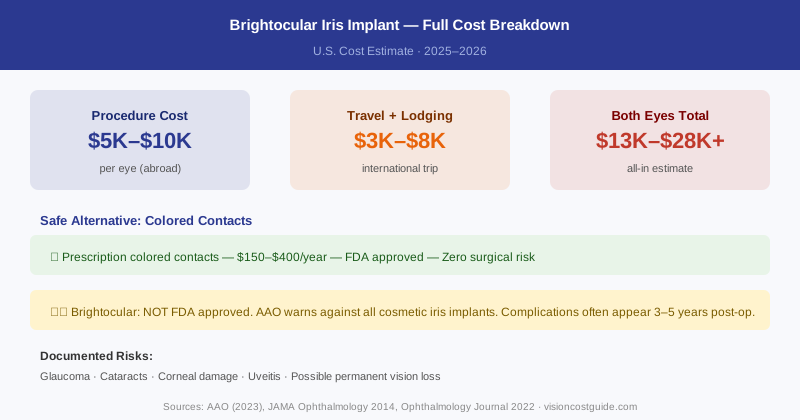
$5,000 to $10,000 per eye — and potentially your vision. That’s the actual cost equation behind Brightocular, a colored iris implant device that promises to permanently change your eye color. The price quote looks straightforward. The risks buried in clinical literature are anything but.
If you’re researching Brightocular, you deserve a complete picture before making any decisions.
What Is Brightocular?
Brightocular is a thin, silicone-based disc implanted in the anterior chamber of the eye (the fluid-filled space between the cornea and the iris). The implant sits on top of the natural iris, covering it with a new color. The procedure is marketed for cosmetic eye color change — most commonly to make brown eyes appear blue, green, or gray.
The company operates internationally and markets to patients in multiple countries. The procedure is performed in a surgical setting and takes approximately 15 minutes per eye.
The FDA Status: This Is Critical
Brightocular is not approved by the U.S. Food and Drug Administration. It is not available at any licensed facility in the United States. Americans who pursue this procedure must travel to Turkey, Colombia, Panama, Mexico, or other countries where regulatory standards differ.
The American Academy of Ophthalmology (AAO) — the largest professional organization of eye physicians in the US — issued an explicit warning against all iris implants for cosmetic eye color change. The statement cites the 2014 paper by Vold et al. in JAMA Ophthalmology documenting severe complications including irreversible vision loss.
What It Actually Costs
| Cost Component | Estimate |
|---|---|
| Procedure (1 eye) | $5,000–$10,000 |
| Procedure (both eyes) | $10,000–$20,000+ |
| International travel + lodging | $3,000–$8,000 |
| Pre-op testing abroad | $300–$600 |
| Total (both eyes) | $13,000–$28,000+ |
These figures are based on reports from online patient communities and clinic marketing materials. Prices are opaque and vary significantly by country and clinic.
What’s not included in the quote: the cost of treating complications. Glaucoma medications run $50–$200/month indefinitely. Glaucoma surgery (trabeculectomy) costs $3,000–$8,000 in the US. Cataract surgery to remove a damaged lens costs $3,500–$7,000 per eye. These are real scenarios documented in published clinical case reports.
The Risk Profile, Without Sugar-Coating
The AAO and peer-reviewed literature identify these documented complications of anterior chamber iris implants:
Glaucoma (elevated intraocular pressure): The implant can obstruct aqueous humor outflow, raising eye pressure. Untreated glaucoma causes irreversible optic nerve damage. Multiple published case series show elevated IOP in a significant proportion of patients, often appearing 3–5 years post-procedure rather than immediately.
Cataract formation: The implant can contact and damage the natural lens. Cataracts from implant contact require surgical removal — a separate operation with its own risks.
Corneal endothelial cell loss: The endothelium (the inner cell layer of the cornea) doesn’t regenerate. Chronic mechanical contact with the implant depletes these cells over time. When endothelial cell count drops below a threshold, the cornea becomes permanently cloudy. This requires a corneal transplant — a major surgery with lengthy recovery.
Uveitis (chronic inflammation): The eye recognizes the silicone implant as a foreign body and responds with inflammation. Chronic uveitis requires ongoing medication and is itself a risk factor for glaucoma and cataract.
Explantation complications: Removing the implant later doesn’t reverse damage already done to the endothelium or optic nerve.
A 2022 retrospective study in Ophthalmology (the AAO’s flagship journal) followed patients who had cosmetic iris implants and found that nearly 60% developed at least one serious complication requiring intervention within 10 years. The study concluded that explantation rates were high but that “removal does not guarantee recovery of lost visual function.”
Why People Still Consider It
Marketing for iris implants is sophisticated and emotionally effective. The before/after photos are striking. Patient testimonials — especially those from the first 1–3 years post-procedure — are often positive, because the serious complications (glaucoma, corneal decompensation) frequently take years to manifest.
The demographic most targeted by this marketing is young adults with dark brown eyes, who cannot effectively use standard colored contacts to achieve a significant color change. Standard colored contact lenses overlay color but can’t fully obscure a dark iris. Iris implants genuinely deliver what contacts cannot: a convincing color change on dark eyes.
That’s the real appeal. And it’s why the risk conversation matters so much — the patients most interested are often in their 20s, with 50+ years of vision ahead of them.
The Safe Alternative: Colored Contact Lenses
Colored contact lenses — including options designed for dark eyes — are the only method for eye color change that ophthalmologists and optometrists endorse. Lenses for dark eyes use opaque color layers rather than tinted material, producing visible color change even over brown irises. They require a valid prescription (even purely cosmetic lenses must be fitted by an eye care provider under US law). Annual cost: $150–$400 with a prescription. Zero surgical risk.
| Option | Annual Cost | Risk Level | FDA Status |
|---|---|---|---|
| Prescription colored contacts | $150–$400 | Low (with proper fit/care) | ✅ Approved |
| Non-Rx decorative contacts | $30–$120 | Moderate (if improperly fit) | ⚠️ Requires Rx by law |
| Brightocular iris implant | $13,000–$28,000 (lifetime) | High | ❌ Not approved in US |
For anyone researching Brightocular seriously, the conversation with an ophthalmologist should happen before any international travel booking. Ask specifically about endothelial cell count testing, the long-term complication data, and what explantation would involve if complications arise.
The price of changing your eye color is not just financial. The AAO’s position is unambiguous, and the clinical evidence supporting that position continues to accumulate.
Bottom Line
Brightocular costs $5,000–$10,000 per eye, requires travel abroad, and is not FDA-approved. The AAO and published clinical data document serious, often delayed complications including glaucoma, cataracts, and permanent vision loss. Colored contact lenses — while unable to fully replicate the implant effect on very dark eyes — remain the only eye color change method endorsed by ophthalmology. If you’re set on significant color change for dark eyes, that conversation belongs with an ophthalmologist, not a medical tourism coordinator.
Frequently Asked Questions
Brightocular procedures are quoted at $5,000–$10,000 or more per eye, depending on the country and clinic. Because the device is not FDA-approved in the US, Americans must travel abroad for the procedure — adding travel costs of $3,000–$8,000. Total out-of-pocket typically runs $13,000–$28,000 for both eyes.
No. Brightocular is not FDA-approved in the United States. The American Academy of Ophthalmology (AAO) has explicitly warned patients against iris implants for cosmetic eye color change, citing risks of glaucoma, cataracts, and permanent vision loss.
The AAO and peer-reviewed studies document serious risks: glaucoma (elevated eye pressure requiring medication or surgery), cataracts from lens-implant contact, corneal decompensation, chronic uveitis (inflammation), and in severe cases, blindness. These complications often appear years after the procedure.
Colored contact lenses — daily, monthly, or extended-wear — are the only ophthalmology-approved method for changing eye color. Prescription colored contacts cost $150–$400/year. Non-prescription colored contacts require a prescription too (by US law) and carry their own safety risks if improperly fitted.