Here’s the thing about cataracts: surgery isn’t optional in the long run. Once cataracts progress enough to impair daily function — driving, reading, watching television — glasses can’t correct the haze and light scatter a cloudy natural lens causes. Surgery replaces the lens. The question is only timing and what type of lens implant you choose.
But there’s a real financial decision embedded in that: standard IOL (mostly covered by Medicare) versus premium IOL (significant out-of-pocket cost). Here’s how to think about that cost trade-off clearly.
Cataract Surgery Cost: What You Actually Pay
| Surgery + IOL Type | Medicare/Insurance Pays | Your Out-of-Pocket |
|---|---|---|
| Standard monofocal IOL (covered) | 80% after deductible | $700–$1,500/eye |
| Toric IOL (astigmatism correction) | Standard IOL amount | $1,500–$2,500 extra/eye |
| Multifocal / trifocal IOL | Standard IOL amount | $2,000–$4,000 extra/eye |
| Extended Depth of Focus (EDOF) IOL | Standard IOL amount | $1,500–$3,000 extra/eye |
| Laser-assisted cataract surgery | Standard amount | $500–$1,000 extra/eye |
| Total out-of-pocket range | $700–$7,000+/eye |
Medicare Part B covers cataract surgery as a medically necessary procedure: it pays 80% of approved costs after the Part B deductible ($257 in 2025). You’re responsible for the 20% coinsurance plus any excess charges. For a standard surgery with a standard monofocal IOL, your total out-of-pocket runs roughly $700–$1,500 per eye, often less with a Medicare Supplement (Medigap) plan.
The premium IOL upcharge is almost never covered by Medicare or commercial insurance — it’s classified as an elective upgrade above the medically necessary standard of care.
Standard IOL vs. Premium IOL: The Real Decision
A standard monofocal IOL corrects vision at one focal distance — almost always distance. You’ll see well for driving and distance activities. You’ll need reading glasses for near tasks, and probably progressive glasses for intermediate (computer) distance as well.
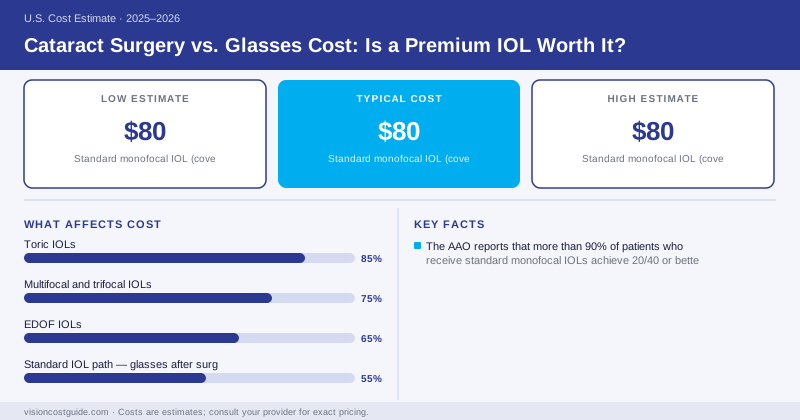
The AAO reports that more than 90% of patients who receive standard monofocal IOLs achieve 20/40 or better distance vision — the legal driving standard — without glasses. Most achieve 20/20 or near.
Premium IOLs are designed to reduce reading glass dependence:
Toric IOLs correct astigmatism along with cataract. If you had significant pre-existing astigmatism (1.5+ diopters), a toric lens can substantially reduce how much residual prescription remains after surgery. The upgrade cost is $1,500–$2,500 per eye out-of-pocket.
Multifocal and trifocal IOLs (PanOptix, Symfony, AcrySof ReSTOR) use optical zones to create multiple focal points, theoretically allowing both distance and near vision without glasses. Results vary significantly by patient — many achieve functional near vision; some experience halos and glare around lights that are permanent or take months to resolve. The upgrade is $2,000–$4,000/eye extra.
EDOF IOLs (Extended Depth of Focus) like Vivity provide a continuous range of focus with fewer halos than multifocal designs but less near vision range. Many ophthalmologists consider EDOF lenses a middle-ground option.
Premium IOL marketing often promises “spectacle independence” — implying you’ll never need glasses again. The honest version: roughly 70–85% of premium multifocal IOL recipients achieve functional near vision without glasses in good lighting. Most still need readers for fine print in low light. Many patients are fully satisfied with this outcome; some are not. Ask your surgeon for their own patients’ spectacle independence rate — not the industry average.
Lifetime Cost Comparison: Surgery vs. Glasses After Surgery
Assume a 70-year-old patient with standard monofocal IOLs has 15–20 years ahead. What do glasses cost over that period versus the premium IOL upgrade?
Standard IOL path — glasses after surgery:
- Reading glasses: $20–$200/pair (often drugstore readers work fine)
- Prescription bifocals or progressives: $200–$500 every 3 years = ~$1,000–$2,500 over 15 years
- Total glasses-after-surgery cost: $1,000–$2,500 over 15 years
Premium multifocal IOL path:
- Upgrade cost: $2,000–$4,000/eye = $4,000–$8,000 total both eyes
- Reduced or eliminated glasses cost
The math: premium IOLs typically cost more than the lifetime glasses they replace — but the quality-of-life value of not needing glasses for most daily activities is a genuine benefit for many patients. If you’re active, travel frequently, swim, or find reading glasses genuinely burdensome, the upgrade cost is easier to justify.
For patients whose primary vision use is sedentary — reading, TV, minimal driving — standard IOLs with readers may be entirely satisfactory at dramatically lower out-of-pocket cost.
Premium multifocal IOLs are not ideal for everyone. Patients with dry eye disease, previous refractive surgery (LASIK, PRK), corneal irregularities, or macular conditions often get better outcomes from monofocal or toric lenses than from multifocal designs. Your surgeon’s recommendation should be based on your specific ocular anatomy — not just which IOL carries the highest reimbursement margin. It’s appropriate to ask directly why a specific lens is recommended for your eyes.
Questions to Ask Before Choosing an IOL
- “Based on my corneal measurements and ocular health, what is my expected residual prescription with each lens type?”
- “What percentage of your premium IOL patients achieve near vision without glasses at 1 year?”
- “What is your rate of halos or glare complaints with multifocal lenses, and how do you manage them?”
- “Is my dry eye or any other condition a contraindication for multifocal IOLs?”
- “If I’m dissatisfied with a premium IOL, what are the options?”
The difference between a surgically excellent outcome with the wrong lens choice and an equally excellent outcome with the right choice can be $4,000–$8,000. These are the questions worth asking before you sign the consent.
See also: Cataract Surgery Cost for full surgical pricing detail, Premium IOL Cost for IOL-specific pricing, and Does Insurance Cover Cataract Surgery for Medicare and commercial coverage details.