Most chalazia don’t need surgery. That’s the thing your doctor may not have emphasized enough when you walked out with a referral to an oculoplastic surgeon. A chalazion — that firm, painless lump in your eyelid — is a blocked meibomian gland that’s become inflamed and walled off. For roughly 50–70% of patients, consistent warm compresses and lid massage over 4–6 weeks resolve it completely without a scalpel. The other 30–50% need an office procedure. Knowing which camp you’re likely in saves real money.
First: What You Can Try at Home for Free
Before spending anything, try this for 4–6 weeks:
- Warm compress (clean washcloth, not too hot) applied for 10 minutes, 2–4 times daily
- Gentle lid massage after each compress to express blocked secretions
- Lid hygiene: diluted baby shampoo or preservative-free lid scrub pads daily
If the chalazion is shrinking — even slowly — keep going. Ophthalmology literature documents spontaneous resolution rates of 40–70% with consistent warm compress therapy. The keyword is consistent: twice a day, every day, for at least four weeks.
When You Need In-Office Treatment
The chalazion hasn’t changed after 6 weeks of proper warm compress therapy. Or it’s large, pushing on your cornea and affecting your vision, or it’s on your upper lid and causing contact lens discomfort. At this point, two in-office options exist:
Incision and Curettage (I&C): The definitive procedure. Local anesthesia is injected into the eyelid, a small incision is made on the inside of the lid (not the skin surface), and the contents are scooped out. Takes about 15 minutes. You’ll have a bruised eyelid for 5–7 days and use antibiotic ointment for a week.
Steroid Injection (triamcinolone): A corticosteroid is injected directly into the chalazion. Less invasive than I&C, but works best on softer, less organized lesions. Resolution takes 2–4 weeks. For darker skin tones, steroid injections carry a risk of depigmentation of the overlying skin — an important consideration your doctor should raise.
Cost Breakdown
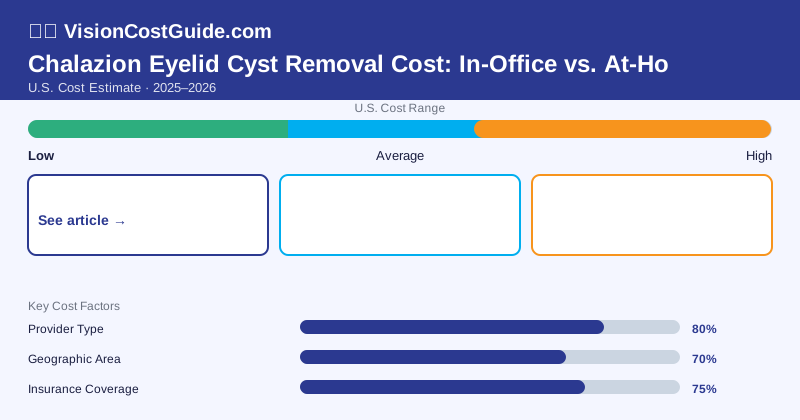
| Treatment Option | Cost Range | Insurance Coverage |
|---|---|---|
| Warm compresses (DIY) | $0 | N/A |
| Lid scrub pads (OTC) | $10–$25/month | Not covered |
| In-office steroid injection | $150–$500 | Sometimes covered under medical insurance |
| Incision and curettage (I&C) | $200–$800 | Often covered under medical insurance |
| I&C at hospital outpatient facility | $500–$1,500 | Higher facility fees even with insurance |
| Repeat procedure (recurrence) | Same range | Re-evaluated for coverage |
Where the procedure is performed matters a lot for self-pay patients. The same 15-minute incision and curettage can cost $200–$400 at a private ophthalmology office and $800–$1,500 at a hospital outpatient department when you add the facility fee. If you’re paying out-of-pocket, ask your ophthalmologist explicitly whether the procedure can be done in-office rather than at the hospital.
Chalazion removal occupies an awkward zone in insurance. It’s coded as a medical (not vision) procedure — CPT 67800 for incision of chalazion. Most commercial medical insurers cover it when documented as symptomatic and having failed conservative treatment. But “failed conservative treatment” is important: insurers want evidence that you actually tried warm compresses for at least 4 weeks before authorizing the procedure. Your ophthalmologist’s documentation of conservative treatment failure strengthens the coverage case. Vision-only plans like VSP don’t cover chalazion removal — it goes through your medical insurance, not your vision benefit.
Why Chalazia Come Back
Chalazia recur in roughly 20–30% of patients — not because the surgery was done wrong, but because the underlying meibomian gland dysfunction (MGD) that caused the original blockage hasn’t been addressed. If you get a second or third chalazion, that’s your body telling you something about your eyelid health.
Recurrent chalazia are a signal to evaluate and treat MGD more aggressively: dedicated warm compress routine, omega-3 supplementation (there’s evidence supporting 1,000–3,000mg/day of EPA+DHA), lid hygiene, and in some cases LipiFlow or IPL if structural gland damage is present. Removing individual chalazia without treating the underlying condition is like treating dandelions without treating your lawn.
Rarely, a persistent chalazion that doesn’t respond to multiple treatments needs biopsy to rule out sebaceous gland carcinoma — a rare but serious eyelid malignancy that can mimic a chalazion. Your ophthalmologist will make this call based on clinical appearance and behavior.
Never try to pop or express a chalazion at home. Unlike a stye (which is infectious and comes to a head), a chalazion is a sterile granulomatous cyst. Attempting to squeeze it can introduce bacteria, convert a sterile cyst to an infected abscess, or traumatize the eyelid tissue — creating a more complex problem than what you started with. Warm compresses, yes. Manual squeezing, no.
Bottom Line
Give warm compresses a genuine 4–6 week trial before spending money on in-office treatment. If you need a procedure, incision and curettage costs $200–$800 in a private ophthalmology office and is often covered by medical insurance when conservative treatment is documented as having failed. Skip the hospital outpatient setting if you can — the facility fee significantly inflates the cost without changing the outcome.