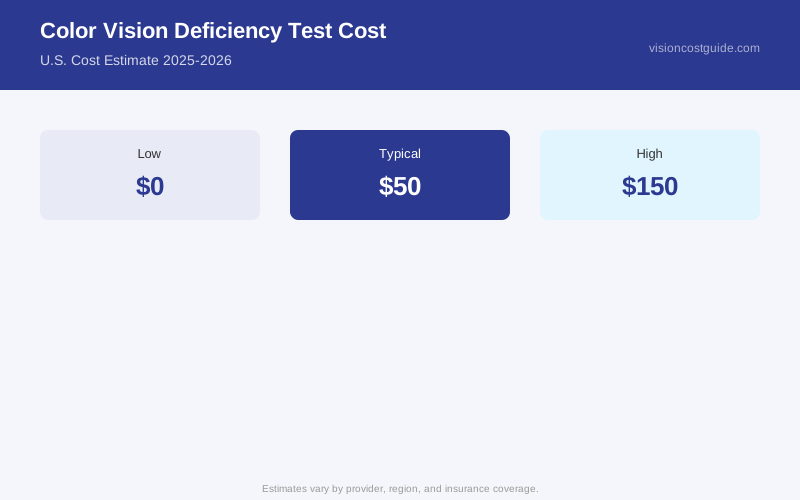
Most people assume a color vision test is just flipping through a book of colored dots. What they don’t realize is that there are half a dozen different tests — ranging from a free 30-second screening to a $100+ occupational evaluation — and which one you need depends entirely on why you’re being tested.
Who Needs Color Vision Testing
The National Eye Institute estimates that approximately 8% of males and 0.5% of females of Northern European descent have some form of color vision deficiency. That’s roughly 13 million Americans. Most have red-green deficiency (deuteranomaly or protanomaly), which is inherited on the X chromosome.
Color vision testing matters in several contexts:
- Routine pediatric eye exams: Identifying color deficiency early so teachers and parents can accommodate it in learning environments
- Occupational screening: Aviation, law enforcement, military, firefighting, electricians, and healthcare roles often have color vision requirements
- Acquired deficiency: Color vision can change with optic nerve disease, macular degeneration, glaucoma, and certain medications — monitoring for change matters
- Genetics/counseling: Parents who know their status can better understand inheritance risk for children
Types of Color Vision Tests and What They Cost
| Test | Type | What It Detects | Typical Cost |
|---|---|---|---|
| Ishihara Plates (24 or 38 plate) | Screening | Red-green deficiency | Included in most exams |
| Hardy-Rand-Rittler (HRR) | Screening | Red-green and blue-yellow | Usually included |
| Farnsworth D-15 | Arrangement | Moderate-severe deficiency, type classification | $25–$75 |
| Farnsworth-Munsell 100-Hue | Arrangement | Full deficiency spectrum, acquired changes | $50–$150 |
| Anomaloscope | Matching | Gold standard, quantifies severity | $100–$200+ |
| Digital/app-based tests | Screening | Variable accuracy | $0–$20 |
Most routine eye exams include a basic color screening test (Ishihara or HRR) at no additional charge. You won’t see a line item for it — it’s bundled into the exam fee. Occupational testing that requires documentation and a detailed report will add $50–$150 or more to your bill.
The Ishihara Test: What It Does (and Doesn’t) Do
The Ishihara pseudoisochromatic plates are the most widely used color vision test in the world. Each plate shows a number or pattern embedded in a field of colored dots — people with normal color vision read the number; those with red-green deficiency see a different number or nothing.
The Ishihara is excellent for detecting red-green deficiency but doesn’t:
- Classify the type precisely (protanopia vs. deuteranopia vs. protanomaly)
- Detect blue-yellow deficiency (tritan defects) reliably
- Quantify severity
- Detect acquired (rather than inherited) color deficiency changes
If you’re being screened for an occupational requirement or experiencing a possible acquired color change, you need a more comprehensive test.
Farnsworth-Munsell 100-Hue Test
The FM-100 is 85 colored caps arranged in four trays. You sort each tray in hue order. The result isn’t just pass/fail — it produces a detailed error score and chart showing exactly which color axis is affected and how severely.
This test takes 20–30 minutes per eye and costs $50–$150 depending on the practice. It’s the standard for:
- Documenting occupational color requirements
- Monitoring for acquired deficiency from optic nerve or macular disease
- Research settings requiring precise color discrimination measurement
Inherited color deficiency is stable — it doesn’t get worse over time and affects both eyes equally. Acquired color deficiency (from optic neuritis, macular degeneration, or certain drugs like hydroxychloroquine) can progress, affect only one eye, and affect blue-yellow more than red-green.
If you’ve always passed color tests and suddenly start failing them — or if you notice colors look different between your two eyes — that’s a flag for acquired disease requiring evaluation. This is different from inherited deficiency and warrants an optical coherence tomography scan and thorough retinal exam.
Does Insurance Cover Color Vision Testing
For children, color vision screening is typically included in a comprehensive pediatric eye exam and covered by insurance or Medicaid as part of the exam.
For occupational testing ordered by an employer, coverage is inconsistent — your employer or occupational health provider may pay for it directly. Vision insurance plans generally don’t cover occupational testing as a separate line item.
For acquired deficiency monitoring in the context of a documented eye disease, testing may be covered as part of a medically necessary exam under medical insurance (not vision insurance).
| Scenario | Who Pays |
|---|---|
| Routine screening (part of comprehensive exam) | Covered by vision insurance/exam fee |
| Pediatric screening | Covered under pediatric benefits (ACA) |
| Occupational evaluation with documentation | Out-of-pocket or employer pays |
| Monitoring for optic nerve/macular disease | Medical insurance (with diagnosis) |
| App-based self-test | Out-of-pocket ($0–$20) |
Occupational Color Requirements: What You Need to Know
Aviation has among the strictest requirements. The FAA requires pilots to demonstrate “normal color vision” using one of several approved tests. The Ishihara alone is not sufficient for final medical certification — if you fail the Ishihara, you’ll need an alternative test (OCVT or MFT) administered by an Aviation Medical Examiner. The Aviation Medical Examiner evaluation costs $100–$250 depending on the examiner.
Law enforcement and firefighting requirements vary by department. Some accept Ishihara results; others require D-15 or even FM-100 documentation. Check requirements with the specific agency before paying for an evaluation — the spec matters.
Online and app-based color vision tests vary wildly in accuracy. Monitor calibration, ambient lighting, and screen glare all affect results. A study in the journal Ophthalmic & Physiological Optics found that popular online color vision tests had sensitivity rates as low as 64% for detecting red-green deficiency — missing more than one in three cases. Don’t rely on app tests for occupational documentation or medical decision-making. See an eye care provider for a validated test.
Living With Color Vision Deficiency: Practical Cost Implications
There’s no treatment for inherited color deficiency, but there are management tools:
- EnChroma glasses: Specialty lenses that enhance color contrast cost $280–$450 for regular frames. They don’t restore normal color vision but can significantly improve color discrimination for some people with red-green deficiency
- Apps: Color identification apps (like Color Name & Hue or ColorBlind Pal) are free and help in practical situations
- Occupational accommodations: Legally required under the ADA if the job function doesn’t require specific color discrimination
The color-blind glasses page covers EnChroma and similar options in detail.
Bottom Line
Basic color vision screening is effectively free — it’s included in any comprehensive eye exam. The Ishihara or HRR plates take two minutes and cost you nothing extra. If you need a detailed occupational evaluation, documentation, or monitoring for acquired disease, plan on $50–$150 for formal testing with a report.
The most important thing to know: if you’ve always had normal color vision and notice a change — colors look dull, one eye sees colors differently than the other — see your eye doctor promptly. Acquired color deficiency can be an early sign of optic nerve or retinal disease that’s treatable when caught early.