Dry eye disease is the #1 reason people stop wearing contact lenses. But “I can’t wear contacts” often really means “I can’t wear the wrong contacts.” The right lens material, replacement schedule, and care routine can make a real difference — though they cost more than standard lenses. Here’s what works, what it costs, and how to make it affordable.
Why Contacts Cause Dry Eye Problems
Standard soft contact lenses dehydrate throughout the day. They absorb moisture from the tear film — sometimes including the mucin and lipid layers critical to tear stability. Traditional HEMA-based lenses have water contents of 38–55%. They feel comfortable at 8 a.m. and increasingly uncomfortable by 3 p.m. as they dehydrate against your cornea.
The contact lens industry has responded with materials designed to minimize this dehydration. Silicone hydrogel materials allow dramatically more oxygen through the lens, keeping corneal metabolism healthier. Phosphorylcholine (PC) surface technologies (Proclear) mimic natural tear phospholipids. Water gradient designs (Dailies Total1) maintain moisture at the lens surface even as the center dehydrates.
According to the American Academy of Optometry, dry eye symptoms affect up to 50% of contact lens wearers in the U.S. — roughly 21 million people.
Contact Lens Options for Dry Eyes and Their Costs
| Lens Option | Annual Supply Cost | Notes |
|---|---|---|
| Standard daily disposable (Dailies AquaComfort Plus) | $180–$280/year | Entry level; moderate dry eye performance |
| Silicone hydrogel daily (Acuvue Oasys 1-Day) | $280–$400/year | High oxygen; good for mild-moderate dry eye |
| Water gradient daily (Dailies Total1) | $350–$550/year | Best moisture retention in soft lens category |
| Silicone hydrogel bi-weekly (Acuvue Oasys) | $180–$320/year | Good performance, lower cost than dailies |
| Proclear monthly (phosphorylcholine tech) | $120–$200/year | FDA-cleared “for dry eye patients” claim |
| Senofilcon A (J&J Acuvue) with lacrisert-type hydration | $300–$450/year | Newer moisture-lock technologies |
| Scleral lenses (custom fit, specialty) | $800–$3,000 total + annual care | Best option for moderate-severe dry eye/OSD |
The Top Soft Lens Choices for Dry Eye Patients
Dailies Total1 (Alcon) — widely regarded as the current gold standard among soft daily lenses for dry eye. The water gradient design puts a nearly 100% water content surface against your eye, transitioning to a silicone hydrogel core. Clinical studies show significantly better end-of-day comfort than traditional dailies. Cost: $350–$550/year at retail; $280–$420 through 1-800 Contacts or online suppliers.
Acuvue Oasys 1-Day (J&J) — senofilcon A material with HydraLuxe technology, designed to integrate with the tear film. Excellent performance for moderate dry eye. Cost: $280–$400/year retail; $220–$330 online.
Acuvue Oasys (bi-weekly) — the original Oasys material with Hydraclear Plus is a classic for a reason. Two-week replacement. Less expensive than daily equivalents. Performance is strong for patients who maintain the replacement schedule.
Proclear (CooperVision) — has an FDA-cleared label for patients with “mild symptoms of discomfort or reduced wearing time associated with contact lens wear” — the only such claim in the U.S. PC Technology mimics natural cell membrane phospholipids.
When Soft Lenses Don’t Work: Scleral Lenses
For patients with moderate-to-severe dry eye disease — especially those with Sjögren’s syndrome, graft-versus-host disease, Stevens-Johnson syndrome, limbal stem cell deficiency, or advanced meibomian gland dysfunction — soft lenses may not be tolerable regardless of material choice.
Scleral lenses vault over the entire cornea and rest on the sclera (white of the eye). The space between the lens and cornea is filled with preservative-free saline, creating a permanent liquid environment for the eye surface. Patients with otherwise unwearable dry eyes often achieve 10–12 hours of comfortable wear with sclerals.
The cost is significantly higher: $800–$3,000 for the initial fitting and lens supply, plus $300–$600/year for lens solutions. But for appropriate patients, scleral lenses can restore contact lens wear when nothing else has worked, and can protect corneal health in severe ocular surface disease.
- Buy online with your prescription. 1-800 Contacts, ContactsDirect, and Lens.com typically charge 20–35% less than buying from your OD’s office for the same lens
- Use rebates. Alcon, J&J, and CooperVision all offer annual mail-in or online rebates — often $100–$150 per year for full-year supply purchases
- Use FSA/HSA funds. Contact lenses and related solutions are qualified FSA/HSA expenses
- Try semi-annual instead of daily if cost is the barrier. Bi-weekly silicone hydrogel (like Acuvue Oasys) costs roughly half of daily equivalents and performs well for moderate dry eye
- Treat the dry eye, not just the lens. Adding daily lubricating eye drops, omega-3 supplements, and warm lid compresses can make more affordable lens options tolerable
Dry Eye Treatments That Complement Contact Lenses
Managing the underlying dry eye improves any lens option’s comfort. The most evidence-backed add-ons:
Lubricating eye drops with contacts — use drops labeled “safe for contact lenses” (preservative-free or with a disappearing preservative). Refresh Contacts, Biotrue, and ReNu MultiPlus Multi-Purpose Solution all have formulations for use with lenses. Cost: $10–$25/month.
Omega-3 supplements — the AAO recommends dietary omega-3 (1,000–2,000 mg EPA+DHA daily) for meibomian gland dysfunction. Quality fish oil or algae-based supplements run $15–$40/month.
Warm compresses + lid hygiene — helps unclog meibomian glands that produce the lipid layer of the tear film. A heated eye mask ($20–$40 one-time) used 5 minutes daily makes a real difference.
Punctal plugs — if these are placed to retain tears on the eye surface, they may extend comfortable contact lens wear time by hours. Plugs cost $100–$300 per procedure; many insurance plans cover them when prescribed for dry eye.
What Not to Do
Don’t overwear lenses in dry conditions and assume it’s just the lens type. Sleeping in lenses you’re not supposed to sleep in, wearing contacts 14–16 hours daily, or wearing lenses during airplane travel dramatically worsens dry eye symptoms regardless of lens material.
And don’t keep switching lenses without addressing the underlying tear film problem. A doctor can evaluate your tear break-up time, meibomian gland function, and corneal staining to target the specific dry eye mechanism — which should drive the lens recommendation.
Bottom Line
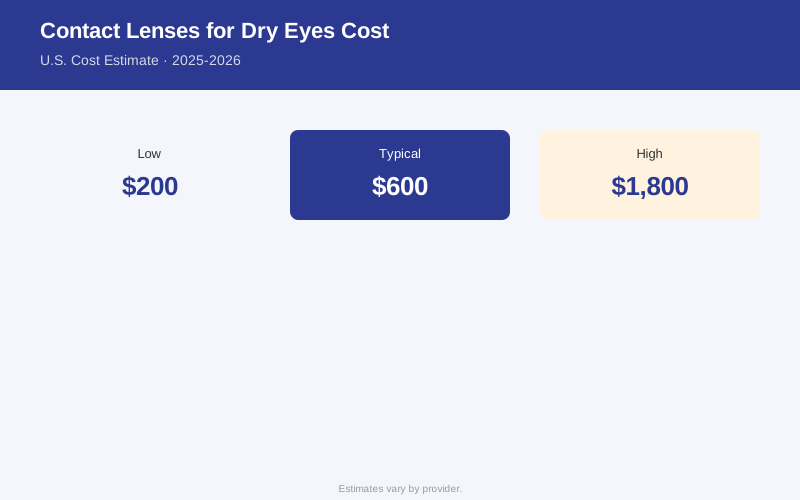
Contact lenses for dry eyes cost $180–$550/year for premium soft options, and $800–$3,000 for scleral lenses in severe cases. Daily silicone hydrogel lenses with moisture-lock technology (Dailies Total1, Acuvue Oasys 1-Day) perform best in the soft lens category. For severe dry eye disease, sclerals are the game-changer despite higher cost. Treat the underlying dry eye condition in parallel — better tear film makes any lens more comfortable and extends your comfortable wearing time.