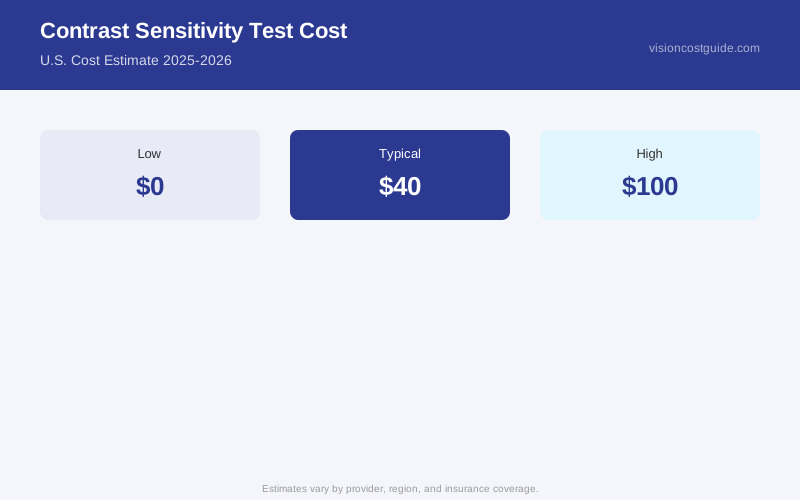
NEI-funded research has consistently shown that contrast sensitivity loss — not visual acuity loss — better predicts real-world functional vision problems like difficulty driving at night, recognizing faces, and navigating stairs. Yet the standard Snellen eye chart you read every year at your exam tells you nothing about contrast sensitivity. Here’s what the test actually measures, what it costs, and when your eye doctor should be ordering it.
Visual Acuity vs. Contrast Sensitivity: The Missing Piece
Measuring 20/20 vision confirms you can read a high-contrast black letter on a white background at 20 feet. That’s useful. But real-world vision rarely involves maximum contrast. You’re driving at dusk, recognizing a face across the room, reading pale ink on an off-white form. All of these require contrast sensitivity — the ability to detect subtle differences in shading.
Someone can have 20/20 acuity and severely compromised contrast sensitivity. This happens early in glaucoma, after cataract development, in certain corneal conditions, and as a normal (but problematic) consequence of some refractive procedures.
The AAO’s 2024 preferred practice patterns for multiple conditions include contrast sensitivity testing as a component of complete functional assessment — yet it’s routinely omitted from standard eye exams unless a doctor specifically adds it.
Types of Contrast Sensitivity Tests
| Test | Format | What’s Measured | Notes |
|---|---|---|---|
| Pelli-Robson Chart | Letter chart, decreasing contrast | Spatial contrast at low frequencies | Most widely used clinical test |
| Vistech/VCTS | Sinusoidal grating patches | Full contrast sensitivity function | Research standard, less common clinically |
| Mars Letter Contrast Sensitivity | Letter chart | Photopic contrast sensitivity | Portable, standardized |
| Vector Vision CSV-1000 | Grating targets, 4 spatial frequencies | Full spatial frequency range | Common in surgical practices |
| Functional Acuity Contrast Test (FACT) | Gratings at 5 frequencies | Comprehensive CSF | Often used pre/post LASIK |
| Digital/tablet-based | Variable | Screening only | Less standardized |
What It Costs
| Setting | Typical Cost |
|---|---|
| Bundled into comprehensive eye exam | $0 (no separate charge) |
| Standalone diagnostic add-on | $30–$75 |
| Pre/post refractive surgery evaluation | $0–$50 (bundled into consult) |
| Low vision specialty evaluation | Included in evaluation fee ($150–$300) |
| Neuro-ophthalmology evaluation | Included in clinic fee |
In most general optometry and ophthalmology practices, contrast sensitivity is not routinely performed — so there’s no charge because it’s not done. When a surgeon or specialist orders it specifically (for LASIK evaluation, glaucoma monitoring, or cataract outcome assessment), it’s usually bundled into the visit fee without a separate line item.
Some practices with advanced testing equipment charge a diagnostic testing fee of $30–$75 for a formal contrast sensitivity measurement with printed results.
When Contrast Sensitivity Testing Actually Matters
Before and after refractive surgery: LASIK can reduce contrast sensitivity, particularly at night — a known side effect related to the optical zone size and pupil diameter. Baseline testing before surgery and follow-up testing afterward documents changes and is part of quality outcome assessment. If you’re experiencing night vision problems post-LASIK, contrast sensitivity testing (along with wavefront aberrometry) helps quantify the functional impact.
Cataract evaluation and surgical timing: Patients with cataracts who maintain 20/40 or better acuity but report significant night driving difficulty, glare, or face recognition problems may have contrast sensitivity that’s already substantially impaired. Testing helps justify surgical timing — insurance may require documented functional impairment when acuity alone doesn’t meet threshold criteria.
Glaucoma monitoring: Contrast sensitivity loss can precede detectable visual field changes in early glaucoma. It’s sensitive to early functional loss even when the OCT and standard perimetry are still normal or borderline.
Multiple sclerosis and optic neuritis: Optic neuritis frequently impairs contrast sensitivity more than acuity. After an episode, contrast sensitivity may remain reduced even when acuity recovers — documenting this guides rehabilitation and monitoring.
Low vision assessment: For patients with macular degeneration or other conditions reducing reading ability, contrast sensitivity testing helps prescribe low vision aids like high-contrast magnifiers and task lighting.
Night driving requires detecting low-contrast targets — a dark car on a dark road, a pedestrian in dim light — under mesopic (dim) lighting conditions. Most contrast sensitivity tests are performed under photopic (bright) conditions, which doesn’t fully replicate night vision demands.
If night driving is your primary complaint, ask whether your provider tests under both photopic and mesopic conditions. The CSV-1000 and FACT test can be performed in both light levels. The mesopic contrast sensitivity result is more directly relevant to driving safety than the standard bright-light measurement.
Does Insurance Cover It
Medicare and most insurers follow coverage guidelines for contrast sensitivity testing. As a component of a comprehensive ophthalmological exam (CPT 92014), it’s covered as part of the exam — no separate billing needed. If billed as a standalone diagnostic procedure, coverage depends on whether the ordering diagnosis code supports medical necessity.
For LASIK and other elective refractive procedures, contrast sensitivity testing is part of the elective evaluation and is paid out-of-pocket.
Vision insurance (VSP, EyeMed) covers the exam but doesn’t specifically reimburse add-on diagnostic testing that isn’t part of the standard exam protocol.
If you’re being evaluated for premium IOL selection for cataract surgery — particularly multifocal or extended-depth-of-focus IOLs — contrast sensitivity testing should be part of your pre-op workup. Patients with already-impaired contrast sensitivity (from optic nerve disease, corneal irregularity, or retinal conditions) may not tolerate the additional contrast reduction that some multifocal IOLs introduce. A surgeon who doesn’t test contrast sensitivity before offering a premium IOL is missing an important piece of the candidacy evaluation.
The Real-World Impact
A 2019 study in JAMA Ophthalmology found that contrast sensitivity loss was a stronger predictor of driving cessation in older adults than visual acuity loss alone. Adults with low contrast sensitivity were more likely to restrict their driving, stop driving at night, and report difficulty with road sign recognition — even when their 20/20 acuity appeared preserved.
If you’re in your 50s or 60s and noticing difficulty with night driving, face recognition in dim light, or reading in poor lighting conditions — and your doctor tells you your vision is “20/20, looks fine” — that’s the moment to ask specifically for a contrast sensitivity test. It costs almost nothing to add to an exam and may explain everything.
Bottom Line
Contrast sensitivity testing costs $0–$75 depending on whether it’s bundled into your exam or billed separately. The test takes 5–10 minutes. Standard Snellen acuity testing misses this entirely. It’s most clinically relevant for refractive surgery candidates, cataract surgical timing, glaucoma monitoring, and anyone reporting night vision or low-light difficulties that don’t match their acuity. If those descriptions fit your situation, ask your eye care provider to add it at your next visit.