“Her eyes look fine” — that’s what parents often hear before their child struggles to read, holds books inches from her face, or complains of headaches after homework. What they’re missing is that children’s eyes can compensate aggressively for refractive errors by constantly flexing their focusing muscle. Without cycloplegic drops to paralyze that muscle, a standard refraction often misses the real prescription entirely. Here’s what the test costs and why it matters more than most parents realize.
What Cycloplegic Refraction Is
The eye has a remarkable ability to accommodate — to adjust focus by contracting the ciliary muscle, which changes the shape of the crystalline lens. In children, this accommodation is extremely powerful. A child with significant farsightedness (+3.00 or more) can overcome it with accommodation, reading clearly at near and far distances while appearing to see normally.
The cost of this constant effort: chronic eye strain, headaches after visual tasks, difficulty sustaining attention during reading, and — critically — amblyopia (lazy eye) in cases where the accommodation is unequal between the two eyes or triggers inward strabismus (crossing).
Cycloplegic drops (typically cyclopentolate 1% or atropine 1%) temporarily paralyze the ciliary muscle, eliminating accommodation. With the focusing mechanism switched off, a refraction reveals the eye’s true optical state — not what the accommodative reflex is hiding.
Cost of Cycloplegic Refraction
| Setting | Typical Cost |
|---|---|
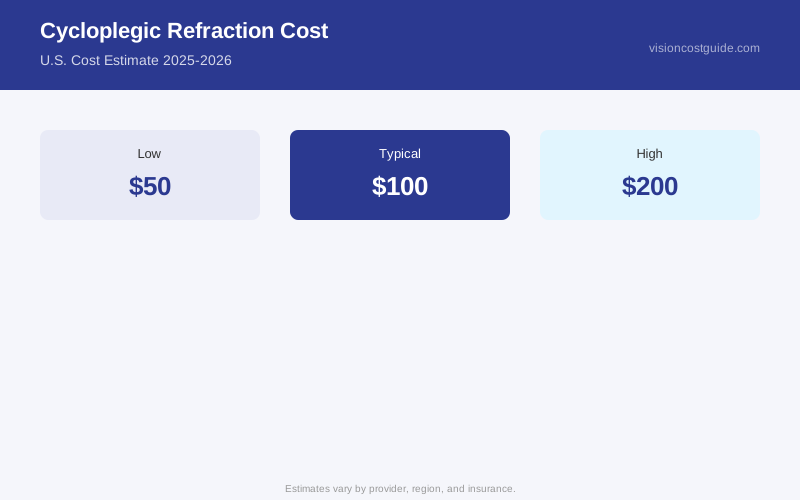
| Cycloplegic refraction added to pediatric eye exam | $50–$100 |
| Bundled into comprehensive pediatric exam | Often $0 (included in exam fee) |
| Pediatric ophthalmology visit (full evaluation) | $150–$350 (exam includes cycloplegia) |
| Cycloplegic refraction for adult (special indication) | $50–$120 |
| Without insurance, standalone visit + drops | $100–$250 |
Many pediatric ophthalmology practices routinely perform cycloplegic refraction on children under 7 as part of their standard comprehensive exam — it’s bundled into the exam fee. Some optometry practices add it as a separate line item.
When done for a child with an established diagnosis (amblyopia, strabismus, high hyperopia), it’s covered by medical insurance or vision insurance as part of a comprehensive exam, usually at your standard co-pay.
When Cycloplegic Refraction Is Required
Children under 6: Accommodative amplitude is highest in young children. Standard (non-cycloplegic) refraction may miss significant farsightedness entirely. The American Academy of Ophthalmology recommends cycloplegic refraction for children whenever there’s concern about amblyopia risk, strabismus, or significant refractive error.
Suspected amblyopia: Anisometropia (unequal refractive error between the eyes — a common amblyopia cause) can only be accurately measured under cycloplegia. A child may compensate in the better eye while the weaker eye falls behind in visual development.
Esotropia (inward crossing): Accommodative esotropia is caused by farsightedness — the child accommodates to see clearly, and the accommodation drives the eyes inward. Accurate measurement of the farsightedness is essential for treatment. The AOA notes that accommodative esotropia accounts for approximately one-third of all strabismus cases in children.
Inconsistent manifest refraction results: Adults who show significant variability in their refraction across visits, or who have unusually large accommodative reserves, may benefit from cycloplegic refraction to get a stable baseline.
Pre-LASIK evaluation in young patients: For patients under 25 being evaluated for refractive surgery, cycloplegic refraction documents the true stable refractive error independent of accommodation.
Cyclopentolate 1% is the most common clinical cycloplegic. It achieves full cycloplegia in 30–45 minutes and wears off within 24 hours. It’s preferred for clinic-based cycloplegic refractions.
Atropine 1% provides deeper, longer-lasting cycloplegia. It’s instilled at home for 1–3 days before the exam. It’s preferred for children with very dark irides (who respond less completely to cyclopentolate), children with suspected significant accommodative spasm, and when the most precise refraction accuracy is needed. Atropine effects last 1–2 weeks — vision remains blurry and pupils remain dilated throughout. This is why atropine is used less routinely for clinic visits.
Atropine is also the preferred myopia control medication in low concentrations (0.01–0.05%) — different application, same drug.
The Waiting Period: What Happens at the Appointment
A cycloplegic refraction appointment takes longer than a standard exam:
- Drops instilled: 1–2 drops per eye of cyclopentolate; often repeated once after 5 minutes
- Waiting period: 30–45 minutes for full cycloplegia to take effect — bring entertainment for kids
- Refraction performed: Retinoscopy and/or automated refraction under cycloplegia
- Dilated exam: Since the pupil is already dilated, the back of the eye is examined at the same visit
The total appointment time is typically 90 minutes to 2 hours. Plan accordingly — this is why pediatric eye exams in ophthalmology practices often run longer than adult exams.
After the Appointment: Managing the Effects
With cyclopentolate:
- Near vision is blurry for 4–24 hours — no close reading, homework, or screens that day
- Pupils remain dilated for 12–24 hours — sunglasses are important
- Distance vision is usually acceptable for adults; children often manage fine
- Mild facial flushing and slight drowsiness are possible (especially in infants) — normal, not alarming
With atropine (from home dosing):
- Near blur persists for up to 2 weeks
- Sun sensitivity throughout the period
- Children need sunglasses and may need reading glasses temporarily while drops are active
Infants and toddlers are more susceptible to systemic effects of cycloplegic drops — cyclopentolate and atropine can both cause increased heart rate, flushing, and in rare cases behavioral changes in very young patients. Pediatric ophthalmologists use age-appropriate concentrations and doses. If your infant shows unusual irritability, high fever, or difficulty breathing after cycloplegic drops, contact your doctor immediately. For routine pediatric use by experienced practitioners, serious adverse events are rare.
Does My Child Actually Need This — or Is It Being Over-Ordered
It’s a fair question. Not every child needs a cycloplegic refraction at every visit. Routine annual screenings for school-age children without risk factors can often start with standard refraction. But there are clear indications:
- Any child with suspected or confirmed amblyopia
- Children with strabismus or a history of strabismus
- Children whose prescription is changing rapidly year over year
- Children who show large differences between manifest (non-cycloplegic) and cycloplegic refractions at their first visit
- Preschool-age children having their first comprehensive exam
If your child’s optometrist is recommending a referral to a pediatric ophthalmologist specifically for a cycloplegic refraction, it’s usually a meaningful clinical decision — not upselling.
Bottom Line
Cycloplegic refraction costs $50–$120 when billed separately, and is frequently bundled into pediatric ophthalmology exam fees. Insurance covers it as part of a medically necessary exam for children with amblyopia, strabismus, or significant refractive error at your standard co-pay. The appointment takes 90 minutes to 2 hours due to the waiting period after drops. For children under 6, for any child with amblyopia or strabismus risk, and for anyone whose prescription doesn’t seem to match their symptoms, cycloplegic refraction is the measurement you can actually trust.