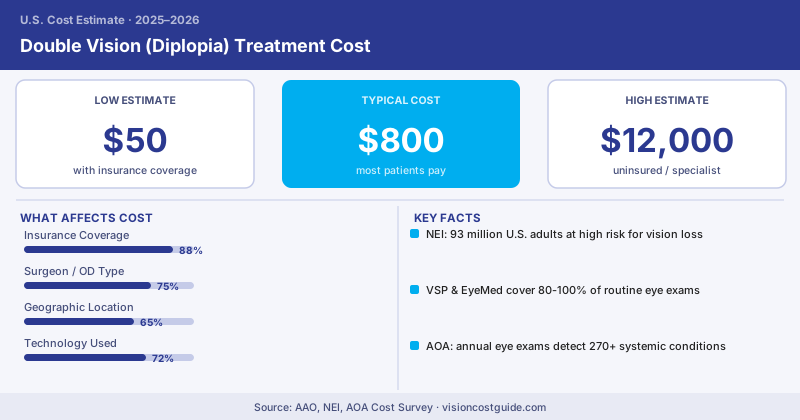
Seeing two of everything is disorienting, often scary, and definitely not something to ignore. Double vision — the medical term is diplopia — can have causes ranging from a simple muscle imbalance to a neurological emergency. The cost of evaluation and treatment varies just as widely: $150 for a specialist visit, up to $8,000 or more for strabismus surgery.
Here’s what to expect at each step — and what you’ll owe.
First: Is This an Emergency?
New-onset double vision in an adult is a red flag. If your diplopia came on suddenly and is accompanied by headache, drooping eyelid, facial numbness, slurred speech, or difficulty walking, get to an emergency room immediately. These can be signs of a stroke, brain aneurysm, or cranial nerve palsy — all requiring urgent imaging, not an eye appointment.
The National Eye Institute (NEI) notes that acquired diplopia in adults is most commonly caused by thyroid eye disease, cranial nerve palsies (III, IV, or VI), stroke, myasthenia gravis, or decompensated phoria (a previously stable eye misalignment). A thorough workup is always the starting point.
What Does the Evaluation Cost?
A complete diplopia workup typically involves an ophthalmologist (often neuro-ophthalmologist) or a strabismus specialist. The evaluation may include:
- Detailed ocular motility testing
- Cover/uncover and Maddox rod testing
- Prism neutralization measurement
- Neuroimaging referral (MRI/CT) if neurological cause is suspected
| Service | Typical Cost |
|---|---|
| Ophthalmologist / neuro-ophthalmologist visit | $200–$600 |
| Strabismus specialist evaluation | $200–$500 |
| MRI brain/orbits (neurological workup) | $500–$3,000 without insurance |
| Blood tests (thyroid, myasthenia) | $100–$400 |
| Emergency department visit (acute-onset diplopia) | $1,000–$5,000+ |
With health insurance, your specialist visit copay is typically $30–$80 for an in-network specialist. Neuroimaging will be covered under your medical benefit after deductibles.
Treatment Costs: From Simple to Surgical
Treatment depends entirely on what’s causing the double vision. Here’s the spectrum:
Prism glasses — the most common non-surgical treatment. Ground-in prism or Fresnel prism press-on lenses are applied to your existing glasses to realign the images your two eyes see. Cost: $50–$200 for Fresnel press-on; $200–$600 for ground-in prism lenses. This is a vision benefit item — VSP, EyeMed, and other vision plans often contribute.
Eye patching — simply patching one eye eliminates diplopia immediately. Effective for short-term relief while the underlying cause is being treated. Cost: negligible ($5–$20 for a patch).
Botulinum toxin (Botox) injection — for some forms of acquired strabismus and cranial nerve palsies, Botox injected into the eye muscle can temporarily weaken it, allowing the misalignment to correct or resolve naturally. Cost: $300–$1,500 per injection session, usually covered by medical insurance when medically necessary.
Strabismus surgery — when the deviation is stable and doesn’t resolve on its own, surgery to adjust the tension of eye muscles is the definitive fix. Cost: $4,000–$10,000 per eye depending on complexity, anesthesia, and facility.
| Treatment | Self-Pay Cost | With Insurance |
|---|---|---|
| Fresnel prism glasses | $50–$200 | Usually covered by vision plan |
| Ground-in prism lenses | $200–$600 | Partial vision benefit coverage |
| Botox injection (medical) | $500–$1,500/session | Covered under medical benefit |
| Strabismus surgery (1 muscle) | $4,000–$7,000 | $500–$3,000 OOP |
| Strabismus surgery (complex, 2+ muscles) | $7,000–$12,000 | $1,000–$4,000 OOP |
Insurance Coverage for Diplopia Treatment
Diplopia evaluation and treatment is covered as a medical service — not a vision service — when it results from a medical condition rather than simple refractive error.
- Medical insurance covers the evaluation, neuroimaging, lab work, Botox injections, and strabismus surgery.
- Vision insurance may cover prism glasses or contribute toward lenses.
- Medicare: Covers medically necessary diplopia treatment under Part B. Strabismus surgery is covered when caused by a medical condition (thyroid eye disease, stroke, cranial nerve palsy). Purely cosmetic strabismus surgery is not covered.
Medicare and commercial insurers may scrutinize strabismus surgery claims to ensure the indication is functional (diplopia affecting daily life) rather than purely cosmetic. Your surgeon’s office should document the clinical impact — trouble driving, reading, working — to support the prior authorization and any appeals. Keep a symptom log noting how diplopia affects your daily activities.
What About Thyroid Eye Disease as the Cause?
Thyroid eye disease (Graves’ ophthalmopathy) is one of the most common causes of acquired diplopia in adults. In this case, treatment targets both the underlying thyroid condition and the eye involvement. Orbital decompression surgery, strabismus surgery, and eyelid surgery may all be needed — often in sequence.
According to a 2021 analysis, thyroid eye disease affects approximately 50,000 Americans per year and is the leading cause of acquired adult strabismus requiring surgical correction. Each surgical stage has its own cost, and the full treatment course can run $15,000–$40,000+ without insurance.
Don’t rush into strabismus surgery for new-onset diplopia. Most guidelines recommend waiting 6–12 months for spontaneous recovery (especially for cranial nerve palsies) and ensuring the deviation is stable for at least 4–6 months before operating. Premature surgery often requires re-operation. Patience here genuinely pays off — both clinically and financially.
Bottom Line
Double vision workup typically costs $200–$600 for the initial specialist visit, often covered by medical insurance with standard specialist copays. Treatment ranges from a $50 Fresnel prism to $4,000–$12,000 for strabismus surgery. New sudden-onset diplopia is a medical emergency — don’t wait to be seen. Established or gradual diplopia deserves a careful, staged approach that can often be managed with prism glasses before surgery is ever needed.