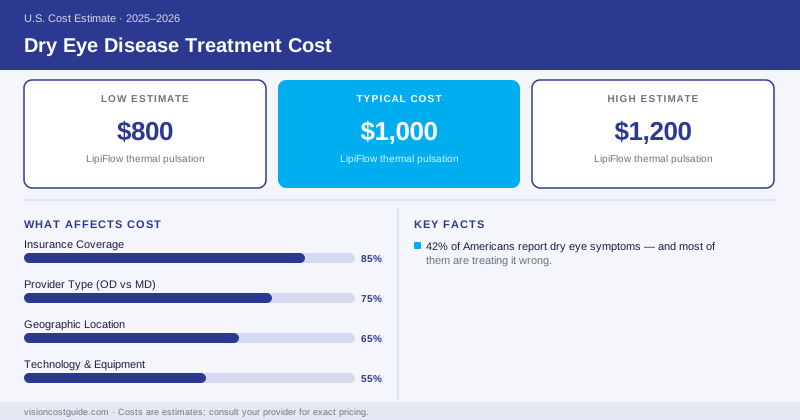
42% of Americans report dry eye symptoms — and most of them are treating it wrong. The National Eye Institute (NEI) estimates that dry eye disease affects approximately 16 million Americans, with women twice as likely as men to develop the condition. Yet the vast majority manage it with whatever lubricating drops they grabbed at the pharmacy, without understanding that dry eye has distinct subtypes with very different treatment costs.
If your eyes burn, feel gritty, blur intermittently, or water constantly (paradoxical tearing is real — a dry surface triggers reflex tearing), you have options well beyond the basic drop. Here’s what each tier of treatment actually costs.
Why Subtype Determines Cost
Before getting into numbers, one data point changes everything: the AOA reports that meibomian gland dysfunction (MGD) — a blockage of the oil-secreting glands in your eyelids — is the underlying driver in approximately 86% of dry eye cases. That means most dry eye is evaporative, not aqueous-deficient (the classic “not enough tears” type).
This matters for cost because evaporative dry eye from MGD doesn’t respond well to lubricating drops alone. You’re adding water to a system that’s losing it too fast because the oil layer isn’t functioning. Effective treatment targets the meibomian glands — and that costs more than a bottle of drops.
Treatment Costs by Option
| Treatment | Monthly / Session Cost | Best For |
|---|---|---|
| OTC artificial tears (preserved) | $10–$25/month | Mild, infrequent symptoms |
| OTC preservative-free unit-dose vials | $15–$35/month | Chronic use, preserved-drop sensitivity |
| Prescription Restasis (cyclosporine 0.05%) | $30–$80/month with insurance ($500–$700 without) | Aqueous-deficient dry eye, inflammation-driven |
| Prescription Xiidra (lifitegrast 5%) | $30–$80/month with insurance ($600–$700 without) | Dry eye with significant discomfort/signs |
| Collagen punctal plugs | $200–$400 per pair (dissolves in 7–90 days) | Aqueous deficiency; trial before permanent plugs |
| Silicone punctal plugs | $400–$700 per pair (semi-permanent) | Confirmed aqueous-deficient dry eye |
| Intense pulsed light (IPL) | $300–$700/session (3–4 sessions needed) | MGD-driven evaporative dry eye |
| LipiFlow thermal pulsation | $800–$1,200 per treatment | Moderate-to-severe MGD |
OTC Drops: The Starting Point (and Its Limits)
For mild dry eye — occasional symptoms, usually tied to screen use, low humidity, or seasonal allergens — OTC artificial tears are the right starting point. They’re cheap ($10–$25/month for preserved drops), widely available, and effective for situational symptom relief.
The preserved-vs.-preservative-free distinction matters more than most people realize. Preservatives like benzalkonium chloride (BAK) stabilize the formula in multi-dose bottles, but they’re toxic to the ocular surface epithelium with frequent use. If you’re using drops more than 4–6 times a day, preservative-free unit-dose vials ($15–$35/month) are worth the extra cost. Using preserved drops 6–8 times daily can make chronic dry eye worse, not better.
Drops like Systane Ultra, Refresh Optive Mega-3, and TheraTears also differ in their formulations — some target aqueous deficiency, others are specifically formulated to supplement the lipid layer for MGD. If your drops aren’t working, the formulation may be wrong for your subtype, not the category itself.
Prescription Drops: Real Cost With and Without Insurance
When OTC drops aren’t controlling symptoms, two prescription medications dominate:
Restasis (cyclosporine ophthalmic emulsion 0.05%) reduces inflammation thought to contribute to aqueous-deficiency dry eye. It works slowly — 3–6 months to full effect — which makes adherence a real challenge. List price: $500–$700/month. With commercial insurance and prior authorization, patients typically pay $30–$60 copay.
Xiidra (lifitegrast 5%) has a faster onset (some patients see improvement at 2 weeks) and targets a different inflammatory pathway. Same price range: $600–$700/month list, $40–$80 with insurance coverage.
Both require prior authorization from most insurers. The PA process usually requires documented failure of OTC treatment and a diagnosis supporting medical necessity. Ask your eye doctor’s billing staff to initiate the PA before you try to fill the prescription — it’ll save you a phone-tag nightmare.
Punctal plugs are tiny silicone or collagen devices inserted into the small openings (puncta) in your eyelid corners that drain tears from your eye surface. Blocking those drains keeps your natural tears — and whatever drops you use — on the eye longer.
Collagen plugs dissolve in 7–90 days ($200–$400/pair) and are useful for diagnosing whether plugs help before committing to permanent ones. Silicone plugs are semi-permanent ($400–$700/pair) and can be removed if they cause issues.
The procedure itself takes under 5 minutes in-office and is typically covered by medical insurance when documented as medically necessary. For patients with aqueous-deficient dry eye who use drops frequently, plugs can dramatically reduce drop consumption and improve quality of life. They don’t help MGD-driven dry eye the same way — you’re retaining tears that still lack a functional oil layer.
Advanced In-Office Treatments: Targeting MGD
If your dry eye is MGD-driven (gritty, worse in the morning, lid margins that look thickened or show blocked gland openings), OTC drops and prescription anti-inflammatories won’t fix the root cause. Two in-office technologies address the blocked meibomian glands directly:
Intense Pulsed Light (IPL) uses broad-spectrum light pulses to reduce inflammation in the periocular skin and melt the thickened meibum blocking the glands. Originally a dermatology treatment for rosacea, IPL has robust clinical evidence for MGD. Cost: $300–$700 per session, with 3–4 sessions typically needed — total investment of $900–$2,800. Insurance doesn’t cover it. Results typically last 12–18 months.
LipiFlow thermal pulsation uses a device that fits over the eye to apply precisely controlled heat (42.5°C) to the inner eyelid while simultaneously pulsing to express clogged meibomian glands. A single treatment costs $800–$1,200 and is usually done every 12–18 months. Insurance rarely covers it, though some flex spending (FSA/HSA) accounts accept it with a Letter of Medical Necessity.
Meibomian gland damage from long-standing MGD can be permanent. Advanced meibography — imaging that shows gland structure — can reveal whether atrophy has already set in. If your glands are structurally intact, early treatment can halt or reverse the progression. If significant atrophy is already present, the treatment goal shifts to symptom management rather than gland restoration. Ask your eye doctor whether meibography is part of your dry eye workup; it’s typically $50–$150 and rarely covered but worth having before committing to expensive treatment.
What You’ll Likely Spend
For most people, dry eye management costs $10–$35/month long-term if OTC drops control symptoms. If you need prescription medication, plan for $30–$80/month with insurance. A punctal plug procedure adds a one-time $200–$700 (usually covered). In-office treatments for MGD — IPL or LipiFlow — run $900–$2,800 out-of-pocket for a full course.
The most expensive mistake is staying at the OTC tier for years when your subtype requires something different. A comprehensive eye exam with dry eye testing — including meibography and tear osmolarity — costs $100–$250 and determines which tier of treatment you actually need. That’s money well spent before you spend $35/month indefinitely on drops that won’t fix your underlying problem.
Frequently Asked Questions
OTC artificial tears run $10–$35/month. Prescription drops like Restasis or Xiidra cost $500–$700/month list price, but with commercial insurance the copay is typically $30–$80. Punctal plugs are a one-time cost of $200–$700 and last months to years. Advanced in-office treatments like LipiFlow are a separate $800–$1,200 per session.
Most commercial insurance plans and Medicare Part D cover both Restasis (cyclosporine 0.05%) and Xiidra (lifitegrast 5%) with prior authorization. Copays with coverage are typically $30–$80/month. Without coverage, both drugs run $500–$700/month — manufacturer savings cards can reduce this for commercially insured patients who meet income criteria.
Yes, in most cases. Punctal plugs are a medical procedure, not vision care. When documented as medically necessary for aqueous-deficient dry eye that hasn't responded to artificial tears, the procedure is generally covered under medical insurance. Patient cost with coverage is typically $20–$100 after deductibles.