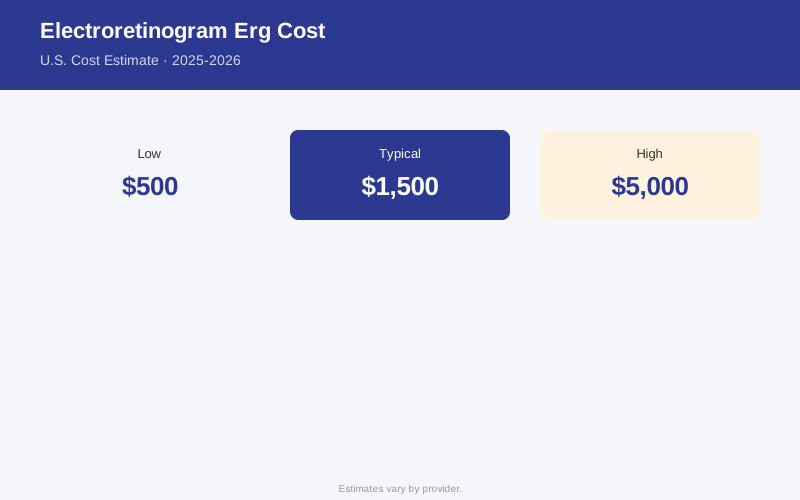
Most patients have never heard of an electroretinogram — until their ophthalmologist says “I need to order one.” Then the next question is usually: “What does that cost?” The answer ranges from under $300 to over $1,000, depending heavily on where you live, whether you’re seeing a specialist or a general ophthalmologist, and how your insurance is structured.
What Is an Electroretinogram?
An ERG measures the electrical response of the retinal cells — rods and cones — when exposed to light stimuli. It’s essentially an EEG for your eye. Electrodes are placed on or near the eye’s surface (contact lens electrodes or skin electrodes near the eye), and flashes of light trigger measurable electrical signals. The pattern and amplitude of those signals tells your doctor whether specific retinal cell populations are functioning normally.
ERGs are ordered for:
- Retinitis pigmentosa — detecting rod and cone dysfunction before vision loss is symptomatic
- Evaluating unexplained vision loss when the retina looks normal on exam
- Monitoring toxicity from hydroxychloroquine (Plaquenil) used in rheumatologic conditions
- Pre-operative assessment before cataract surgery in patients with retinal disease
- Stargardt disease and other hereditary retinal dystrophies
- Pediatric vision evaluation when a child can’t cooperate with standard tests
The National Eye Institute recognizes ERG as a critical tool in diagnosing inherited retinal degenerations, which affect approximately 1 in 3,000 people in the U.S. — around 100,000 Americans.
ERG Cost by Type and Setting
| ERG Type / Setting | Estimated Cost (No Insurance) |
|---|---|
| Full-field (flash) ERG — academic medical center | $600–$1,200 |
| Full-field ERG — private retinal practice | $300–$700 |
| Multifocal ERG (mfERG) | $500–$1,000 |
| Pattern ERG (PERG) | $350–$750 |
| Visual evoked potential (VEP, often bundled) | $400–$900 |
| ERG + VEP combined testing session | $800–$1,800 |
| Medicare patient portion (20% after deductible) | $60–$240 |
Why the Cost Varies So Much
Equipment and technician expertise matter enormously here. Full-field ERG requires specialized equipment (Ganzfeld stimulators, amplifiers, signal averaging software) and a trained electrophysiology technician to administer and interpret the test. Not every ophthalmology practice has this capability — many refer to university hospitals or retinal specialists with dedicated electrophysiology labs.
Hospital outpatient vs. private practice: Like most ophthalmic procedures, the same ERG at a hospital outpatient department costs 40–70% more than at a private practice because of facility fees. A full-field ERG that runs $400 at a private retinal specialist can be billed at $900–$1,200 at a hospital-affiliated imaging center.
Type of ERG: Full-field ERG measures global retinal response — useful for diagnosing widespread conditions like retinitis pigmentosa. Multifocal ERG (mfERG) maps responses across 61–103 specific retinal locations and is used to detect focal damage from macular diseases or medication toxicity. mfERG is more technically complex and costs more.
Geographic variation: Major academic centers in Boston, San Francisco, and New York charge more than practices in smaller markets. If you’re in a rural area, you may travel to a regional center, which adds indirect costs.
Insurance Coverage for ERG
Medicare Part B covers ERG when it’s medically necessary for a covered diagnosis. CPT codes 92275 (ERG) and 92274 (multifocal ERG) are both recognized. After your deductible, you pay 20% of the Medicare-approved amount — typically $60–$200 depending on the test type and setting.
Commercial insurance generally covers ERG for the same medical indications. Coverage is straightforward for hereditary retinal dystrophies, medication toxicity monitoring (Plaquenil), and unexplained vision loss workups. Pre-authorization may be required — check with your insurer before scheduling.
Hydroxychloroquine monitoring note: The AAO guidelines recommend baseline ERG and annual mfERG for patients on long-term Plaquenil therapy at doses above 5 mg/kg/day. Since Plaquenil is prescribed by rheumatologists and internists, the ERG monitoring often gets caught between medical specialties when it comes to insurance authorization. Make sure your ophthalmologist submits the Plaquenil diagnosis code (not just the retinal code) to ensure coverage.
- Ask your ophthalmologist to submit a prior authorization before scheduling — many insurers require it
- For Plaquenil monitoring, the ordering diagnosis should include the hydroxychloroquine use code alongside any retinal finding
- If you’re uninsured, ask about payment plans — ERG facilities often allow installments for out-of-pocket costs over $500
- University hospital electrophysiology labs may have reduced fees for uninsured patients who meet income criteria
- Ask whether a combined ERG + VEP session can be done on one visit to reduce facility fees
What the Test Experience Is Like
An ERG takes 1–2 hours for a full battery. Your eyes are dilated and sometimes anesthetized with eye drops. Contact lens electrodes rest on your cornea, and you sit in a darkened room or a Ganzfeld dome while light stimuli are presented. The test is not painful, though some patients find the contact lens electrodes mildly uncomfortable. Children who can’t cooperate may require sedation (general anesthesia), which adds $1,500–$4,000 to the total cost and requires a separate anesthesia team.
When ERG Is Non-Negotiable
If you’ve been diagnosed with retinitis pigmentosa, Stargardt disease, or another hereditary retinal dystrophy, ERG results directly inform prognosis — the rate of rod vs. cone degeneration matters enormously for planning your life and managing expectations. It also establishes a baseline for monitoring progression and, increasingly, for determining eligibility for gene therapy trials.
For Plaquenil users, skipping the annual mfERG isn’t just financially tempting — it’s medically risky. Plaquenil retinal toxicity is initially asymptomatic. By the time you notice visual changes, the damage is typically permanent. The mfERG catches pre-symptomatic toxicity when stopping the drug can prevent further loss.
Alternatives and Limitations
No test fully replaces ERG for its specific indications. That said:
- OCT can detect structural thinning in retinitis pigmentosa and is often done alongside ERG, not as a replacement
- Automated visual field testing is complementary but doesn’t measure cellular function
- Genetic testing for inherited retinal disease has become more accessible ($250–$1,500) and can confirm a diagnosis suggested by ERG
If cost is a barrier, discuss with your physician which component of the ERG battery is most essential for your specific question. A targeted mfERG for Plaquenil monitoring, for instance, may cost less than a full ERG + VEP panel ordered for general unexplained vision loss.
Bottom Line
An electroretinogram costs $300–$1,200 out of pocket, with Medicare patients paying $60–$200 after the deductible. It’s a specialized test done at retinal specialty centers and academic hospitals — not everywhere. Insurance covers it for legitimate medical indications including retinal dystrophies, Plaquenil toxicity monitoring, and unexplained vision loss. If your doctor has ordered one, it’s for a serious reason. Don’t let the cost lead you to skip it; the conditions ERG evaluates are exactly those where early detection changes outcomes.