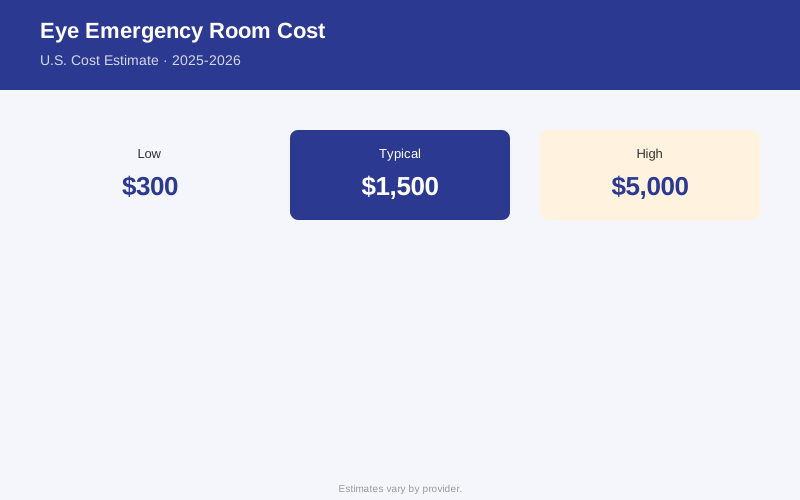
Sudden eye pain at 10 p.m. on a Saturday. Do you go to the ER? Call an on-call eye doctor? Drive to urgent care? The decision costs real money — and the wrong choice can mean a $2,000 bill for a condition a $150 urgent care visit could have handled, or a delayed diagnosis that costs your vision. Here’s the map.
True Eye Emergencies: Go to the ER (or Call an Eye Doctor Immediately)
Some eye symptoms are genuine emergencies where minutes matter. These warrant an immediate ER visit or an emergency ophthalmology call:
- Sudden loss of vision in one or both eyes — could be a central retinal artery occlusion (“eye stroke”); treatment window is under 90 minutes
- Chemical splash in the eye — immediate irrigation needed; call 911 or go directly to ER
- Penetrating eye injury — any object that has punctured the eye; do not touch or rub
- Eye injury with visible bleeding or distorted pupil — possible globe rupture
- Sudden severe eye pain + nausea + halos around lights + rock-hard eye — signs of acute angle-closure glaucoma; can cause permanent vision loss within hours
- Flashes of light + sudden shower of new floaters + curtain across vision — retinal detachment, requires same-day surgical evaluation
For these, the setting doesn’t matter — get help immediately. ER costs are irrelevant compared to the cost of permanent vision loss.
Eye Emergency Cost by Setting
| Setting | Typical Cost (Without Insurance) |
|---|---|
| Hospital emergency room (eye complaint) | $800–$2,500+ |
| Urgent care center (basic eye care) | $100–$350 |
| Ophthalmology office (urgent/same-day slot) | $150–$400 |
| Optometry office (urgent same-day) | $100–$250 |
| Telehealth eye visit | $40–$150 |
| On-call ophthalmology after-hours | $200–$600 (after-hours surcharge possible) |
Conditions Appropriate for Urgent Care or Same-Day Eye Doctor
Most eye complaints that feel urgent are NOT true emergencies. These can typically wait for urgent care or a same-day eye appointment:
- Pink eye (conjunctivitis) — viral or bacterial; uncomfortable but rarely dangerous
- Stye or eyelid bump — warm compress and/or antibiotic drops; not vision-threatening
- Mild eye injury — sand/dust in the eye, minor corneal abrasion (no penetration)
- Subconjunctival hemorrhage — the red patch on the white of the eye; looks alarming, almost always resolves without treatment
- Mild iritis symptoms — light sensitivity and aching, without vision loss or extremely high pressure
- Contact lens-related discomfort — irritation, mild redness after extended wear
- Foreign body sensation without visible object — a corneal abrasion or small debris
If you have access to a same-day ophthalmology or optometry appointment, that’s almost always the best path — better equipment, genuine eye expertise, and lower cost than the ER.
Why the ER Is the Wrong Place for Most Eye Problems
Emergency rooms are designed and staffed for life-threatening conditions. An ophthalmologist is rarely on-site. For most eye complaints, you’ll see an emergency medicine physician who does a basic exam, prescribes antibiotic drops for any red eye to be safe, and bills you $1,000–$2,000. That same care — and usually better care — is available at an urgent care with an eye-trained provider or a same-day optometry appointment for $100–$350.
The financial difference is stark. A 2022 JAMA study found that emergency department visits for low-acuity conditions (including most eye complaints) average $2,011 in total facility charges, while urgent care visits for the same conditions average $177. Insurance doesn’t make the ER cheap — you still pay copays, coinsurance, and the facility fee applies to your deductible, often at a higher rate than outpatient visits.
If your red eye is also painful AND associated with vision loss AND you wear contact lenses — don’t wait. Acanthamoeba keratitis and Pseudomonas bacterial keratitis (contact lens-related infections) can permanently scar the cornea within 24–48 hours. That scenario — painful red eye + reduced vision + contact lens use — warrants same-day ophthalmology, not urgent care. If same-day ophthalmology isn’t available, the ER is appropriate.
Insurance and Eye Emergency Costs
Medical insurance (not vision insurance) covers eye emergencies. A true eye emergency — acute glaucoma attack, retinal detachment evaluation, chemical burn, penetrating injury — is treated as a medical event. Your ER copay (typically $150–$350 in-network) applies, plus coinsurance on the facility charges.
Vision insurance (VSP, EyeMed) covers routine eye exams, not medical emergencies. Don’t assume your vision plan will cover an ER bill for an eye injury.
Urgent care eye visits are covered under your medical insurance at the urgent care tier — usually $50–$100 copay in-network, significantly less than your ER tier.
Telehealth options are available for minor eye complaints. A video visit with a physician or optometrist for pink eye costs $40–$150 and is covered by many telehealth benefits in commercial insurance plans.
What to Do at Midnight on a Weekend
When something goes wrong with your eye after hours:
- Sudden vision loss, severe pain, or a chemical splash — call 911 or go to the ER immediately, right now
- Acute angle-closure symptoms (halos, rock-hard eye, nausea) — ER immediately
- Flashes + new floaters + curtain effect — call your ophthalmologist’s after-hours line; most retinal practices have 24-hour coverage
- Pink eye or stye — telehealth is fine; it can wait until morning if needed
- Mild red eye, no pain, no vision change — lubricating drops, avoid contact lenses, see an OD in the morning
- Foreign body in eye — irrigate with clean water or saline; if still present or vision affected, urgent care or ER
- Find the after-hours number for your ophthalmologist now and store it in your phone
- Know the nearest urgent care center that has eye care capabilities (many do not — call ahead)
- Keep a bottle of lubricating eye drops and a sterile saline eyewash solution at home
- If you wear contact lenses, own a pair of backup glasses — removing contacts in an eye emergency is essential
- Know the difference: vision loss = ER; red eye + discharge = wait for urgent care or OD
Bottom Line
The right setting for an eye emergency saves both your vision and your money. True emergencies — sudden vision loss, chemical burns, penetrating injuries, acute glaucoma attack, retinal detachment symptoms — go to the ER or ophthalmology on-call line immediately. Cost is irrelevant. Everything else — pink eye, minor injuries, styes, mild discomfort — is appropriate for urgent care ($100–$350) or a same-day optometry or ophthalmology appointment ($100–$400). The ER for a stye is a $1,500–$2,500 mistake. Knowing the difference is free.