Most people think they need an eye exam when their vision gets blurry. That’s backwards. By the time you notice vision changes, conditions like glaucoma, diabetic retinopathy, or early macular degeneration may have been progressing silently for years. Regular eye exams catch these things before you’d ever notice them — and catching them early dramatically changes treatment outcomes and cost.
The American Optometric Association sets clinical guidelines for exam frequency by age and risk level. Here’s exactly what they recommend, what it costs, and how to plan around it.
AOA-Recommended Exam Frequency by Age
| Age Group | No Risk Factors | With Risk Factors | Key Reason |
|---|---|---|---|
| Infants (6–12 months) | At least once | More often if indicated | Critical developmental milestone |
| Toddlers/preschool (1–5 years) | At least once | More often if indicated | Amblyopia and strabismus detection |
| School-age (6–17 years) | Every year | Every year (or more) | Myopia progression, school readiness |
| Adults 18–39 | Every 2 years | Every year | Baseline health, prescription stability |
| Adults 40–64 | Every year | Every year (or 6 months) | Presbyopia, early glaucoma, cataracts |
| Adults 65+ | Every year | Every year (or 6 months) | Macular degeneration, glaucoma, cataracts |
| Contact lens wearers | Every year (any age) | Every year | Prescription validity, corneal health |
“Risk factors” include: diabetes, hypertension, family history of glaucoma or macular degeneration, previous eye injury or surgery, high myopia (−5.00 or beyond), African American ancestry over 40 (higher glaucoma risk), and use of medications that affect eye pressure or retinal health.
What an Eye Exam Costs by Type
A comprehensive exam isn’t the same thing as a basic refraction, and the cost differences reflect that:
| Exam Type | Cost Without Insurance | What’s Included |
|---|---|---|
| Basic refraction (prescription check only) | $50–$80 | Lens prescription only — not a full health exam |
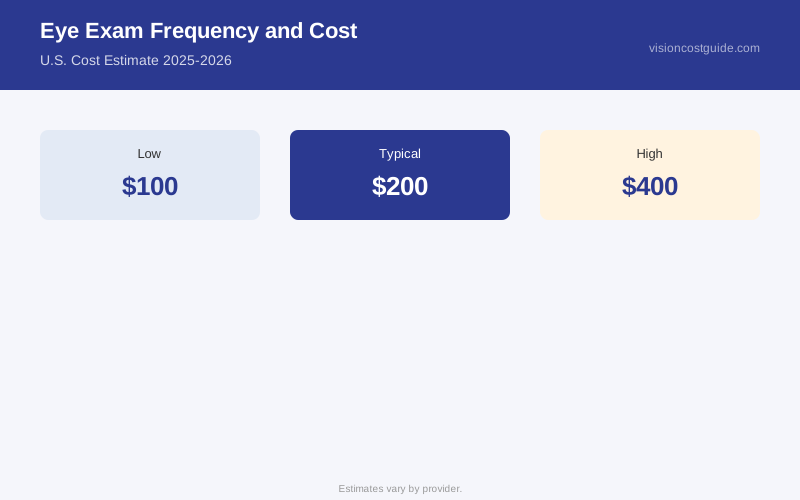
| Routine comprehensive eye exam | $100–$200 | Refraction + ocular health screening, pressure check |
| Contact lens fitting exam | $120–$200 | Includes fit assessment, corneal measurement |
| Medical eye exam (dilated, disease monitoring) | $150–$300 | Full dilation, detailed retinal exam |
| Pediatric eye exam | $100–$180 | Age-appropriate testing for children |
| Specialist consultation (glaucoma, retina) | $200–$500+ | Subspecialty-level evaluation |
Note: Basic refractions at retail optical chains are often advertised as low as $60–$85 because they exclude the health evaluation component. That price is appropriate for a prescription update in someone with a known stable prescription — not for a first exam or annual health screening.
Three conditions that progress silently — and why exam frequency matters:
Glaucoma: Called the “silent thief of sight” because it causes no pain and no noticeable vision changes until substantial damage has occurred. The NEI estimates that more than 3 million Americans have glaucoma, and more than half don’t know it. Early-stage glaucoma detected through an exam is highly treatable; late-stage glaucoma causing visual field loss is not reversible.
Diabetic retinopathy: The leading cause of new blindness in working-age Americans. The CDC reports that 90% of vision loss from diabetic retinopathy is preventable with early detection and treatment. Annual dilated eye exams for diabetics aren’t optional — they’re the primary detection mechanism.
Macular degeneration: Affects 11 million Americans. Early-stage AMD has treatment options that dramatically slow progression to advanced AMD. By the time symptoms are obvious, the therapeutic window may have passed.
Annual exam cost: $100–$200. Early treatment cost: $0–$500. Late-stage treatment cost: $10,000–$100,000+. The math is not subtle.
Insurance Coverage: What It Typically Pays
Most vision insurance plans cover one comprehensive eye exam per year (or every 24 months) as part of the basic benefit. Typical coverage:
- In-network exam: Fully covered or $10–$25 copay
- Out-of-network: $40–$80 reimbursement toward actual cost
- Medical eye exams (for diagnosed conditions): Often covered under health insurance, not vision insurance — use your medical card
Important distinction: a routine vision exam (refractive exam) falls under vision insurance. A medical eye exam for a diagnosed condition — glaucoma monitoring, diabetic retinopathy evaluation, macular degeneration follow-up — falls under major medical insurance (commercial, Medicare, Medicaid). Using the wrong card at the wrong type of exam results in an unexpected bill.
Medicaid and Medicare Coverage
Medicare Part B covers dilated annual eye exams for diabetics and people at high risk for glaucoma (those with a family history, diabetes, or African American ancestry over 40). Routine refraction exams are NOT covered by Medicare Part B.
Medicaid covers pediatric eye exams as an essential benefit under EPSDT (Early and Periodic Screening). Adult coverage varies by state.
Medicare Advantage plans often include vision coverage as an added benefit where original Medicare does not. If you’re 65+ on Medicare Advantage, check your supplemental vision benefit before paying out of pocket.
The True Cost of Skipping Exams
Americans skip eye exams at a surprisingly high rate. A 2024 survey by the Vision Council found that only 56% of adults had an eye exam in the previous two years. Cost is the most cited barrier — but the math on this is backwards.
An annual exam at $120–$200 prevents conditions that cost $1,000–$100,000+ to treat when caught late. Early-stage glaucoma managed with $30–$80/month eye drops is a very different financial picture than late-stage glaucoma requiring filtering surgery ($3,000–$8,000+). Early-stage wet macular degeneration that responds to injections costs $500–$2,000/year; advanced AMD with vision loss costs far more in quality-of-life and indirect costs.
Many adults with near-normal distance vision skip eye exams for years, assuming nothing is wrong. This is the highest-risk pattern: people with undiagnosed glaucoma, early AMD, or other silent conditions who feel fine. Regular exams are especially important precisely when your vision feels normal — that’s exactly when silent conditions are most treatable. The AOA’s recommendation of every 2 years for low-risk adults 18–39, and every year for everyone 40+, reflects clinical evidence, not insurance sales incentives.
How to Reduce Exam Costs
- Costco Optical and Walmart Vision Center offer comprehensive exams at $60–$90, significantly below most independent optometrists
- VSP, EyeMed, or Humana vision plans cost $5–$15/month and cover most of the exam fee for in-network providers
- Community health centers (FQHCs) offer sliding-scale vision care for uninsured or underinsured patients; fees are based on income
- Medical school/optometry school clinics offer supervised exams at reduced rates ($30–$70)
- Free screening events through the AAO EyeCare America program provide referrals to volunteer ophthalmologists for qualifying patients
Regular eye exams are one of the clearest examples in healthcare where spending a small amount now demonstrably prevents spending a much larger amount later.