A welding arc can flash-burn your corneas in seconds — the painful condition welders call “arc eye” — and it happens to people who think a quick tack weld is harmless. The fix isn’t optional, and it isn’t expensive relative to your eyesight. A proper setup runs $40 to $600 depending on whether you go passive or auto-darkening, plus safety glasses underneath.
Here’s exactly what you need and what OSHA says about it.
OSHA isn’t suggesting — it’s requiring
OSHA mandates eye and face protection for welding under 29 CFR 1926.102 and 1910.252, and the shade number isn’t a guess. It scales with the process and amperage. The agency reports that eye injuries cost U.S. employers hundreds of millions of dollars a year, and welding is among the highest-risk trades for them.
| Gear | Typical Cost | Notes |
|---|---|---|
| Passive (fixed-shade) helmet | $40–$80 | One shade, flip down to weld |
| Auto-darkening helmet | $100–$400 | Adjusts instantly, most popular |
| Premium auto-darkening | $400–$600 | Wide view, grind mode, solar+battery |
| ANSI Z87.1 safety glasses (under hood) | $10–$30 | Required as primary protection |
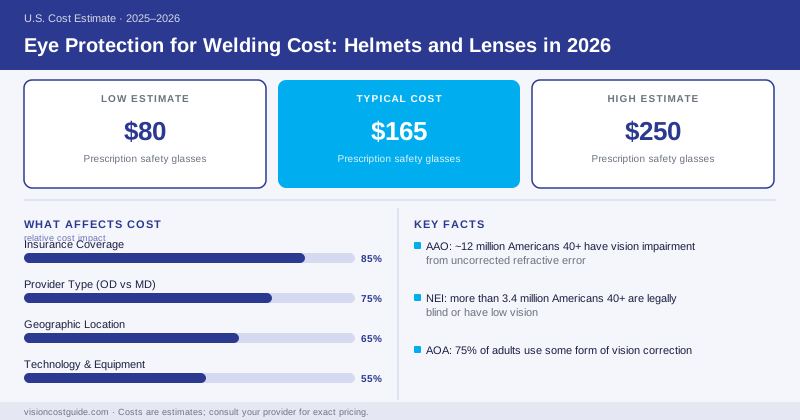
| Prescription safety glasses | $80–$250 | If you wear corrective lenses |
You need two layers: an auto-darkening welding helmet ($100 to $400) for the arc, plus ANSI Z87.1 safety glasses ($10 to $30) underneath for grinding and flying debris. OSHA requires both. Skipping the safety glasses because “the hood covers it” is a common and dangerous mistake.
Picking the right shade
The shade number controls how much intense light the lens blocks. Too light and you risk arc eye; too dark and you can’t see your puddle.
- Shade 8–9: light work, low amperage
- Shade 10–12: most stick and MIG welding
- Shade 13–14: heavy arc, high amperage, carbon arc
Auto-darkening helmets let you dial in the exact shade and switch to a clear “grind mode,” which is why most welders pay the premium. ANSI Z87.1 is the standard to look for — same family of impact ratings used for general industrial safety glasses.
Never weld with sunglasses, regular tinted glasses, or a worn-out auto-darkening lens that flickers. None block the UV and infrared an arc produces. A single unprotected flash can cause arc eye — and repeated exposure raises cataract risk, according to the National Eye Institute.
If you wear a prescription
Roughly two-thirds of American adults need vision correction, and welders are no exception. You’ve got two routes:
- Prescription safety glasses ($80 to $250) worn under the helmet — durable and OSHA-compliant.
- Cheater lenses (magnifying inserts) that clip inside the helmet for close work, around $10 to $20.
If you need everyday correction too, getting a current eyeglasses prescription first makes the safety-glasses order accurate. Start with an eye exam at $50 to $200 — and tell the optometrist you weld, since they’ll factor in your working distance.
How to manage the cost
- Buy auto-darkening once, use it for years. The $200 helmet outlasts a dozen cheap passive ones.
- Employer must provide it. OSHA generally requires employers to supply required PPE at no cost to workers — ask before buying your own.
- Use FSA/HSA for prescription safety glasses.
- Replace cracked or scratched lenses immediately; a compromised lens isn’t protection.
- Wear prescription sunglasses off the clock — UV adds up across a career.
Bottom line
Welding eye protection is a two-part system: an auto-darkening helmet at $100 to $400 plus ANSI Z87.1 safety glasses underneath. Match the shade to your amperage, never weld with anything less, and let your employer foot the bill where OSHA requires it. Your corneas don’t grow back — this is the cheapest insurance you’ll ever buy.
Frequently Asked Questions
A basic passive welding helmet runs $40 to $80. Auto-darkening helmets cost $100 to $400, and premium models with adjustable shade reach $600. Safety glasses worn underneath add $10 to $30.
OSHA and ANSI guidance ranges from shade 8 for light work up to shade 14 for heavy arc welding. Most arc welding lands in the shade 10 to 13 range. The correct shade depends on the amperage and process.
Yes. OSHA requires primary eye protection — ANSI Z87.1 safety glasses — underneath the helmet to guard against flying particles, grinding debris, and slag when the hood is up.