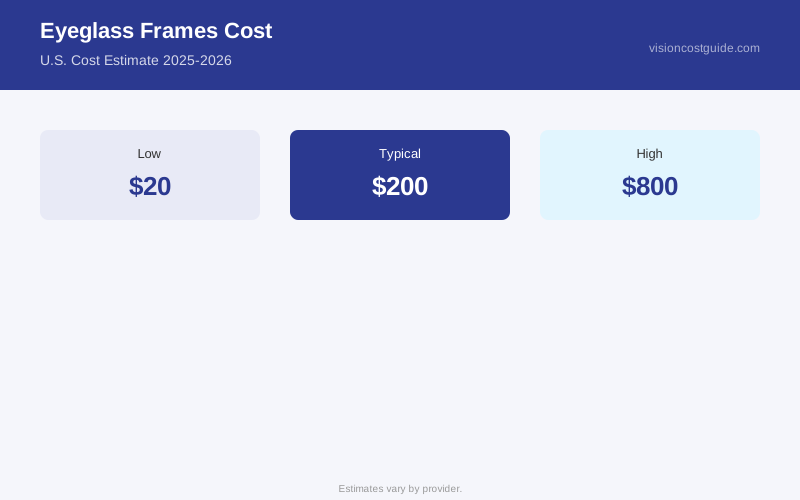
Frames don’t correct your vision. The lenses do. Yet in most full-service optical shops, frames account for 40–60% of the total pair cost — sometimes more. A $500 pair of glasses might have $80 worth of lenses and $420 worth of frame. That gap exists because optical retail has historically bundled frame selection, professional fitting, and brand premium in a way that obscures where the money goes. Here’s how to see through it.
What Frames Actually Cost by Tier
| Frame Tier | Price Range | Examples | What You’re Getting |
|---|---|---|---|
| Ultra-budget online | $5–$20 | Zenni house frames, Firmoo | Basic acetate or metal, limited adjustability |
| Budget online | $20–$60 | EyeBuyDirect, Goggles4U | Better variety, some premium finishes |
| Mid-market online | $60–$150 | Warby Parker, Felix + Iris | Branded materials, tried-on or home try-on |
| Wholesale club | $80–$180 | Costco Optical, Sam’s Club | Quality frames, in-person selection |
| Chain optical house brand | $100–$250 | LensCrafters, Visionworks | Standard retail, included in many packages |
| Designer/licensed brand | $200–$500 | Ray-Ban, Oakley, Prada, Gucci | Brand premium, typically Italian or Japanese made |
| Luxury eyewear | $400–$1,200+ | Lindberg, Cartier, Porsche Design | Premium materials, craftsmanship, status |
What Actually Drives Frame Pricing
Materials matter less than marketing suggests. A $50 acetate frame from a quality factory and a $350 “designer” acetate frame are sometimes made in the same Italian or Japanese factory with similar raw materials. The price difference reflects brand licensing fees, not material quality. That said:
- Titanium frames ($120–$400): Genuinely lighter and more durable than most plastics; hypoallergenic; worth the premium for sensitive skin or very lightweight requirements
- Memory metal (beta-titanium): Flexes under stress and returns to shape — reduces breakage from sitting on or bending; worthwhile for active wearers
- Standard acetate: The most common material; durable, available in infinite colors/patterns, easy to adjust; wide quality range
- Wire/metal: Cheaper to produce, usually lighter than acetate, variable durability
- Carbon fiber: Premium weight reduction, expensive, relatively rare
Brand licensing. Designer frames like Ray-Ban, Prada, and Gucci are typically manufactured by Luxottica (now EssilorLuxottica) or Safilo Group under license. The optical quality of the frame is similar to non-designer frames in the same construction tier; the price premium is 60–80% brand name, 20–40% materials and craftsmanship.
The AAO notes that frames should fit correctly — hold their alignment, sit evenly on both ears, not pinch the nose — and that a well-fitting $60 frame will serve you better than a poorly fitting $400 one.
Frame fit isn’t cosmetic — it directly affects optical performance, especially for progressives, bifocals, and high prescriptions.
A frame that sits too low means your progressive corridor lands in the wrong place. A frame with the wrong vertex distance affects the effective prescription power at your eye. A frame with significant pantoscopic tilt needs to be compensated in the lens design.
Good fit criteria:
- Pupils should be centered vertically in the frame (or slightly above center)
- Frame sits firmly without nose pinch or ear discomfort
- Frame width matches your face — no gaps at temples, no squeezing at cheeks
- Pupillary distance from frame center matches your PD
Getting fitted professionally costs nothing extra in-store. If you buy frames online, verify your PD carefully and accept that some adjustment may be needed.
Frame Materials: Quick Reference
| Material | Weight | Durability | Adjustability | Price Range | Best For |
|---|---|---|---|---|---|
| Acetate/zyl | Moderate | Good | Easy | $30–$400 | Most adults |
| Metal/alloy | Light | Moderate | Moderate | $30–$300 | Minimalist style |
| Titanium | Very light | Excellent | Moderate | $120–$400 | Active, sensitive skin |
| Memory metal | Very light | Excellent | Good | $100–$300 | Active, kids |
| TR-90/nylon | Very light | Good | Limited | $30–$150 | Sports, children |
| Carbon fiber | Very light | Excellent | Limited | $200–$600 | Premium minimalists |
Insurance Coverage for Frames
Most vision plans offer a frame allowance of $130–$200 per year or per benefit cycle (often 24 months). You choose any in-network frame; the plan covers up to your allowance, you pay the difference.
Important nuance: some chains markup frames to capture insurance allowances — a frame priced at $200 under insurance may be findable for $140 at a retailer that doesn’t play insurance markup games. Costco Optical, in particular, prices frames without insurance-motivated markups.
If your frame selection costs less than your allowance, the remainder typically doesn’t carry over or apply to lenses. Use the full allowance strategically.
The Multiple-Pair Strategy
Once you understand frame pricing, the case for multiple pairs strengthens considerably:
- Online backup pair: $10–$30 (same prescription as primary)
- Prescription sunglasses frame: $20–$100 online, $80–$300 in-store
- Task-specific frames (computer glasses): $20–$80 online
Having three pairs at $30–$40 each online often costs less than one “premium” in-store pair and serves your life better — different styles for different contexts, backups for when one pair is lost or broken.
Be cautious about frame quality at the very lowest price tier ($5–$15). Some ultra-budget frames have limited nose pad adjustability, poor hinge quality, or proportions that don’t work for most face shapes. Spending $25–$40 at a slightly higher budget tier typically eliminates these issues. The functional floor for reliable frames is around $20–$30 at quality online retailers like Zenni or EyeBuyDirect.
What You Should Actually Pay
For most adults without strong brand preferences:
- Primary everyday pair: $30–$150 for frames (online to Warby Parker range), or use insurance allowance in-store
- Backup pair: $10–$40 online
- Prescription sunglasses: $20–$80 frame cost online, have lenses made there too
For adults who prefer designer brands:
- Buying designer frames directly from the optical shop is the most expensive option
- Sites like FramesDirect, SmartBuyGlasses, or 39DollarGlasses carry authenticated designer frames at 30–50% off retail
The only frame worth paying full designer price for is one that fits perfectly, feels right, and you’ll wear without hesitation every day for two years.