Here’s a scenario worth thinking through: a $20 pair from Zenni versus a $600 pair from your optometrist. Is one genuinely 30 times better? For some people in some situations — yes, honestly. For others, the expensive pair is mostly overhead and markup. Knowing which situation you’re in changes the math completely.
The American Academy of Ophthalmology notes that about 11 million Americans over 12 need vision correction but don’t have it — often citing cost. Here’s what the market actually looks like in 2025, and where the money genuinely makes a difference.
Eyeglasses Cost by Tier
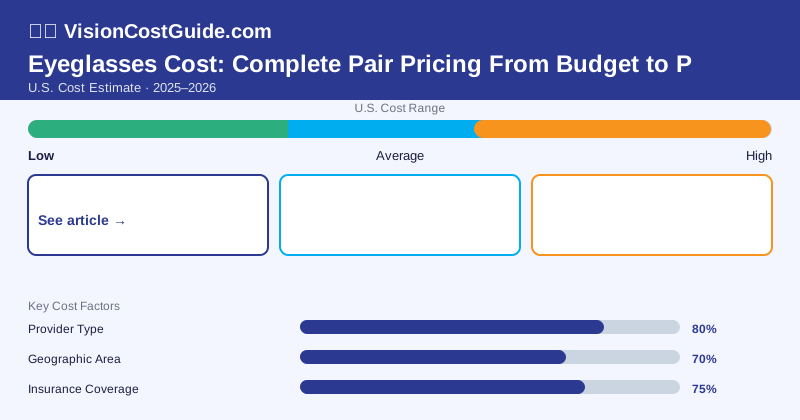
| Price Tier | Complete Pair Cost | Where to Buy | What You Get |
|---|---|---|---|
| Ultra-budget | $20–$100 | Zenni, EyeBuyDirect, GlassesUSA | Basic plastic frames, standard CR-39 lenses, minimal coatings |
| Mid-range | $100–$250 | Warby Parker, online mid-tier, retail chains | Better frames, polycarbonate or 1.67 lenses, AR coating included |
| Full-service optical | $200–$500 | Private optometrist, LensCrafters, Visionworks | Frame selection + professional fitting, premium lenses available |
| Designer/luxury | $400–$900+ | Optical boutiques, LensCrafters | Brand-name frames (Ray-Ban, Oakley, Versace), premium lenses |
| High-prescription specialty | $300–$700+ | Any optical with specialty lens access | Thinner/lighter lens indices (1.74+), complex prescriptions |
Frame vs. Lens Cost: Where the Money Goes
A $400 pair from your optometrist might break down like this:
- Frame: $150–$200
- Lenses: $100–$150
- Coatings (AR, scratch, UV): $50–$100
- Progressive or specialty design: $50–$200 additional
Frame markup at brick-and-mortar optical is substantial. A frame that costs the optician $30–$50 wholesale sells at 2–4x. That’s where online retailers win decisively — $20–$40 frames from Zenni are often comparable quality to $150–$200 frames at a full-service practice.
Where online retailers can fall short: lens precision, optical center placement accuracy, and the fitting adjustments that make a difference with complex prescriptions.
What Actually Matters: Prescription Complexity
For a mild, straightforward prescription — sphere-only, no astigmatism, low power — a $30 pair from Zenni with CR-39 plastic lenses delivers perfectly functional correction. Optics at low prescriptions are forgiving.
For complex prescriptions — high cylinder (astigmatism), high sphere power, prism, or multifocal — precision matters significantly more. The optical center has to sit accurately in front of your pupil. Frame geometry affects how well the prescription performs. A skilled optician and a quality lens lab earn their margin in these situations.
Most vision plans (VSP, EyeMed, Davis Vision) include:
- One comprehensive exam with a copay ($10–$20)
- A frame allowance ($150–$200)
- A lens benefit (typically covers standard single-vision or progressive lenses up to a dollar amount) With a $200 frame allowance and standard lens benefit, you can often walk out of an optical office with quality glasses for $0–$50 out of pocket — if you stay within the benefit structure.
Where people overspend: choosing frames $100 over the allowance, upgrading to premium lens designs that aren’t fully covered, and buying premium coatings the plan doesn’t include.
The Online Glasses Trade-Off
Online glasses are genuinely cost-effective for:
- Backup pairs
- Simple prescriptions
- Fashion frames you’ll replace in 1–2 years anyway
- Kids’ glasses that will be outgrown quickly
They’re riskier for:
- High or complex prescriptions where placement precision matters
- Progressive lenses (fitting progressives properly requires measurements an online retailer can’t take)
- First-time progressives (adaptation is harder without professional fitting guidance)
Adjustments, Repairs, and Lifetime Costs
Frame adjustment — nose pads, temple fit, alignment — is free at the office where you bought the glasses. At a competitor’s optical, expect $10–$20. Bring glasses back where you bought them for service.
Frame repair runs $30–$80 depending on the break. Temple arm replacement: $50–$100 for common styles. Sometimes replacing the pair is cheaper.
Anti-reflective coating delamination — a white haze on the lens surface — means the coating has failed and the lenses need replacing, not fixing.
Extended warranties on eyeglasses — sold as “scratch protection” or “replacement protection” at $30–$75 per pair — are rarely worth buying. Scratched lenses can usually be replaced as a pair ($50–$150) rather than replaced whole, and most plans already include a one-time replacement provision. Do the math on what you’re actually buying before adding it.
See also: Progressive Lens Cost if you need bifocal or no-line multifocal lenses, and Annual Cost of Vision Care for the full yearly glasses and contacts spending picture.
Bottom Line
A complete pair of functional eyeglasses costs $20–$100 online or $200–$500 at a full-service optical. The right price point depends on prescription complexity, how long you’ll wear them, and whether professional fitting matters for your lens design. Budget pairs are genuinely fine for simple prescriptions; complex or multifocal prescriptions warrant the investment in professional fitting and quality lenses.
Frequently Asked Questions
Eyeglasses cost between $100 and $600 at full-service opticians, while online retailers offer frames and lenses for $20 to $200. The final price depends on lens type (single vision, bifocal, progressive), frame brand, and anti-reflective or blue light coatings, which can add $50 to $200 to the base cost.
Most health insurance plans do not cover eyeglasses, though some vision-specific plans or supplemental coverage may offer $100 to $150 annual allowances toward frames and lenses. Medicare generally does not cover routine eyeglasses except after cataract surgery, so most seniors pay out-of-pocket or use discount vision plans like VSP or EyeMed.
In-store optician orders typically take 1 to 2 weeks for standard glasses and 2 to 3 weeks for progressive or specialty lenses. Online retailers usually ship within 5 to 10 business days, though expedited shipping options can deliver frames in 2 to 5 days for an additional fee of $10 to $30.