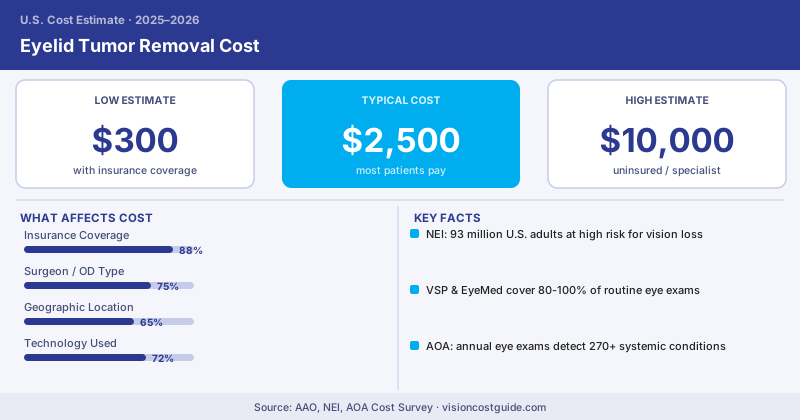
Most eyelid bumps are benign. A chalazion here, a small sebaceous cyst there. But the eyelid is also the most common site for basal cell carcinoma on the face—and that changes the cost conversation significantly. Knowing which type of lesion you have is the first (and most important) step.
Eyelid Tumors: Benign vs. Malignant
Benign eyelid lesions include chalazion (lipogranuloma of the meibomian gland), sebaceous cysts, papillomas, nevi (moles), dermoid cysts, xanthelasma, and molluscum contagiosum. Most are cosmetically bothersome at worst.
Malignant eyelid tumors are more common than most people realize. The AAO reports that approximately 5–10% of all skin cancers occur on the eyelid. Basal cell carcinoma (BCC) accounts for 90–95% of malignant eyelid tumors—but squamous cell carcinoma, sebaceous carcinoma, and melanoma also occur and carry higher risk.
Cost Breakdown by Lesion Type
| Procedure | Cost Range |
|---|---|
| Oculoplastic evaluation | $150–$400 |
| Chalazion incision and drainage | $300–$800 |
| Benign lesion excision (small, in-office) | $300–$1,200 |
| Shave excision + biopsy | $200–$800 |
| Pathology/histology (biopsy reading) | $100–$400 |
| Mohs micrographic surgery (BCC) | $1,000–$4,000 |
| Eyelid reconstruction (after Mohs) | $1,500–$6,000 |
| Total for BCC with full reconstruction | $4,000–$10,000+ |
Chalazion and Benign Lesions: Straightforward Costs
A chalazion (blocked, inflamed meibomian gland) is the most common eyelid bump. Many resolve with warm compresses alone—cost: $0. Persistent chalazia are treated with incision and curettage (I&C), an in-office procedure under local anesthesia. Cost: $300–$800, usually covered by medical insurance when symptomatic.
Small papillomas, nevi, and skin tags are removed in-office by shave or scissor excision. Add $100–$400 for histopathology if the specimen is sent for biopsy (which it should be, especially if the lesion changed in size, color, or texture).
Note: purely cosmetic removal of benign lesions is not covered by insurance. If your doctor documents it as symptomatic (irritation, blocking lashes, functional impairment), coverage becomes possible.
Basal Cell Carcinoma: Where Costs Escalate
BCC on the eyelid is serious for two reasons: the tumor is near critical structures (cornea, lacrimal drainage, visual axis), and incomplete removal leads to recurrence and destruction of more tissue.
Mohs micrographic surgery is the standard of care for periocular BCC. A dermatologic surgeon removes the tumor in stages, immediately examining each layer microscopically until clear margins are confirmed. This technique achieves 98–99% cure rates—far superior to simple excision. Cost: $1,000–$4,000 depending on number of stages needed.
After Mohs, the resulting defect must be reconstructed by an oculoplastic surgeon. Eyelid reconstruction is an art—restoring both function (full closure to protect the cornea) and appearance. Reconstruction cost: $1,500–$6,000 depending on defect size and technique (primary closure, skin grafts, flaps, or free tarsal grafts).
Combined Mohs + reconstruction: $4,000–$10,000 or more for large or inner-canthus tumors.
Mohs surgery and eyelid reconstruction for skin cancer are always covered by medical insurance—they’re medically necessary procedures. You’ll pay your deductible and any coinsurance, but the full cost is never out-of-pocket for insured patients. Medicare Part B covers Mohs surgery under the surgical benefit. Reconstrutive oculoplastic surgery following cancer excision is covered under all ACA-compliant plans as a reconstructive (not cosmetic) procedure.
The Sebaceous Carcinoma Warning
Sebaceous carcinoma of the eyelid mimics a chalazion—it presents as a recurrent, non-healing eyelid bump. It’s rare but aggressive, with potential for regional lymph node spread. The AAO’s clinical guidelines emphasize that any chalazion recurring after proper drainage should be biopsied.
If sebaceous carcinoma is diagnosed, treatment involves wide local excision with map biopsies, possible sentinel lymph node biopsy ($1,500–$4,000 additional), and potentially orbital exenteration in advanced cases. Treatment costs: $8,000–$40,000+, covered by medical insurance.
This is the reason a $100–$400 biopsy on a suspicious eyelid bump is worth every dollar.
Xanthelasma: The Cosmetic Case
Xanthelasma are yellowish cholesterol deposits on the inner eyelids—benign but often cosmetically bothersome. Removal options include chemical cauterization with trichloroacetic acid (TCA), laser ablation, or surgical excision. Cost: $300–$1,500 per session, rarely covered by insurance unless causing functional obstruction.
Recurrence is common (20–40%), and multiple sessions may be needed. Getting a fasting lipid panel ($30–$80) to check for dyslipidemia is worthwhile—treating the underlying lipid abnormality may slow recurrence.
Finding the Right Surgeon
Eyelid tumor removal—especially reconstruction after cancer excision—requires an oculoplastic surgeon (an ophthalmologist with fellowship training in plastics and reconstructive surgery). General plastic surgeons and dermatologists can remove the cancer, but eyelid reconstruction around delicate ocular anatomy is subspecialty work. The American Society of Ophthalmic Plastic and Reconstructive Surgery (ASOPRS) directory lists board-certified specialists by location.
The cost difference between a well-done reconstruction and a failed one is enormous—revision surgery after poor primary closure can cost $3,000–$8,000 more and still leave permanent functional deficits.
Don’t let any eyelid bump linger unexamined. A $200 biopsy is cheap. Ignoring a BCC until it involves the lacrimal system or orbital rim is not.