Your cataract surgeon quotes you a price for “laser cataract surgery.” Then they quote a lower price for “regular” cataract surgery. The difference can be $1,500 or more — per eye. Is the laser version actually better, or is it a premium upsell you don’t need?
The honest answer: it depends on your prescription, your chosen lens, and your surgeon’s skill. Here’s what the data actually shows.
The Core Cost Difference
Traditional phacoemulsification (phaco) uses manual incisions and ultrasound energy to break up and remove the cloudy lens. Femtosecond laser-assisted cataract surgery (FLACS) uses a computer-guided laser to make incisions, soften the lens, and open the lens capsule — before phaco finishes the job.
The laser adds cost without replacing surgery. You still have phaco. You just have laser-assisted steps first.
| Surgery Type | Out-of-Pocket Cost Per Eye | What Insurance Covers |
|---|---|---|
| Traditional phaco (monofocal IOL) | $0–$500 copay/deductible | Covered by Medicare/insurance |
| FLACS with monofocal IOL | $1,000–$2,500 upgrade fee | Laser premium = patient pays |
| Traditional phaco + premium IOL | $1,500–$4,000 IOL premium | IOL premium = patient pays |
| FLACS + premium IOL (trifocal, EDOF) | $3,500–$6,500 combined premium | Both premiums = patient pays |
Medicare and commercial insurers cover standard cataract surgery — but they cover only the “basic” version. The laser component is classified as an elective upgrade, so that portion always comes out of your pocket regardless of your insurance plan. The American Academy of Ophthalmology (AAO) confirmed in its 2023 practice guidance that FLACS carries an out-of-pocket premium because it isn’t considered medically superior to manual phaco for most uncomplicated cases.
What the Laser Actually Does Better
FLACS offers three documented advantages — and they matter more for some patients than others.
Capsulotomy precision. The laser creates a perfectly circular opening in the lens capsule to a tolerance of fractions of a millimeter. Manual capsulotomies, even in expert hands, vary slightly in diameter and centration. For premium multifocal and EDOF lenses, capsulotomy precision affects how well the lens centers and how the optics perform. If you’re paying $3,500+ for a PanOptix or Symfony-style IOL, FLACS is a reasonable addition to protect that investment.
Lens fragmentation. The laser pre-softens the nucleus, reducing the ultrasound energy needed during phaco. In dense cataracts (brunescent nuclei), less ultrasound energy means less heat and less potential endothelial cell loss. For patients with low endothelial cell counts — which your surgeon can measure with specular microscopy — FLACS may reduce surgical risk.
Astigmatism correction. FLACS can create arcuate corneal incisions with laser precision to reduce astigmatism at the time of surgery. For patients with 0.75–1.5 diopters of corneal astigmatism, this can improve uncorrected vision outcomes, though toric IOLs remain the gold standard above 1.5D.
When It’s Worth the Upgrade — and When It’s Not
- You’re getting a premium multifocal or EDOF IOL (alignment precision matters most)
- You have a dense or brunescent cataract (reduced ultrasound energy is protective)
- You have low endothelial cell counts (corneal health is marginal)
- You have 0.75–1.50D of regular corneal astigmatism (laser arcuate incisions may help)
- Your surgeon has substantial FLACS experience and a modern laser platform
For straightforward cataracts with a monofocal IOL target (distance or near), studies consistently show that FLACS and manual phaco produce equivalent visual outcomes. A 2020 Cochrane review analyzed 16 randomized controlled trials and found no significant difference in best-corrected visual acuity between FLACS and conventional surgery. The laser doesn’t make uncomplicated cataracts easier to remove by experienced surgeons.
FLACS requires an additional docking step where a suction ring attaches to your eye. A small percentage of cases experience suction loss mid-procedure, which can complicate surgery. The overall complication rate is low — but FLACS isn’t risk-free. Ask your surgeon how many FLACS procedures they perform per month, and what their personal docking/complication rates are. Volume and experience matter significantly with this technology.
Insurance and Medicare: The Upgrade Rules
Medicare Advantage and traditional Medicare Part B cover the medically necessary portion of cataract surgery — surgeon fees, facility, anesthesia, and a basic monofocal IOL. The FLACS laser upgrade fee and any premium IOL upgrade are entirely patient responsibility. Surgeons must have patients sign an Advanced Beneficiary Notice (ABN) when billing Medicare alongside elective upgrades.
Most commercial plans mirror Medicare: surgery covered, technology upgrades not. A few state-regulated plans may cover FLACS for specific indications (dense cataracts, prior LASIK), but don’t count on it. Always verify with your insurer and get the surgery center’s specific billing codes before proceeding.
If you’re using an HSA or FSA, the out-of-pocket laser premium and any IOL upgrade fees qualify as medical expenses. That can offset several hundred dollars in taxes depending on your bracket.
The Real Question to Ask Your Surgeon
Don’t ask “is laser cataract surgery better?” — that’s too broad. Ask:
- “Given my specific lens choice, what precision advantage does the laser actually add?”
- “Do I have any corneal factors (endothelial count, astigmatism) that would benefit from FLACS?”
- “How many FLACS procedures do you personally perform, versus manual phaco?”
A surgeon who does FLACS every day and strongly recommends it for your premium lens is giving you different information than a surgeon who does it occasionally and is adding it as a revenue option. The conversation matters.
Bottom Line
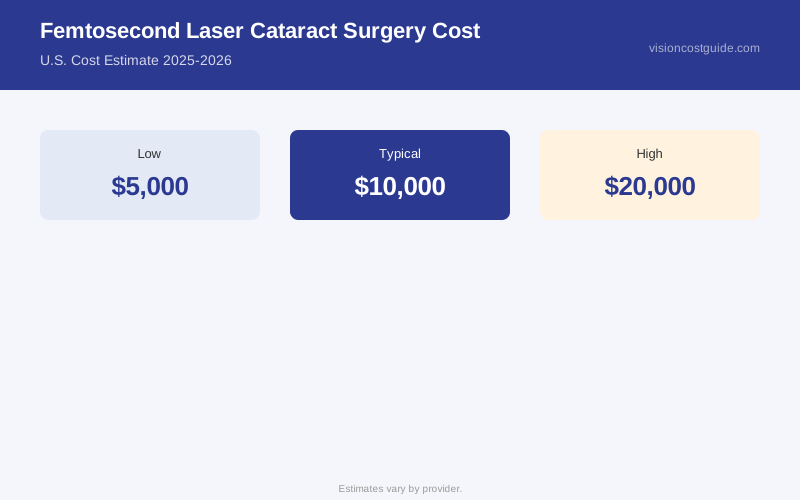
FLACS costs $1,000–$3,000 more per eye than traditional cataract surgery and isn’t covered by Medicare or commercial insurance. The upgrade is most defensible when paired with a premium multifocal or EDOF IOL, or when specific corneal factors favor reduced ultrasound energy. For straightforward cataracts with a monofocal lens, the clinical evidence doesn’t support a meaningful visual advantage. Discuss your specific anatomy with your surgeon — the lens choice usually matters more than whether a laser assisted in making the incisions.