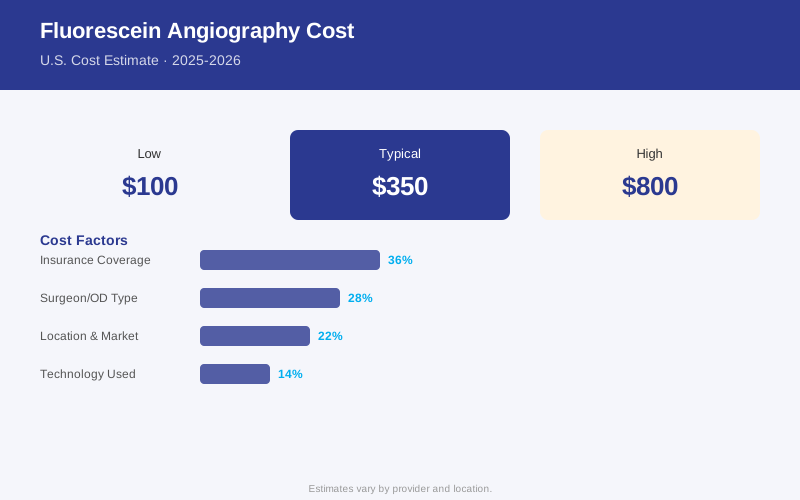
Your retinal specialist just said three words: fluorescein angiography. Then handed you a cost estimate ranging from $200 to $700. That wide range isn’t a mistake — it reflects real variation in how and where this test gets performed. Here’s exactly what you’re paying for and how to keep costs manageable.
What Is Fluorescein Angiography?
Fluorescein angiography (FA) is a diagnostic imaging test that maps blood flow through the retina and choroid — the vascular layers at the back of your eye. A fluorescent dye (sodium fluorescein) is injected into a vein in your arm. As it circulates through the retinal blood vessels, a specialized camera takes rapid sequential photographs. The entire imaging sequence takes about 10 minutes.
Doctors use FA to diagnose and monitor:
- Diabetic retinopathy — detecting leaking or abnormal vessels
- Age-related macular degeneration (AMD) — distinguishing wet from dry forms
- Retinal vein or artery occlusion
- Uveitis and inflammatory retinal diseases
- Choroidal neovascularization
According to the American Academy of Ophthalmology, diabetic retinopathy affects approximately 26% of adults with diabetes in the United States, making FA one of the most commonly ordered retinal diagnostic tests.
Fluorescein Angiography Cost Breakdown
| Setting | Typical Cost (Without Insurance) |
|---|---|
| Hospital outpatient department | $400–$800 |
| Private ophthalmology practice | $150–$450 |
| Retinal specialty clinic | $200–$600 |
| Academic medical center | $350–$700 |
| With Medicare (patient pays 20% after deductible) | $40–$160 |
| With commercial insurance (varies) | $0–$200 copay/coinsurance |
What Drives the Price?
Facility type is the single biggest factor. A hospital outpatient department charges a facility fee on top of the physician fee — that can double your bill compared to an independent ophthalmology practice. If your retinal specialist has admitting privileges at a hospital but also has a private office, ask explicitly whether the test will be done in the hospital setting or the office. It’s a fair question, and the answer directly affects your cost.
Geographic location matters too. Urban markets in California, New York, and Massachusetts routinely run 25–40% higher than the national average for specialist procedures. Rural areas may charge less but may have fewer options.
Whether it’s combined with other tests. FA is frequently ordered alongside optical coherence tomography (OCT). When bundled on the same visit, practices may charge one facility/administration fee instead of two, which can save you $75–$150.
The dye itself is inexpensive (sodium fluorescein costs only a few dollars), so you’re mostly paying for physician time, technician time, and imaging equipment.
Insurance Coverage
Medicare Part B covers fluorescein angiography when medically necessary (CPT code 92235). After your Part B deductible ($257 in 2025), you pay 20% of the Medicare-approved amount. In most markets that means $40–$120 out of pocket.
Commercial insurance varies by plan. Most PPO and HMO plans cover FA as a diagnostic service when ordered for a covered condition like diabetic eye disease or AMD. Check whether your retinal specialist is in-network — out-of-network charges can multiply your cost by 2–3x.
Vision insurance (VSP, EyeMed, Spectera) does NOT typically cover fluorescein angiography. These plans cover routine eye exams and eyewear, not medical retinal procedures. FA falls under medical/surgical benefits, not vision benefits.
- Confirm the procedure will be performed in the doctor’s office setting, not a hospital outpatient department
- Ask whether the FA will be combined with OCT on the same visit to reduce fees
- Verify your retinal specialist is in-network for your medical insurance — not vision insurance
- If uninsured, ask for the self-pay rate; many practices discount 20–40% for cash patients
- Plan for someone to drive you: your eyes will be dilated and may remain sensitive for 4–6 hours
Side Effects and Risks (These Affect Your Time, Not Just Your Wallet)
Sodium fluorescein is generally very safe, but about 5% of patients experience mild nausea. A small percentage have allergic reactions ranging from hives to, very rarely, anaphylaxis. Severe reactions are uncommon but real — your provider should have emergency equipment on hand. Your skin and urine will turn orange-yellow for 24–48 hours after the test. That’s normal and harmless.
Alternatives to Fluorescein Angiography
OCT angiography (OCTA) is a newer, non-invasive technology that maps retinal blood flow without dye injection. It’s increasingly replacing traditional FA for many indications. OCTA typically costs $100–$250 per eye and is covered by Medicare for appropriate diagnoses. For many patients being monitored for diabetic retinopathy or AMD, OCTA now offers equivalent diagnostic information. Ask your specialist whether OCTA is appropriate for your situation — it’s faster, requires no injection, and carries no dye-related side effects.
Indocyanine green angiography (ICGA) uses a different dye to image the choroidal circulation. It’s usually performed alongside FA (not as a replacement) and adds $100–$300 to the total cost.
The NEI Perspective on Retinal Imaging
The National Eye Institute reports that early detection and treatment of diabetic retinopathy can reduce the risk of severe vision loss by 95%. Fluorescein angiography remains a cornerstone of that detection process. If your doctor has ordered this test, it’s almost certainly because the clinical stakes are high enough to justify the cost and the slight discomfort of the dye injection.
Saving Money on Fluorescein Angiography
- Outpatient office vs. hospital: Always ask where the procedure will occur. Office-based FA in a private practice typically runs $150–$300 less than the same test in a hospital outpatient department.
- Federally qualified health centers (FQHCs): If you’re uninsured or have limited income, FQHCs offer sliding-scale fees for many specialist services. Not all have retinal imaging on-site, but they can facilitate referrals.
- Patient assistance from dye manufacturers: Alcon and other pharmaceutical companies occasionally have programs for low-income patients. These programs are more relevant for ongoing medication costs than for single procedures, but it’s worth asking.
- Combine with your existing appointment: If you’re already scheduled for a dilated eye exam, ask whether the FA can be done the same day to avoid a second visit copay.
Bottom Line
Fluorescein angiography costs $150–$800 depending on where you live, where the test is performed, and your insurance. For Medicare patients it’s usually $40–$120 out of pocket. For uninsured patients in a private ophthalmology practice, $150–$350 is a realistic target if you ask for the self-pay rate. The test is brief and usually covered when your doctor orders it for a legitimate retinal condition. Don’t skip it to save money — the conditions FA diagnoses are exactly the ones that cause irreversible vision loss when caught late.