Here’s a number that catches people off guard: 42% of American adults with diabetes haven’t had a dilated eye exam in the past year, according to CDC Vision Health Initiative data. Fundus photography is one of the tools helping close that gap — but it shows up as an add-on charge on your eye exam bill and patients often don’t know what it is or whether they need it.
What Is Fundus Photography?
Fundus photography is a specialized image of the back of your eye — the retina, optic disc, macula, and blood vessels. A technician uses a low-power microscope with a camera (called a fundus camera) to capture these images while your pupil is dilated, or in some cases without dilation using a “nonmydriatic” camera.
The images give your eye doctor a permanent record to:
- Detect glaucoma early by monitoring the optic nerve over time
- Track diabetic retinopathy progression between visits
- Document macular changes in age-related macular degeneration
- Spot suspicious lesions in the retinal periphery
- Create a baseline for monitoring in healthy patients
A fundus photograph is not the same as an OCT scan. OCT gives cross-sectional depth data; fundus photography provides a two-dimensional surface map. Many practices offer both.
Fundus Photography Cost
| Setting | Cost Per Visit (Both Eyes) |
|---|---|
| Retail optometry (LensCrafters, MyEyeDr, etc.) | $30–$75 |
| Independent optometrist’s office | $30–$80 |
| Ophthalmology practice add-on | $50–$150 |
| Optomap wide-field imaging (Optos device) | $35–$99 |
| Specialist retinal photography | $100–$250 |
| Fundus photography billed through Medicare (patient portion) | $10–$40 |
Optomap vs. Standard Fundus Photography
You’ve probably been asked at your optometrist’s office: “Would you like the Optomap scan for $39?” That’s an ultra-widefield fundus image taken with an Optos device. It captures about 200 degrees of the retina in a single shot without dilation — versus roughly 45 degrees with a standard fundus camera.
The Optos scan can be done without eye drops and takes seconds. Many ODs offer it as a dilation alternative for routine healthy patients. Whether it’s worth the extra $35–$99 depends on your risk factors. For a 25-year-old with no systemic disease, probably not mandatory. For anyone with diabetes, hypertension, a family history of retinal detachment, or high myopia — it’s excellent value.
Does Insurance Cover Fundus Photography?
The honest answer: it depends on why it’s being done.
Medical insurance (including Medicare Part B): Covers fundus photography with dilation when it’s medically necessary — for example, documenting diabetic retinopathy (CPT 92250), glaucoma monitoring, or retinal disease. Your cost is typically 20% coinsurance after your Part B deductible, which comes to $10–$40 in most cases.
Vision insurance (VSP, EyeMed, Spectera): Usually does NOT cover fundus photography as a separate line item. These plans cover the routine eye exam, not diagnostic imaging add-ons.
Routine patient self-pay: When your OD is simply offering retinal photography as a preventive baseline in an otherwise healthy patient, it’s almost always a self-pay charge. It won’t be billed to medical insurance because there’s no diagnosis code to support it. That’s where the $30–$80 add-on fee comes in.
Watch for upcharges at retail optometry chains. Some practices charge $40–$60 for fundus photography as a routine add-on and present it as nearly mandatory. For low-risk patients under 40 with no systemic disease, dilation with a standard slit lamp exam is clinically equivalent. You can decline the extra scan and still get an excellent exam. If you have diabetes, glaucoma risk, or are over 55, the imaging is much more justified.
When Fundus Photography Is Worth Every Penny
For these patients, fundus photography is genuinely high value:
Diabetics: The AAO recommends annual dilated exams for all people with diabetes. Fundus photography creates a permanent, time-stamped record of retinal vessel health. Year-over-year comparisons catch early diabetic retinopathy before it threatens vision. The cost of the photograph ($40–$80) is trivial compared to treating advanced retinopathy.
Glaucoma suspects: If your cup-to-disc ratio is borderline, fundus photography gives your doctor a baseline image. Changes to the optic nerve head over time are the clearest early warning sign of glaucoma progression.
High myopes (−6.00 and beyond): Severe nearsightedness stretches the retina and increases retinal tear and detachment risk. Annual fundus photographs document any new lattice degeneration or peripheral changes.
AMD patients: Fundus photography, especially combined with OCT, tracks drusen deposits and geographic atrophy in dry AMD. For wet AMD patients on anti-VEGF injections, it confirms treatment response.
What to Ask at Your Exam
When the front desk or technician asks whether you want the retinal photograph, it’s reasonable to ask:
- “Is this being billed to my medical insurance or vision insurance?”
- “Will you submit it under a diagnosis code, or is this self-pay?”
- “Is this the Optomap wide-field scan, or a standard fundus photo?”
- “Given my health history, do you think this is clinically necessary today, or a nice-to-have baseline?”
A good OD will give you a straight answer. If they’re vague or just say “most patients get it,” that’s not a clinical recommendation — it’s an upsell.
The National Eye Institute’s Position
The NEI notes that early detection of diabetic retinopathy, glaucoma, and AMD through regular imaging significantly reduces the risk of permanent vision loss. Fundus photography is listed as a key tool in the NEI’s recommended care pathway for diabetic patients. For those with risk factors, it’s not optional — it’s part of responsible care.
Saving Money on Fundus Photography
- Ask your insurer first. If you have diabetes or glaucoma, medical insurance may cover fundus photography at no cost to you beyond your deductible. Don’t pay out of pocket before checking.
- Community health centers. Federally qualified health centers often include retinal screening for diabetic patients at low or no cost.
- Free diabetes screening events. The American Diabetes Association and various hospital systems periodically offer free retinal screenings at community health fairs.
- Decline if low risk. Healthy patients under 40 with no systemic disease, no family history of retinal conditions, and no high myopia can safely defer fundus photography and have a thorough exam with dilation instead.
Bottom Line
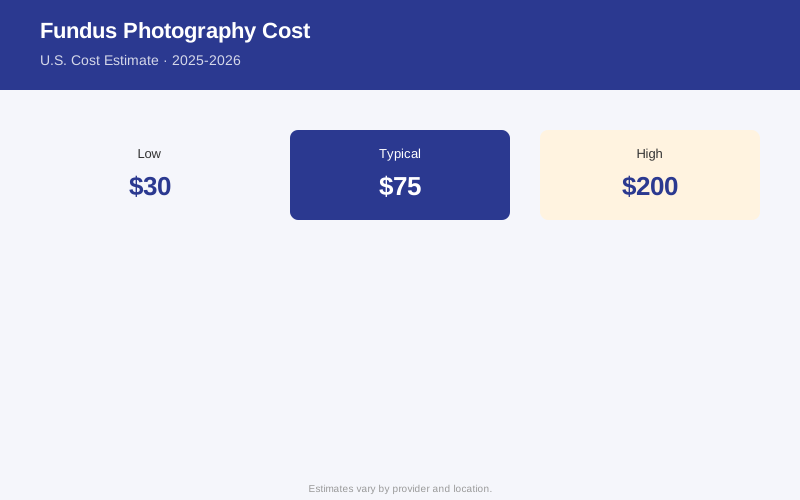
Fundus photography costs $30–$150 at most optometry and ophthalmology practices, with Optomap scans landing around $35–$99. Medical insurance covers it when there’s a qualifying diagnosis. For patients with diabetes, glaucoma risk, or AMD, it’s excellent preventive medicine for the price. For low-risk healthy patients, it’s an optional add-on you can evaluate based on your budget and comfort level. Just don’t let anyone make the decision for you without explaining why it’s clinically indicated.