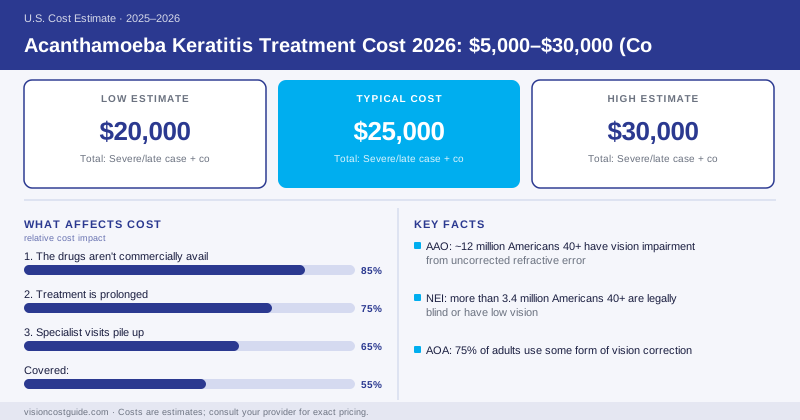
Here’s something contact lens wearers need to read once and never forget: swimming, showering, or using a hot tub in contact lenses can give you a parasitic corneal infection that takes 6–18 months to treat, costs $5,000–$30,000, and can permanently blind you if it’s misdiagnosed for even a few weeks.
Acanthamoeba keratitis isn’t common. But it’s catastrophically bad when it happens — and it’s almost exclusively a contact lens wearer’s disease.
The CDC estimates that roughly 1–2 cases per million contact lens wearers occur in the United States each year. That sounds rare until you consider there are approximately 45 million contact lens wearers in the U.S. — meaning several hundred cases every year, concentrated in people who do exactly what the packaging says not to do: sleep in lenses, rinse lenses with tap water, shower or swim without removing them first.
What Makes This Infection So Expensive
Acanthamoeba is a free-living microscopic parasite found in virtually all water sources — tap water, lakes, pools, hot tubs, even treated municipal water. It doesn’t cause disease in most exposures. But introduce it to the space between a contact lens and a compromised corneal surface, and it can invade corneal tissue and form protective cysts that are extraordinarily difficult to kill.
The expense comes from three factors:
1. The drugs aren’t commercially available. The two most effective treatments — PHMB (polyhexamethylene biguanide, a pool disinfectant repurposed as an eye drop) and CHX (chlorhexidine, an antiseptic used in wound care) — have no FDA-approved ophthalmic formulations in the U.S. They must be compounded by specialty pharmacies. That means higher cost, potential delays, and insurance coverage battles.
2. Treatment is prolonged. Even with optimal treatment, Acanthamoeba keratitis requires 4–6 months of intensive drops. The cyst form (trophozoite) of the organism is highly drug-resistant. Initial dosing schedules call for drops every 1–2 hours around the clock — including waking up multiple times per night. Patients are often still on some level of drops at the 12-month mark.
3. Specialist visits pile up. This isn’t a condition managed by your regular optometrist. Acanthamoeba keratitis requires a corneal specialist (ophthalmologist subspecialist) with confocal microscopy capability for monitoring. Monthly visits are standard; more frequent visits during active treatment are common.
Treatment Cost Breakdown
| Treatment Component | Cost Range | Notes |
|---|---|---|
| Emergency corneal specialist evaluation | $300–$600 | Initial workup including confocal microscopy |
| Corneal scraping + culture | $200–$500 | Diagnostic procedure; lab fees additional |
| Confocal microscopy (monitoring) | $150–$400 per session | Every 4–8 weeks for months |
| Compounded PHMB or CHX drops | $200–$500/month | Off-label; often not covered by insurance |
| Propamidine (Brolene) drops | $100–$300/month | Where available; less commonly used in U.S. |
| Oral anti-amebic medications (if used) | $100–$400/month | Sometimes added for severe cases |
| Specialist follow-up visits | $150–$400 each | Monthly minimum; more frequent early on |
| Pain management (topical anesthetics, analgesics) | $50–$200/month | Disease is intensely painful |
| Total: Mild/early case (4–6 months) | $5,000–$10,000 | Diagnosed within first 2–4 weeks |
| Total: Moderate case (6–12 months) | $10,000–$20,000 | Diagnosed with stromal involvement |
| Total: Severe/late case + corneal transplant | $20,000–$30,000+ | Scarring requiring keratoplasty |
The Diagnosis Problem
Acanthamoeba keratitis is frequently misdiagnosed — often for weeks or months. The early presentation (pain, redness, photophobia, blurred vision) is essentially identical to bacterial keratitis or herpetic (HSV) keratitis. Many patients are initially treated with standard antibiotic or antiviral drops, which don’t work on Acanthamoeba but delay the correct diagnosis.
The signature finding — a ring-shaped corneal infiltrate — typically develops later in the disease course, by which point significant corneal damage has occurred. Confocal microscopy (a specialized imaging tool that can visualize the Acanthamoeba cysts directly in the corneal stroma without a biopsy) is the gold standard for early diagnosis, but it’s only available at corneal subspecialty centers.
If you wear contact lenses and develop eye pain, redness, and light sensitivity that doesn’t respond to antibiotic drops within 48–72 hours, insist on a referral to a corneal specialist. Not your regular optometrist — a corneal specialist with confocal microscopy. Tell them about any water exposure in your lenses. This distinction changes your entire treatment plan. Delayed diagnosis of Acanthamoeba keratitis is one of the most predictable causes of preventable blindness in contact lens wearers.
Hospitalization: When It Escalates
Severe Acanthamoeba keratitis — particularly cases with scleritis (infection spreading to the white of the eye) or cases where outpatient drop compliance is impossible — sometimes requires hospitalization for IV medications and nursing-supervised hourly drop administration. A hospitalization adds $3,000–$10,000 to total costs depending on duration, and is mostly covered by medical insurance as inpatient care.
Corneal Transplant: The Last Resort
If Acanthamoeba is eliminated but leaves dense corneal scarring that permanently impairs vision, a corneal transplant (penetrating keratoplasty or deep anterior lamellar keratoplasty, depending on the depth of scarring) may be needed to restore sight. This adds $5,000–$15,000 to the total cost, and transplants for post-infectious scarring are typically covered by medical insurance.
There’s an additional complication: transplanting into a cornea that had active infection carries a risk of reactivating dormant Acanthamoeba cysts. Most corneal specialists require documented culture negativity and extended treatment before proceeding with keratoplasty.
The Prevention Math Is Simple
PHMB eye drops cost $200–$500/month. A contact lens case costs $2. The math is not complicated.
What causes Acanthamoeba keratitis, almost universally:
- Swimming, showering, or using a hot tub while wearing contacts
- Rinsing contact lenses or cases with tap water instead of sterile saline
- Sleeping in contacts (increases corneal hypoxia and microtrauma, creating entry points)
- Using homemade or non-sterile saline
These aren’t fine print — they’re the reason Acanthamoeba keratitis is almost entirely preventable:
- Never swim, shower, or use a hot tub in contact lenses. Not briefly. Not with your eyes closed. Not ever.
- Rinse your case with sterile saline only — never tap water. Let it air dry face down on a clean tissue daily.
- Replace your case every 3 months — biofilm inside old cases is a real risk factor.
- Use hydrogen peroxide-based systems (Clear Care) rather than multipurpose solutions — they’re more effective against Acanthamoeba.
- If an eye gets red and painful, remove your lens immediately and see a professional within 24 hours.
Insurance Coverage Reality
Here’s the honest breakdown:
Covered: Office visits, diagnostic procedures, hospitalizations, corneal transplant (if needed) — all covered by standard medical insurance under diagnosis code B60.13 (Acanthamoeba keratitis).
Often not covered or partially covered: Compounded PHMB and CHX drops. These require proactive appeals with medical necessity documentation. Ask your specialist to submit a letter of medical necessity citing the lack of approved alternatives. Some commercial plans cover compounded medications if the prescribing physician documents that no FDA-approved equivalent exists.
Pain management: Partially covered. Topical NSAIDs and oral analgesics are typically covered; topical anesthetics for office use are covered, but are generally not prescribed for home use due to toxicity concerns.
The total financial burden for a moderate case can easily reach $15,000–$20,000, with a meaningful portion ($1,500–$4,000) in out-of-pocket medication costs even with good insurance.
The Bottom Line
Acanthamoeba keratitis is the most expensive — and most preventable — complication in contact lens wear. An untreated pool swim in contacts can set off a chain of events costing tens of thousands of dollars and potentially your sight. The treatment is brutal, prolonged, painful, and not fully covered by insurance.
Take out your contacts before you shower. Every single time.
Cost estimates based on CDC contact lens safety data, published Acanthamoeba keratitis clinical series, and compounding pharmacy pricing surveys. CDC reports approximately 1–2 cases per million contact lens wearers annually. Individual treatment costs vary significantly by disease stage at diagnosis, clinic type, and insurance coverage.
Frequently Asked Questions
The two main antiseptic medications — PHMB (polyhexamethylene biguanide) and CHX (chlorhexidine) drops — are not FDA-approved ophthalmic formulations and are compounded by specialty pharmacies. Compounded PHMB or CHX drops typically cost $200–$500 per month at the aggressive initial dosing frequency (every 1–2 hours around the clock). During the first 4–8 weeks of treatment, patients may need 2–4 bottles per month. Total medication cost for a typical 6-month course ranges from $1,200 to $4,000.
Yes. Acanthamoeba keratitis can cause severe corneal scarring and permanent vision loss, especially if diagnosis is delayed. The CDC notes that diagnosis is frequently missed early because the presentation mimics bacterial or herpetic keratitis. Cases diagnosed and treated within the first month have excellent prognosis; cases reaching the stromal ring infiltrate stage often result in significant permanent vision loss and may require corneal transplantation. Every week of misdiagnosis meaningfully worsens the outcome.
Specialist visits, diagnostic procedures, and hospitalizations are covered by medical insurance. However, the compounded PHMB and CHX drops are a significant coverage gap — because they aren't FDA-approved ophthalmic formulations, insurers often deny them as 'experimental' or 'compounded preparations.' Patients frequently pay $200–$500/month out of pocket for these medications. Propamidine isethionate (Brolene) drops, where available, may have better coverage. Ask your specialist's billing department to submit the medication under a diagnosis code (B60.13) with medical necessity documentation.