Roughly 3 in every 100 American children has amblyopia — what most people call lazy eye. That’s about 2–3% of the U.S. population, according to the NEI, making it the most common cause of vision loss in children. The good news: caught early, it’s treatable. The bad news: many parents don’t realize the cost picture is more complicated than just buying an eye patch.
Here’s what amblyopia treatment actually costs, and what changes that number up or down.
What Amblyopia Is (and Why Treatment Costs Vary So Much)
Amblyopia isn’t an eye muscle problem. It’s a brain problem — the visual cortex never properly learns to process images from one eye, usually because that eye had an obstacle to clear vision during early development: misalignment (strabismus), high or unequal refractive error, or a structural issue like a cataract.
Treatment works by forcing the brain to use the weaker eye. There are three ways to do that, and they have very different cost profiles.
The Three Treatment Approaches
1. Patching (occlusion therapy) The non-amblyopic eye is covered with a patch for 2–6 hours per day, forcing the brain to rely on the weaker eye. Patches cost $0.50–$3 each (self-adhesive, disposable). The total material cost is minimal. The real cost is the professional monitoring: eye exams every 4–8 weeks during active treatment to track improvement and adjust the patching schedule. At $150–$300 per exam with 6–10 visits over 12 months, annual monitoring costs $900–$3,000.
2. Atropine penalization drops Atropine drops blur near vision in the better eye, serving the same function as a patch. They’re more convenient for active kids and show similar outcomes to patching in the NEI-sponsored PEDIG amblyopia trials. The drug itself is inexpensive ($20–$60/month). Follow-up visit frequency mirrors patching — every 4–8 weeks during active treatment.
3. Vision therapy A structured program of in-office exercises and at-home activities, designed to improve visual processing, binocular coordination, and depth perception. Used for residual amblyopia after patching, for older children with limited patching response, and increasingly for adults. Sessions are 45–60 minutes with a developmental optometrist or orthoptist, at $100–$200 per session. Most programs run 20–40 sessions over 4–12 months.
Cost Breakdown
| Treatment Component | Cost | Notes |
|---|---|---|
| Initial ophthalmology/optometry evaluation | $150–$350 | Cycloplegic refraction, cover test, visual acuity |
| Corrective glasses (often prescribed first) | $150–$400 | Optical treatment precedes patching/drops |
| Adhesive eye patches (per box of 20) | $10–$60 | Material cost only |
| Follow-up exams during patching (per visit) | $150–$300 | Typically every 4–8 weeks |
| Atropine 1% drops (monthly) | $20–$60 | Generic atropine is inexpensive |
| Vision therapy per session | $100–$200 | In-office; 45–60 minutes |
| Vision therapy program (20 sessions) | $2,000–$4,000 | Plus at-home kit materials |
| Simple patching case (12 months) | $1,200–$3,500 | Glasses + patches + 8 follow-ups |
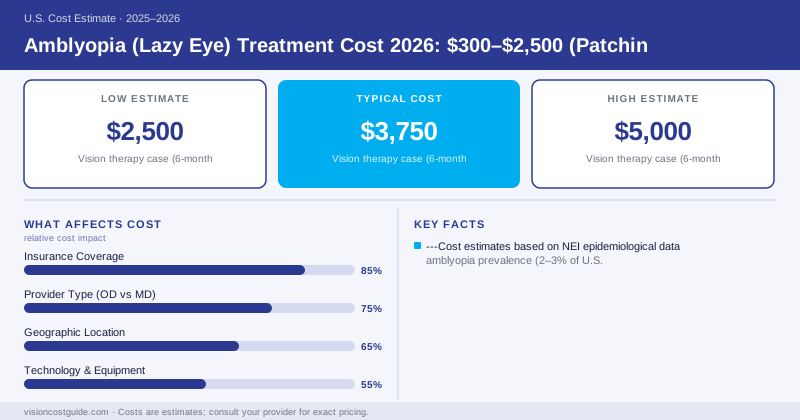
| Vision therapy case (6-month program) | $2,500–$5,000 | Includes evaluation, sessions, glasses |
Before patching or drops begins, most children with amblyopia are prescribed corrective glasses. Why? Because sometimes the amblyopia is primarily refractive (caused by unequal prescription between the eyes) — and correcting the prescription alone can resolve or significantly improve amblyopia without any further treatment. The AAO recommends a trial of glasses-only treatment for 18–24 weeks before adding patching. Skipping this step and going straight to patching means potentially treating an eye that would have improved with spectacles alone.
Age Matters — A Lot
Treatment outcomes are strongly tied to the age at which treatment begins. The visual cortex is most plastic (receptive to change) before age 7–8. Treatment before age 7 typically produces excellent results — most children achieve 20/30 or better vision in the amblyopic eye with consistent treatment.
After age 8, the response is still possible but slower and less complete. A 2023 analysis published in Ophthalmology found that children treated between ages 7–12 achieved meaningful improvement, but final acuity outcomes were modestly worse than those treated younger. Adolescents can still respond, especially to vision therapy.
Adults are the hardest to treat. Adult amblyopia treatment (typically vision therapy) can produce meaningful gains in some patients, but the evidence base is much thinner, and many ophthalmologists are skeptical. Expect out-of-pocket costs if pursuing adult treatment since insurance coverage is even more limited.
School vision screenings miss a significant proportion of amblyopia cases. The NEI estimates that 5–8% of preschool children have a vision disorder serious enough to benefit from treatment, but many aren’t identified until they’re in school — by which point optimal treatment age is partially or fully past. If your child has a family history of strabismus or amblyopia, or you notice any eye turn or squinting, schedule a comprehensive pediatric eye exam before age 3 — not just a school screening.
Insurance Coverage Reality
For children, amblyopia treatment generally receives decent insurance coverage:
- Office visits and exams: Covered under medical insurance as medically necessary
- Corrective glasses: Covered by vision insurance under the pediatric vision benefit (required by ACA marketplace plans for children under 19)
- Atropine drops: Covered as a prescription drug
- Vision therapy: Variable — check your specific plan. Codes 92065 (orthoptic training) and 97112 (neuromuscular reeducation) get different treatment by different insurers. Some plans cover up to 20 sessions per year; others exclude it entirely
For adults, coverage is much more limited — most plans consider adult vision therapy cosmetic or experimental.
When Vision Therapy Is Worth the Cost
Vision therapy isn’t just for amblyopia. It’s used for convergence insufficiency, binocular vision disorders, and visual processing issues. For amblyopia specifically, vision therapy is most supported by evidence when:
- The child is older (8+) and patching compliance is poor
- Residual amblyopia remains after patching/drops have plateaued
- There’s a binocular vision component that patching alone doesn’t address
- An adult is seeking improvement (with realistic expectations)
The AAO’s clinical guidelines consider vision therapy an accepted treatment for amblyopia but note that evidence is strongest for patching and atropine as first-line options. Vision therapy typically comes after or alongside conventional treatment, not instead of it.
The Bottom Line
Most children with amblyopia can be treated effectively for $1,200–$3,500 over 12 months — primarily glasses, patches, and monitoring visits. Vision therapy programs cost more ($2,500–$5,000 for a full program) but are clinically supported for appropriate candidates. Treatment before age 7 gives the best outcomes. After age 8, you’re working against declining visual plasticity.
The NEI’s data is clear: amblyopia is the leading cause of monocular vision loss in American children. It’s preventable-ish and treatable — but only if caught before the visual system locks in.
Cost estimates based on NEI epidemiological data on amblyopia prevalence (2–3% of U.S. population), AAO clinical guidelines on amblyopia management, and PEDIG randomized controlled trial data on patching and atropine outcomes. Individual treatment costs vary by region, practice type, and insurance coverage.
Frequently Asked Questions
Most private health insurance plans cover amblyopia treatment for children as a medically necessary pediatric benefit. This includes office visits, the initial evaluation, and atropine drop prescriptions. Coverage for vision therapy is more variable — some plans cover it when billed under medical benefits with a medical diagnosis code (H53.00–H53.03), while others exclude it as 'educational' or 'behavioral.' Vision therapy tends to get better coverage when it's prescribed by an ophthalmologist or optometrist affiliated with a medical group. Always verify with your insurer before committing to a vision therapy program.
Treatment is most effective under age 7–8, when the visual system is highly plastic, but it doesn't abruptly stop working after that. The AAO's clinical guidelines acknowledge that amblyopia treatment can be effective in older children and adolescents up to age 17. Adult amblyopia treatment is more controversial — the visual system has less plasticity after age 18, and response rates are lower. However, small clinical trials and case series have shown meaningful improvement in some adults, particularly with intensive vision therapy. Adults seeking treatment should consult a developmental optometrist with specific amblyopia experience rather than a general practice.
Untreated amblyopia leads to permanent vision loss in the affected eye. The NEI estimates that amblyopia affects 2–3% of the U.S. population and is the most common cause of monocular vision loss in children and young adults. A child with untreated amblyopia relies entirely on the non-amblyopic eye for functional vision throughout life — meaning if that eye is ever injured or develops disease, there's no backup visual capacity. The cost of not treating is permanent; the cost of treating is finite. Most cases treated under age 7 achieve normal or near-normal vision in the amblyopic eye.