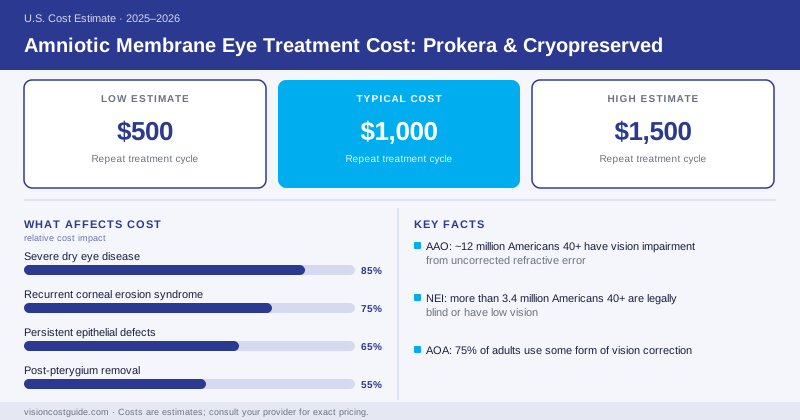
Six months of artificial tears. Two lid hygiene routines. A course of Restasis. Still burning eyes every morning, persistent surface erosions, and vision that fluctuates throughout the day. For patients who’ve exhausted the standard dry eye toolkit, amniotic membrane treatment represents a fundamentally different approach — not a lubricant or anti-inflammatory, but a biologic that recruits the eye’s own healing processes.
Here’s what it costs, how it works, and when it’s actually the right call.
What Amniotic Membrane Treatment Is
The amniotic membrane is the innermost layer of the fetal placenta. It’s rich in growth factors, anti-inflammatory proteins, and basement membrane components that promote epithelial healing and reduce scar formation. Ophthalmologists have used amniotic membrane grafts for decades for corneal reconstruction; Prokera (by Bio-Tissue) is the most widely used commercial product for outpatient treatment.
Prokera is a cryopreserved amniotic membrane mounted on a thin, flexible polycarbonate ring — essentially a bandage lens with biologic properties. The ophthalmologist places it directly on the eye (over the cornea, under the eyelids) in an office procedure taking 5–15 minutes. It stays in place for 3–7 days before removal.
During that time, the membrane releases:
- EGF (epidermal growth factor) — stimulates corneal epithelial regrowth
- Anti-inflammatory proteins — suppresses the inflammatory cascade underlying chronic surface disease
- Basement membrane proteins — supports normal epithelial attachment and migration
- Anti-fibrotic factors — reduces scarring as tissue heals
The NEI notes that chronic ocular surface disease affects millions of Americans and represents one of the most challenging areas in ophthalmology to treat when conventional therapies fail. Amniotic membrane grafts fill a gap that no drop or ointment can.
2026 Cost Breakdown
| Cost Component | Typical Range | Notes |
|---|---|---|
| Prokera device (material) | $300–$600 | Billed separately or bundled |
| Office placement procedure | $150–$400 | Ophthalmologist fee |
| Follow-up removal visit | $75–$200 | Usually 3–7 days later |
| Total per eye | $500–$1,500 | Varies by practice and region |
| Bilateral treatment | $1,000–$3,000 | Both eyes not always needed |
| Repeat treatment cycle | $500–$1,500/eye | Some conditions require 2–3 cycles |
Bio-Tissue makes two versions: standard Prokera and Prokera Slim (thinner profile, often better tolerated for outpatient wear). AMNIOX (Clarix 1K) is a competing product using a different preservation method. All use human amniotic membrane; efficacy data is broadly comparable. Your ophthalmologist’s preferred product will usually determine which one you receive.
Conditions It’s Used For
Prokera is appropriate for a specific subset of patients — those with surface disease severe enough that conventional treatments haven’t produced adequate healing:
Severe dry eye disease — particularly when there’s corneal staining (surface damage visible with fluorescein dye) despite aggressive lubricant and anti-inflammatory therapy. The membrane helps reset the inflammatory cycle and promote epithelial repair simultaneously.
Recurrent corneal erosion syndrome — a condition where the corneal epithelium repeatedly tears away, often during sleep. Standard treatments include hypertonic saline, bandage contact lenses, and superficial keratectomy. Prokera can accelerate healing and reduce recurrence frequency.
Persistent epithelial defects — areas of the corneal surface that won’t heal after surgery, chemical injury, or infection. An open epithelial defect is a serious condition with infection risk; amniotic membrane provides structural support and growth factors to close the defect.
Post-pterygium removal — pterygium excision leaves a large conjunctival wound. Prokera is sometimes used to reduce scarring and hasten healing when conjunctival autograft isn’t performed.
Chemical and thermal burns — acute ocular surface burns from lye, acid, steam, or other agents. Early amniotic membrane application can significantly improve visual outcomes.
Filamentary keratitis — mucous filaments that adhere to the cornea in severe dry eye, causing severe pain. Prokera can break the inflammatory cycle when other treatments fail.
Insurance Coverage — The Good News
Unlike most dry eye treatments, amniotic membrane therapy has legitimate medical billing codes. CPT code 65778 (placement of amniotic membrane on the ocular surface) and 65779 (suture anchor of amniotic membrane) are Medicare-recognized codes.
Medicare Part B covers Prokera when:
- The diagnosis is medically documented (corneal ulcer, persistent epithelial defect, severe dry eye with corneal involvement, etc.)
- The treating physician is an ophthalmologist
- The procedure is billed under medical (not routine vision) benefits
Prior authorization is frequently required. Your ophthalmologist’s billing team handles this — ask specifically: “Will you submit to Medicare/insurance, and is Prokera typically covered for my diagnosis?”
Commercial insurance (Anthem, BCBS, Aetna, UHC, etc.) coverage varies widely. Some plans follow Medicare coverage policies; others have stricter criteria. Plans that cover it typically require:
- Diagnosis of corneal pathology, not just dry eye
- Documentation of failed conservative therapy
- Prior auth approval before the procedure
Vision plans (VSP, EyeMed, Davis) do not cover Prokera. This is a medical benefit, not a vision benefit.
How It Compares to Other Severe Dry Eye Treatments
| Treatment | Cost | Insurance Potential | Best For |
|---|---|---|---|
| Prokera amniotic membrane | $500–$1,500/eye | Medicare/medical (moderate) | Corneal surface damage, severe DED |
| Autologous serum drops | $200–$500/month | Limited | Ongoing severe dry eye, Sjogren’s |
| Scleral lenses | $1,500–$4,000/pair | Sometimes (medical) | Irregular cornea + dry eye |
| IPL therapy | $400–$800/session | Rarely | Evaporative dry eye, MGD |
| LipiFlow | $1,200–$1,800 bilateral | Rarely | MGD without corneal damage |
Prokera is not a dry eye maintenance treatment — it’s an acute intervention for corneal surface disease. It won’t replace ongoing dry eye management with lubricants, anti-inflammatories, and lid hygiene. After a Prokera treatment cycle, you’ll still need a long-term dry eye management plan.
What to Expect From the Procedure
The placement takes 5–15 minutes in-office, under topical anesthetic drops. You’ll feel mild pressure and foreign body sensation during insertion — normal and expected. The membrane itself is thin and mostly tolerated like a bandage contact lens, though some patients find it uncomfortable enough that they take time off work for the 3–7 day wear period.
Vision is typically blurry while the membrane is in place — the cryopreserved tissue isn’t optically transparent. Plan for limited activities during the treatment period.
Removal is quick (1–5 minutes) and the cornea is evaluated for healing progress. Some conditions require a second placement cycle; recurrent erosion syndrome in particular may need 2–3 rounds before remission.
The Bottom Line
Amniotic membrane treatment occupies a legitimate therapeutic niche — it’s for patients with documented corneal surface damage or severe refractory dry eye, not for anyone who’s tried Refresh Optive twice. The $500–$1,500 per-eye cost is meaningful, but Medicare and medical insurance coverage is a genuine possibility when your diagnosis and documentation are in order.
If you have severe dry eye that’s damaged your corneal surface, ask your ophthalmologist (not just optometrist) directly: “Am I a candidate for Prokera, and would it be covered under my Medicare or medical benefits?” The answer is often yes.
For patients who need ongoing severe dry eye treatment rather than an acute biologic intervention, autologous serum eye drops may be the next conversation.
Frequently Asked Questions
Prokera typically costs $500–$1,500 per eye per treatment when billed out-of-pocket. The Prokera device itself (the cryopreserved amniotic membrane on a polycarbonate ring) runs $300–$600 for the material cost alone. Office fees, the placement procedure, and follow-up visits add to the total. Medicare Part B covers Prokera when medically indicated for corneal pathology, so ask your ophthalmologist to document the diagnosis appropriately.
Prokera and similar amniotic membrane biologics are used for severe dry eye disease that hasn't responded to drops and other treatments, corneal erosions and ulcers, corneal scarring, chemical or thermal burns to the eye, post-surgical healing (especially after pterygium removal or keratectomy), persistent epithelial defects, and inflammatory corneal conditions like Stevens-Johnson syndrome. The membrane's growth factors promote epithelial healing and reduce inflammation simultaneously.
Unlike most dry eye treatments, amniotic membrane therapy (Prokera) has Medicare and medical insurance billing codes. Medicare Part B covers it for appropriate diagnoses like corneal ulcers, persistent epithelial defects, and corneal surface disease. Standard vision insurance plans (VSP, EyeMed) do not cover it — coverage runs through medical, not vision, benefits. Prior authorization is often required. Document carefully: the diagnosis code matters.