Here’s what actually happens when you’re scheduled for argon laser trabeculoplasty, and what it costs at each step along the way.
Step 1: The diagnosis. ALT is recommended when eye drops alone aren’t controlling glaucoma pressure adequately, or when a patient can’t tolerate or reliably use daily drop medication. The National Eye Institute estimates glaucoma affects more than 3 million Americans, with more than half unaware they have the condition until meaningful vision loss has already occurred — which is why consistent pressure control, by whatever method works for the patient, matters so much.
Step 2: The procedure itself.
| Cost Component | Price Range | Notes |
|---|---|---|
| Procedure fee (per eye) | $400–$800 | Outpatient, in-office laser |
| Facility fee | $150–$350 | If done at an ambulatory surgical center |
| Pre-procedure glaucoma exam | Usually bundled | Included in workup |
| Follow-up pressure checks | $75–$150 each | Typically weeks 1, 4, and 12 |
| Medicare/insurance copay | $40–$150 | Standard cost-sharing |
| Repeat treatment (limited) | $400–$800 | Usually only 1–2 repeats per eye over a lifetime |
Step 3: Understanding why it’s a one-or-twice-in-a-lifetime treatment. ALT uses a higher-energy laser than its newer successor, selective laser trabeculoplasty (SLT), and works by creating small thermal burns in the trabecular meshwork that physically scar and tighten the tissue to improve drainage. That scarring effect is exactly why ALT typically can’t be repeated more than once or twice per eye over a patient’s lifetime — the tissue eventually stops responding to further treatment, and additional attempts can actually reduce effectiveness rather than help.
Step 4: The recovery. Most patients experience mild eye irritation and light sensitivity for a day or two, with vision typically stable enough to resume normal activities the next day. A short course of anti-inflammatory drops usually follows for a week or so.
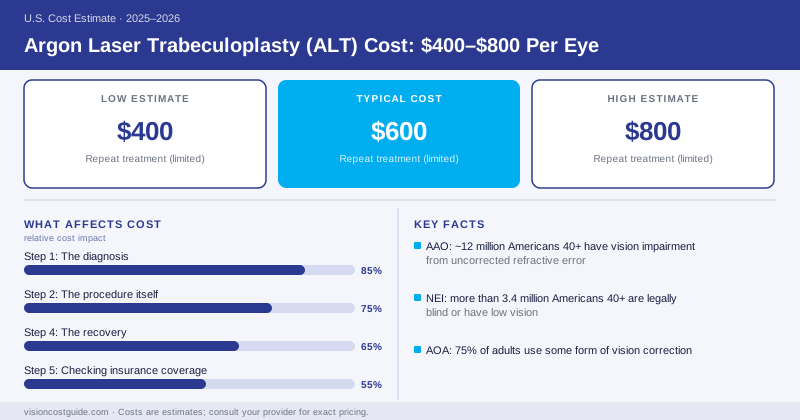
ALT costs $400–$800 per eye and works well for controlling glaucoma pressure, but because it can typically only be repeated once or twice over a lifetime, most ophthalmologists now recommend the newer SLT procedure instead for patients who are candidates for either — SLT can be repeated many more times without losing effectiveness.
Step 5: Checking insurance coverage. ALT is billed as a medical procedure treating a documented glaucoma diagnosis, and Medicare and most commercial insurance plans cover it with standard coinsurance. Expect a copay in the $40–$150 range rather than the full cash price.
Step 6: Weighing ALT against continuing eye drops. Glaucoma medications run $30–$150 a month per drug, and many patients need two or more simultaneously. A single ALT treatment can reduce or eliminate drop dependence for one to five years, which often makes financial sense even at the full cash-pay price — though the newer SLT procedure typically offers the same benefit with more room for future retreatment.
Step 7: Knowing when ALT is still the right call. Despite SLT’s advantages, ALT remains a reasonable option in certain cases — for example, in eyes with heavily pigmented drainage tissue where ALT’s mechanism may work more predictably, or in situations where SLT equipment isn’t available. Your ophthalmologist will factor in your specific eye anatomy and glaucoma severity before recommending one over the other.
ALT lowers pressure gradually, and its effect can wear off over several years even in eyes that respond well initially. Don’t skip follow-up pressure checks after treatment — declining effectiveness isn’t always something you’ll notice on your own, since glaucoma typically causes no symptoms until significant vision loss has already occurred.
Bottom Line
ALT costs $400–$800 per eye and remains an effective glaucoma treatment option, though its limited number of repeat treatments has made the newer SLT procedure the more commonly recommended choice for most patients today. Ask your ophthalmologist which laser is the better fit for your specific eye anatomy.