Marcus, 34, was quoted $4,200 for LASIK to permanently correct the astigmatism that had kept him in glasses since sixth grade. He’d assumed astigmatism was somehow harder or more expensive to fix surgically than ordinary nearsightedness. It isn’t — modern laser platforms treat astigmatism as a standard, routine part of the correction, not an add-on charge at most practices.
Astigmatism — an irregularly shaped cornea (or sometimes lens) that causes blurred or distorted vision at all distances rather than just up close or far away — affects roughly 1 in 3 Americans according to figures cited by the American Optometric Association, making it one of the most common refractive conditions treated surgically.
Surgical Options and Costs
| Procedure | Best For | Typical Cost (Both Eyes) |
|---|---|---|
| LASIK | Most astigmatism up to about 6 diopters, adequate corneal thickness | $3,800-$6,000 |
| PRK | Similar range to LASIK, thinner corneas or higher-risk lifestyles | $3,600-$5,500 |
| SMILE | Lower-to-moderate astigmatism, select platforms | $4,000-$6,500 |
| Toric intraocular lens (IOL) with cataract surgery | Astigmatism + cataracts, usually 60+ | $1,500-$3,500 extra per eye above standard cataract surgery |
| Toric IOL without cataracts (refractive lens exchange) | High astigmatism, presbyopia, LASIK-ineligible | $4,500-$6,500 per eye |
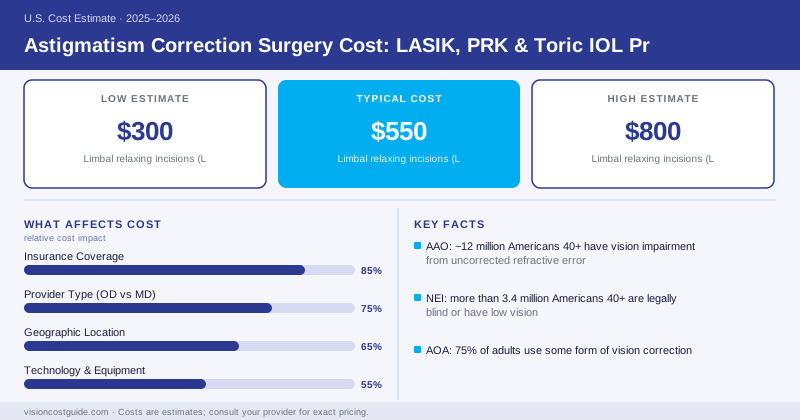
| Limbal relaxing incisions (LRI) | Adjunct to cataract surgery, mild astigmatism | $300-$800 per eye add-on |
Why Astigmatism Doesn’t Usually Cost Extra With LASIK or PRK
A common misconception is that correcting astigmatism requires a specialized, more expensive laser procedure compared to correcting simple nearsightedness or farsightedness. In reality, essentially all modern excimer laser platforms used for LASIK and PRK are designed to treat astigmatism as a standard part of the ablation profile — the surgeon simply programs your specific astigmatism axis and magnitude into the same procedure. Most LASIK practices quote a single flat price regardless of whether your prescription includes astigmatism, within the treatable range of the platform.
When Astigmatism Pushes You Toward a Different Procedure
Higher degrees of astigmatism (generally above 5-6 diopters), irregular astigmatism (from conditions like keratoconus), or insufficient corneal thickness can make someone a poor candidate for LASIK specifically. In these cases:
PRK remains an option since it doesn’t require the same tissue removal for a corneal flap, making it viable for somewhat thinner corneas.
Toric intraocular lens implants — either combined with cataract surgery or as a standalone refractive lens exchange — correct astigmatism by replacing the eye’s natural lens with a lens that has built-in astigmatism correction, sidestepping corneal thickness limitations entirely. This is a more invasive, more expensive route than laser correction, generally considered only for higher prescriptions, LASIK-ineligible corneas, or patients who also have (or are approaching) cataracts.
If you’re already having cataract surgery and also have meaningful astigmatism, upgrading to a toric IOL (versus a standard non-toric lens) typically adds $1,500-$3,500 per eye above the baseline cataract surgery cost, since toric IOLs aren’t usually covered by Medicare or insurance beyond the standard lens allowance — astigmatism correction is considered a refractive upgrade, not medically necessary. For patients with significant astigmatism who want to minimize dependence on glasses after cataract surgery, this is frequently a worthwhile out-of-pocket investment, but it’s an elective add-on cost worth budgeting for separately from the covered portion of surgery.
Toric Contact Lenses: The Non-Surgical Comparison Point
Before committing to surgery, it’s worth remembering that toric soft contact lenses correct astigmatism non-surgically for $300-$700/year — a much smaller ongoing cost than a one-time surgical investment, though it lacks the permanence and convenience surgery offers. The surgery-vs-contacts math typically favors surgery over a roughly 5-8 year timeline for most patients, assuming stable prescriptions and good candidacy.
Insurance Coverage
Elective refractive surgery for astigmatism — LASIK, PRK, SMILE, and refractive lens exchange without cataracts — is not covered by vision or medical insurance in the vast majority of cases, since it’s considered elective rather than medically necessary. The exception is the base cataract surgery cost when a toric IOL is used to also correct astigmatism in a patient who needs cataract surgery regardless — the cataract portion is covered, while the toric lens upgrade itself is typically an out-of-pocket add-on.
Get a thorough corneal topography and pachymetry (thickness) evaluation before committing to LASIK for astigmatism correction — irregular or unusually thin corneas can be a sign of early keratoconus, a condition where LASIK is contraindicated and can worsen outcomes significantly. A reputable surgeon will screen carefully for this before recommending laser surgery.
Bottom Line
Don’t expect to pay a premium for astigmatism correction with standard LASIK or PRK — it’s typically included in the base price. The real cost decision point is whether your prescription and corneal anatomy keep you in laser-correction territory or push you toward the considerably more expensive toric lens implant route.