How much does it actually cost to learn Braille as an adult who’s losing vision later in life? The honest answer: for most people, close to nothing — if they know which door to knock on first.
Fewer than 10% of blind Americans currently read Braille, according to figures widely cited by the National Federation of the Blind, down from a much higher rate decades ago before large-print and audio technology became common. That literacy gap isn’t primarily a cost problem — free options exist — it’s an awareness and access problem.
Free and Low-Cost Braille Training Paths
| Option | Typical Cost | Best For |
|---|---|---|
| Hadley Institute Braille correspondence course | Free | Adults, self-paced home study |
| State vocational rehabilitation Braille instruction | Free-low cost | Working-age adults with vision loss |
| School district Braille instruction (TVI-taught) | Free | Children (IDEA-mandated) |
| Local library or nonprofit group classes | Free-$50 | Any age, community setting |
| Private Braille tutor | $40-$100/hour | Faster, individualized pace |
| Intensive residential training center program | $500-$2,500+ (often grant-funded) | Adults needing comprehensive skills |
| Braille books/materials (embossed) | $20-$100 per title | Ongoing, some libraries loan free |
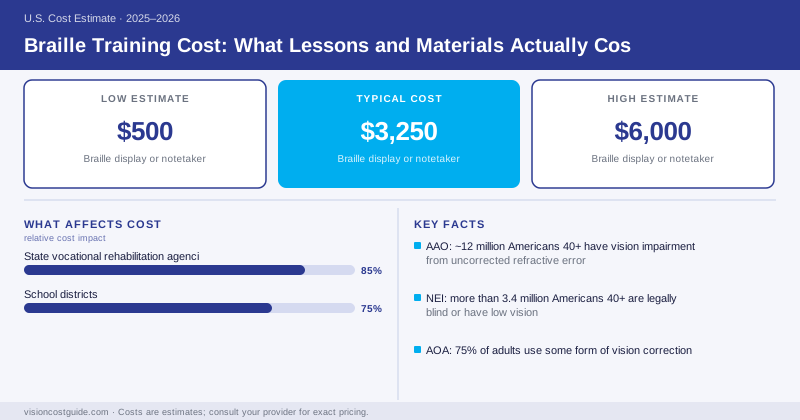
| Braille display or notetaker device | $500-$6,000 | Optional, not required to learn |
Why the Free Options Cover Most People
Three separate funding structures exist specifically to remove cost as a barrier to Braille literacy:
Hadley Institute for the Blind and Visually Impaired offers free, self-paced correspondence courses in Braille (and dozens of other independent living topics) by mail or online, to any legally blind adult in the U.S., at no cost whatsoever. This is the single most accessible starting point for adults.
State vocational rehabilitation agencies fund Braille instruction as part of comprehensive rehabilitation services for working-age adults pursuing employment goals, similar to how they fund orientation and mobility training.
School districts are legally required under the Individuals with Disabilities Education Act (IDEA) to provide Braille instruction to blind and visually impaired students through a Teacher of the Visually Impaired (TVI), at no cost to families, when Braille is determined appropriate for the student.
When Private Tutoring Makes Sense
Private Braille tutors, charging $40-$100/hour, become worthwhile when someone needs faster progress than a self-paced course allows — for example, an adult who lost vision suddenly and needs functional reading skills quickly for work, or a student needing supplemental instruction beyond what the school provides. A private tutor can typically get someone to basic contracted Braille (Grade 2) functional literacy faster than a correspondence course, though total hours needed varies enormously by learner.
Grade 1 Braille is letter-by-letter, uncontracted — slower to read but faster to learn. Grade 2 Braille uses contractions (single characters standing in for common letter combinations like “th” or whole words like “and”) and is what most fluent Braille readers use, since it’s roughly 20% more compact. Most training programs teach Grade 1 basics first, then move to Grade 2 contractions over subsequent months. If your goal is simply labeling household items or reading short notes, Grade 1 alone may be sufficient and faster to acquire — ask your instructor to clarify which track fits your goals before committing to a longer program.
Materials Cost More Than People Expect
Embossed Braille books are physically larger and more expensive to produce than print books — a single novel can run several volumes and $50-$150. The National Library Service for the Blind and Print Disabled, run through the Library of Congress, loans Braille and audio books completely free to eligible patrons, including postage both ways — this is the resource most Braille readers rely on rather than purchasing books outright.
Braille Technology: Optional, Not Required
You do not need a Braille display, notetaker, or embosser to learn Braille — paper and a slate-and-stylus or Perkins Brailler ($200-$700) are sufficient for learning and are what most instructional programs use initially. Electronic Braille displays ($500-$6,000) are a later-stage purchase for people who want to pair Braille output with screen readers and computers, not a prerequisite for literacy.
Be cautious of any private company charging premium rates for “certified” Braille training without directing you first toward Hadley Institute or your state’s blindness services agency. A responsible instructor or program will always mention these free resources upfront, even if they also offer paid services.
Bottom Line
Start with Hadley Institute’s free correspondence course or a call to your state’s vocational rehabilitation agency before paying for anything. For most learners, cost is not the barrier standing between them and Braille literacy.