Your vision in one eye suddenly looks like you’re peering through a smudged bubble, straight lines bend, and colors seem dim — but there’s no pain. If you’re a stressed-out guy in your 30s or 40s, there’s a decent chance it’s central serous retinopathy, or CSR. The AAO notes it most commonly hits men aged 30 to 50, and stress and steroid use are the big triggers.
Here’s the upside: a lot of CSR resolves on its own. Here’s the catch: the workup and persistent cases still cost real money.
What’s Actually Happening
In CSR, fluid leaks and collects under the central retina (the macula), lifting it like a tiny blister and blurring your central vision. It’s not bleeding and it’s not the same as wet macular degeneration — though the symptoms can feel similar, which is exactly why you need imaging to tell them apart.
Diagnostic Costs
You need a retina specialist and imaging to confirm CSR and rule out scarier causes.
| Diagnostic Step | Cost Without Insurance |
|---|---|
| Retina specialist visit | $250–$450 |
| OCT (retinal cross-section scan) | $75–$200 |
| Fluorescein angiography | $300–$600 |
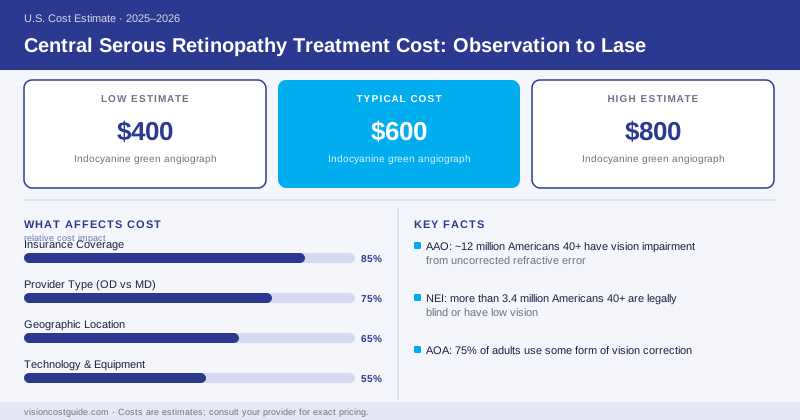
| Indocyanine green angiography | $400–$800 |
OCT is the workhorse here — it’s how your doctor measures the fluid and tracks whether it’s clearing. Expect repeat OCT scans at each monitoring visit.
The “Watch and Wait” Phase
Because most acute CSR resolves within 3–6 months per the AAO, the standard first move is observation, not a procedure.
CSR is one of the few retinal conditions where doing less is usually the right call. The cheapest, most effective treatment is often removing the trigger — stopping unnecessary corticosteroids and dialing down stress — then monitoring with periodic OCT scans. That observation phase runs $300–$800 over a few months. Procedures like laser or photodynamic therapy are reserved for cases that don’t clear, so don’t be surprised or disappointed if your specialist recommends watching rather than treating right away.
The biggest “treatment” is often free: if you’re taking corticosteroids for something else, stopping them (under your prescriber’s guidance) frequently fixes the problem on its own.
When CSR Persists: Treatment Costs
If fluid hasn’t cleared after about four months, or you have chronic recurrent CSR, active treatment comes into play.
| Treatment | Cost Without Insurance |
|---|---|
| Focal laser photocoagulation | $1,500–$3,000 |
| Photodynamic therapy (PDT) with verteporfin | $3,000–$6,000 |
| Micropulse laser | $2,000–$4,000 |
| Oral eplerenone/spironolactone (off-label) | $20–$100/month |
Photodynamic therapy is often the preferred option for chronic CSR, but the verteporfin drug itself is pricey, which drives the higher end of the range. With insurance, your out-of-pocket on a procedure typically lands at $500–$1,500 after deductible.
Don’t ignore CSR just because it’s painless and “usually goes away.” Chronic or repeatedly recurring CSR can permanently thin and damage the macula, leaving you with lasting central blur even after the fluid clears. And if your blur is from wet macular degeneration or a retinal vein occlusion instead of CSR, the treatment is completely different and time-sensitive. Get any new central distortion imaged promptly rather than assuming it’s just stress.
How to Keep Costs Down
Three moves save money. First, get an accurate diagnosis early so you’re not treating the wrong condition. Second, if you’re on corticosteroids, talk to your prescriber — stopping them may end the problem for free. Third, since CSR bills to medical insurance and not your vision insurance, confirm your retina specialist is in-network before the workup. A baseline eye exam with OCT also gives your doctor a comparison image if CSR ever recurs.
Bottom Line
Most CSR cases cost just $300–$800 in monitoring while they resolve on their own over a few months. Persistent or chronic cases needing focal laser or photodynamic therapy run $2,000–$6,000, mostly covered by medical insurance. Since the AAO reports most acute cases clear within 3–6 months, the smartest spend is often a good workup plus removing the trigger — not rushing into a procedure.
Frequently Asked Questions
Often, yes. The AAO notes most acute central serous retinopathy (CSR) cases resolve within 3–6 months without treatment, which is why observation is the standard first step. During that window you're mainly paying for monitoring visits and OCT scans — roughly $300–$800 — rather than active treatment. Persistent or recurrent cases beyond about four months are the ones that need laser or photodynamic therapy.
Yes, as a medical condition billed to medical insurance, not your vision plan. Monitoring visits, OCT imaging, fluorescein angiography, and procedures like laser or PDT are covered under your medical deductible and coinsurance. Vision plans like VSP don't pay for CSR care. Out-of-pocket costs vary widely depending on whether you just monitor or need a procedure.
Fluid builds up under the retina, and the strongest known risk factor is corticosteroid use — pills, inhalers, creams, even nasal sprays. Stress and 'type A' personalities are classically linked too. The AAO notes CSR most often affects men aged 30–50. Stopping unnecessary steroids is frequently the single most effective and cheapest treatment.