The most common treatment for central serous retinopathy costs exactly $0 — because roughly 80-90% of cases resolve entirely on their own within a few months, according to figures widely cited in retina specialist literature. That’s not a reason to skip the doctor, though. It’s a reason to understand what you’re actually paying for when you go.
Central serous retinopathy (CSR, also called central serous chorioretinopathy) causes fluid to leak and accumulate under the retina’s central area, distorting or dimming vision — often described as things looking smaller, dimmer, or curved. It’s strongly associated with stress and corticosteroid use, and it disproportionately affects men in their 30s-50s with high-stress lifestyles or Type A personality traits.
Treatment Costs by Approach
| Approach | When Used | Typical Cost |
|---|---|---|
| Watchful waiting + monitoring visits | First-line for most acute cases | $150-$400 per follow-up OCT visit |
| Corticosteroid discontinuation | If steroids are the trigger | $0 (requires physician coordination) |
| Oral eplerenone | Persistent cases, off-label use | $10-$40/month (generic) |
| Focal laser photocoagulation | Chronic cases with identifiable leak point | $1,500-$3,000 |
| Photodynamic therapy (PDT) | Chronic/recurrent cases, diffuse leakage | $3,000-$6,000 |
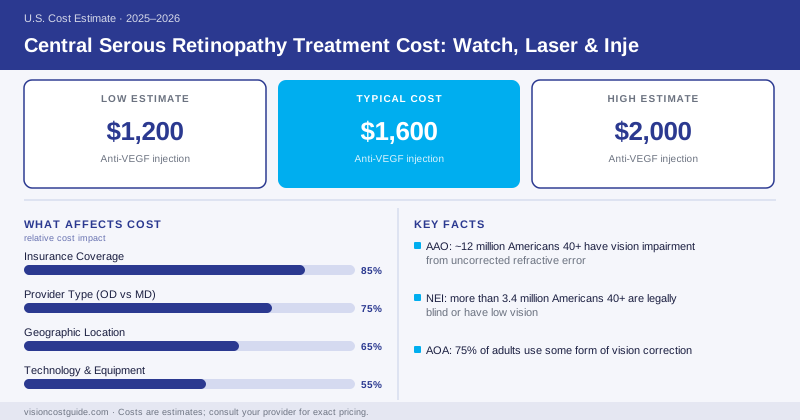
| Anti-VEGF injection | Occasionally used off-label, less common | $1,200-$2,000/injection |
Why “Do Nothing” Is Often the Correct Medical Advice
For a first, acute episode of central serous retinopathy, the standard of care is genuinely watchful waiting — regular monitoring visits with OCT imaging every 4-6 weeks to confirm the fluid is resolving, without any active intervention. This isn’t a doctor being dismissive; it reflects the well-documented natural history of the disease, where the majority of cases self-resolve within 1-6 months as the underlying stress response subsides.
The cost during this period is limited to monitoring visits — typically $150-$400 per OCT check-in — rather than any treatment itself.
Removing the Trigger: Often the Real “Treatment”
Corticosteroid use — oral, inhaled, topical, or even intra-articular steroid injections — is one of the strongest known triggers for CSR. If a patient is on steroids for an unrelated condition (like allergies, an autoimmune flare, or joint pain), coordinating with the prescribing doctor to reduce or discontinue steroids, when medically feasible, is frequently the single most effective intervention — and it costs nothing beyond the coordination itself.
Unlike most eye conditions, central serous retinopathy has a genuinely strong, well-documented link to psychological stress and Type A personality patterns, likely mediated through cortisol’s effect on the choroid’s blood vessels. While “reduce stress” sounds like vague advice, retina specialists take this seriously enough that stress reduction is frequently included as an explicit part of the treatment plan alongside monitoring — and case reports of CSR recurrence often trace back to a new high-stress period in the patient’s life. This costs nothing but is not a throwaway recommendation.
When Active Treatment Becomes Necessary
If fluid doesn’t resolve within 3-4 months, recurs frequently, or threatens central vision significantly, active treatment options come into play:
Focal laser photocoagulation ($1,500-$3,000) targets a specific, identifiable leak point seen on imaging, sealing it directly. This works well when there’s a single clear leak away from the very center of vision.
Photodynamic therapy ($3,000-$6,000) uses a light-activated drug to treat broader or more centrally-located leakage patterns that aren’t good candidates for focal laser, and has become the preferred treatment for chronic or recurrent CSR in many retina practices.
Oral eplerenone, a generic blood pressure medication used off-label, has shown benefit in some clinical studies for persistent CSR and costs a modest $10-$40/month — a much cheaper trial option some specialists try before proceeding to laser or PDT.
Insurance Coverage
Central serous retinopathy diagnosis and treatment are covered under medical insurance as a retinal disease, not a refractive or vision-plan matter. Monitoring OCT visits, laser treatment, and PDT are typically covered with standard specialist copays and coinsurance, though PDT may require prior authorization given its higher cost.
Don’t ignore new central vision distortion or dimming just because CSR is often self-resolving — the same symptoms can indicate other, more serious retinal conditions like a macular hole or wet age-related macular degeneration that need prompt treatment. Get an OCT-based diagnosis from a retina specialist before assuming it’s CSR and simply waiting it out on your own.
Bottom Line
For most patients, the first months of central serous retinopathy cost only the price of a couple of monitoring visits. Active treatment enters the picture — and the budget — only for the minority of cases that don’t resolve on their own.