Most patients assume a $20 online pair of glasses and a $300 pair from the optical shop are basically the same product with a markup. That’s half right. The lenses can carry the identical prescription — but the fit, the measurements, and the service behind them are not the same thing at all. Whether cheap online glasses are worth it comes down entirely to your prescription and how forgiving your eyes are.
Here’s how to tell which camp you’re in.
The Price Gap Is Real — and So Is the Quality Gap
The Vision Council reports the average American spends about $242 per pair of eyeglasses at a traditional shop. Online, a complete single-vision pair starts around $20. That’s not a typo. So where does the extra $220 go in person? Frame selection, an optician’s fitting, in-person adjustments, and a remake guarantee if something’s off.
| Buying Channel | Typical Complete Pair | Best For |
|---|---|---|
| Budget online (Zenni, EyeBuyDirect) | $20–$60 | Simple single-vision, backup pairs |
| Mid online (Warby Parker) | $95–$145 | Single-vision, basic progressives |
| Optical shop / optometrist | $200–$400+ | Complex Rx, high astigmatism, first progressives |
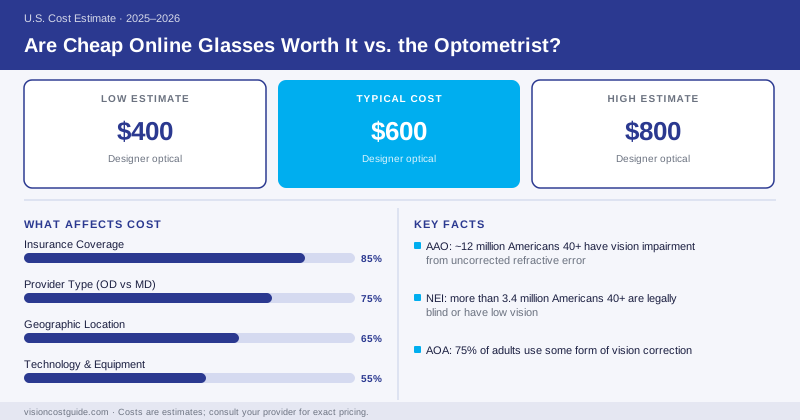
| Designer optical | $400–$800+ | Premium frames, full service |
For a straightforward prescription, the cheap pair genuinely competes on optical quality. The savings are real and the risk is low. For a tricky prescription, that’s where the math flips.
When Cheap Online Glasses Are a Smart Buy
Buy online with confidence when your situation is simple:
- Single-vision lenses with a mild-to-moderate prescription
- You want an affordable backup pair or prescription sunglasses
- Your prescription is stable and you’ve worn glasses for years
- You know your accurate pupillary distance
Pupillary distance (PD) tells the lab where to center each lens over your pupil. A shop measures it during fitting; online, you’re on your own. An error of just 2–3 mm can cause eye strain or headaches, and the effect gets worse as the prescription gets stronger. Ask your optometrist to print your PD on the prescription, or measure carefully against a ruler in a mirror. This single number matters more than the frame you pick.
When You Should Pay for the Optometrist
The in-person route earns its price in specific cases. Strong astigmatism, high prescriptions, and especially progressive lenses all depend on precise fitting measurements that are hard to nail yourself. Progressives also need an accurate fitting height, not just PD — get it wrong and the reading zone sits in the wrong spot.
First-time progressive wearers, in particular, benefit from an optician who can troubleshoot adaptation problems and remake the lenses if needed. A $50 online progressive that you can’t adapt to isn’t a bargain — it’s $50 you spend again somewhere else.
Buying glasses online is not a substitute for an eye exam. The AOA recommends a comprehensive eye exam every one to two years because exams detect glaucoma, diabetic retinopathy, and other serious conditions long before you notice symptoms. You still need a valid, unexpired prescription to order — and skipping the exam to save money can let a treatable disease go undetected. Get the exam, then decide where to buy the glasses.
The Smart Hybrid Approach
You don’t have to pick one lane. A lot of savvy shoppers do this: get the comprehensive exam at an optometrist, ask for the prescription and the PD in writing (you’re legally entitled to your prescription), then buy a complex primary pair in person and a cheap online backup. Best of both worlds.
If cost is the main concern, it’s worth reading how to get cheap eyeglasses for ways to cut the price in either channel, and online glasses vs. in-store cost for a deeper side-by-side.
Frequently Asked Questions
So are cheap online glasses worth it? For a simple prescription and a backup pair, absolutely — you’re getting comparable optics for a fraction of the $242 average. For high prescriptions, strong astigmatism, or your first progressives, the optometrist’s fitting and remake guarantee usually justify the higher price.
The mistake to avoid is treating the online order as a way to skip eye care altogether. Get the exam on the AOA’s recommended one-to-two-year schedule, capture your PD and prescription in writing, and then let the complexity of your lenses decide where you buy. Simple eyes, buy cheap. Complicated eyes, pay for the hands-on service. Either way, the exam comes first.
Frequently Asked Questions
For simple single-vision prescriptions, yes — most reputable online labs (Zenni, EyeBuyDirect, Warby Parker) cut lenses to the same ANSI tolerances as an optical shop. Accuracy problems creep in with high prescriptions, strong astigmatism, and progressives, where a slightly wrong pupillary distance or fitting height throws off the optics. The cheaper the pair, the more it matters that your measurements are exact.
You can order, but you shouldn't skip the exam. You need a valid prescription, and U.S. eye prescriptions typically expire after one to two years. The AOA recommends a comprehensive eye exam every one to two years for most adults because exams catch glaucoma, diabetic changes, and other conditions long before symptoms appear. The exam isn't just for the prescription — it's a health screening.
Pupillary distance (PD) is the millimeter measurement between the centers of your pupils, and it tells the lab where to place the optical center of each lens. Get it wrong by even 2–3 mm and you can get eye strain or headaches, especially in higher prescriptions. Optical shops measure PD as part of the fitting; online buyers must measure it themselves or request it from their prescriber.
Progressives are the riskiest lens to buy cheaply online because they need an accurate fitting height plus PD, and a poor measurement can leave the reading zone in the wrong spot. Some people adapt fine to a $50 online progressive; others struggle and end up rebuying. If you're new to progressives, a first in-person fitting is usually worth the extra cost.
A complete online pair runs $20–$95 versus a Vision Council–reported U.S. average of $242 per pair at brick-and-mortar shops. For a backup pair or a simple prescription, the savings are real and the quality gap is small. For complex lenses, the gap in adaptation and remakes can eat the savings.
An optician can adjust nose pads and temple arms to your face, troubleshoot a prescription that doesn't feel right, verify lens quality in person, and stand behind a remake. Online sellers offer return windows, but you handle fit yourself. For anyone with a tricky fit, a strong prescription, or a history of adaptation problems, that hands-on service has real value.