That box of contacts you reorder every few months has a hidden expiration date — and it’s not on the lenses. It’s on your prescription. Most states cap contact lens prescriptions at one to two years, and once yours lapses, no retailer can legally sell you lenses until you renew. The renewal exam that unlocks the next year typically runs $60 to $200. Here’s why it exists and what drives the price.
A contact prescription is more than a vision number — it includes the lens brand, base curve, and diameter, all of which the doctor must re-verify against your eyes. That’s why you can’t just rubber-stamp a renewal online.
Renewal Exam Cost Breakdown
The price depends on your lens type, your location, and whether insurance applies.
| Lens Type | Renewal Exam Cost | With Insurance |
|---|---|---|
| Standard soft (spherical) | $60–$150 | $0–$40 copay |
| Toric (astigmatism) | $90–$200 | $20–$60 copay |
| Multifocal (presbyopia) | $100–$200 | $20–$60 copay |
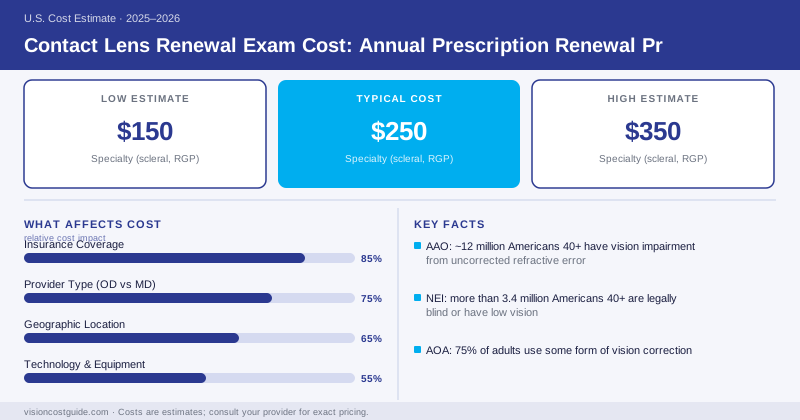
| Specialty (scleral, RGP) | $150–$350 | Varies widely |
Standard renewals sit at the low end; specialty lenses cost more because they require extra measurements and follow-up. This visit overlaps heavily with a routine contact lens exam — in practice, a renewal is the same evaluation done annually to keep your prescription current.
What the Renewal Actually Checks
The doctor isn’t just rechecking your vision. They’re confirming the lens still fits, your cornea is healthy after a year of wear, and there’s no early sign of problems like neovascularization (new blood-vessel growth from low oxygen). The American Optometric Association recommends annual eye exams for contact wearers specifically because lenses can mask developing issues. A full eye exam often happens at the same visit.
Plan on a contact lens renewal exam every one to two years, costing $60–$200 (or a $0–$60 copay with insurance). It’s legally required to keep buying lenses — and it’s the checkpoint that catches eye-health problems contacts can hide.
Why You Can’t Skip It
Two reasons, one legal and one medical. Legally, federal and state rules require a valid, unexpired prescription to buy contacts anywhere in the U.S., online included. Medically, the renewal exists because contacts sit directly on your eye for thousands of hours a year — small problems can develop quietly. The CDC notes improper contact use contributes to roughly 1 million eye-infection-related medical visits annually, and the renewal exam is one of the main ways those issues get caught early.
How Renewal Differs From an Initial Fitting
If you’ve worn the same lens for years, your renewal is usually quick and cheaper than your first-ever fitting. A new wearer or someone switching lens types needs a full fitting with trial lenses and a follow-up, which costs more.
| Visit Type | Typical Cost |
|---|---|
| Renewal (same lens) | $60–$150 |
| New fitting / lens change | $100–$250 |
| Specialty fitting | $150–$400 |
How to Save on the Renewal
Use your vision plan’s exam benefit — most cover a routine exam with a small copay and add the contact evaluation for $0–$60; our vision insurance cost guide breaks that down. Warehouse-club optometrists often charge less, frequently $60–$90. And if you have an FSA or HSA, the exam is an eligible expense you can pay with pre-tax dollars.
Don’t buy from any seller that lets you reorder on an expired prescription — it’s illegal, and it skips the health check your eyes need. An expired prescription can hide a fit or health problem that’s cheap to catch now and costly to ignore.
Bottom Line
Budget $60–$200 for a contact lens renewal exam every one to two years, or a $0–$60 copay with insurance. It’s required by law and worth it medically — the visit keeps your prescription valid and confirms your eyes are handling a year of lens wear safely. Use your vision benefit or a warehouse-club optometrist to keep the cost low.
Frequently Asked Questions
A renewal exam costs $60–$200 depending on lens type and location, with insured patients paying $0–$60 in copays. Specialty lens renewals cost more.
Contact lens prescriptions are valid for one to two years in most states, after which a renewal exam is legally required to keep buying lenses.
No. Federal and state law require an in-person evaluation to renew, since the doctor must confirm the lenses still fit and your eyes remain healthy.