After your mid-40s, the menu shrinks, the phone moves farther from your face, and you start to wonder why everyone prints things so small. That’s presbyopia — and the National Eye Institute notes it eventually affects essentially everyone as the eye’s lens stiffens. The fix you might not know about: contacts that correct near and distance vision at once. Here’s what those multifocal lenses cost across the major brands.
Multifocal contacts blend multiple focal zones into one lens so you can read a menu and see across the room without swapping glasses. They cost more than single-vision lenses, but the brand spread is wide.
Multifocal Contact Costs by Brand
Like every contact category, monthlies undercut dailies on annual price.
| Brand (Multifocal) | Modality | Annual Cost (both eyes) |
|---|---|---|
| Biofinity Multifocal | Monthly | $320–$550 |
| Air Optix plus HydraGlyde Multifocal | Monthly | $360–$560 |
| Acuvue Oasys Multifocal | 2-week | $400–$650 |
| Clariti 1 day Multifocal | Daily | $550–$800 |
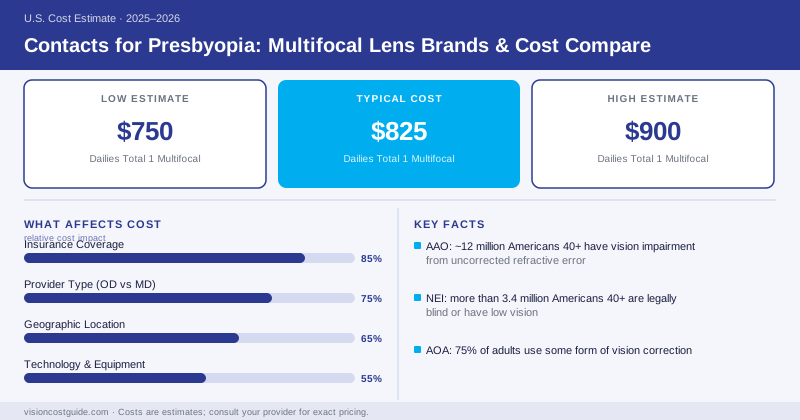
| Dailies Total 1 Multifocal | Daily | $750–$900 |
Monthly multifocals are the value tier; daily multifocals cost more for the no-cleaning convenience. If you’re new to the whole category, our overview of multifocal contacts covers how they work in more depth.
Why Multifocals Cost More
A single-vision lens has one power. A multifocal layers concentric rings of near and distance power, which the brain learns to sort out. That added complexity raises the price 30–50% over the same brand’s standard lens — and it raises the fitting difficulty too.
Multifocal contacts for presbyopia run $300–$900 a year. Monthly options (Biofinity, Air Optix) are the budget choice at $320–$560. Expect an adaptation period of a week or two as your eyes learn the lens — and a longer, pricier fitting to get the add power right.
The Fitting Is More Involved
Multifocal fittings take more chair time because the doctor fine-tunes the “add” power for your reading needs and may try several designs before one clicks. Budget $150–$300 for the contact lens exam plus multifocal fitting — toward the high end of contact fittings. The American Optometric Association recommends a comprehensive exam in this age range anyway, since presbyopia often arrives alongside other age-related eye changes.
Multifocal Contacts vs. Reading Glasses
Here’s the honest trade-off. Multifocals give you glasses-free convenience but ask your brain to adapt, and fine print may look slightly softer than it would through dedicated readers.
| Option | Annual Cost | Trade-Off |
|---|---|---|
| Multifocal contacts | $300–$900 | Convenience; slight adaptation |
| Reading glasses + distance contacts | $250–$600 | Cheaper; juggling two corrections |
| Progressive eyeglasses | $200–$700 | No contacts; switch on/off |
If you’d rather pair single-vision contacts with readers, compare against our eyeglasses cost guide to see which combo costs less for your routine.
Insurance and Saving
Your vision plan’s $130–$200 contact allowance applies to multifocals like any other lens — our vision insurance cost guide shows the net. Buy annual supplies online or at warehouse clubs, and watch for rebates returning $80–$250.
Give multifocals a real adaptation window before judging them, but don’t push through genuine discomfort or persistent blur — that’s a fitting issue to bring back to your doctor, not something to tolerate. The CDC links poor contact habits to roughly 1 million eye-infection-related medical visits a year.
Bottom Line
Presbyopia contacts cost $300–$900 a year. Monthly multifocals from Biofinity and Air Optix are the value leaders; daily multifocals cost more for convenience. Budget for a thorough fitting, use your vision benefit, buy in bulk, and give your eyes a couple of weeks to adapt before you decide.
Frequently Asked Questions
Multifocal contacts run $300–$900 a year by brand and modality. Monthly multifocals are cheapest at $320–$550; daily multifocals reach $700–$900.
Monthly multifocals like Biofinity Multifocal and Air Optix Multifocal are the most affordable at roughly $320–$560 a year.
Many wearers adapt well, but multifocals trade a little sharpness for glasses-free convenience. The American Optometric Association recommends a fitting to dial in the right add power.