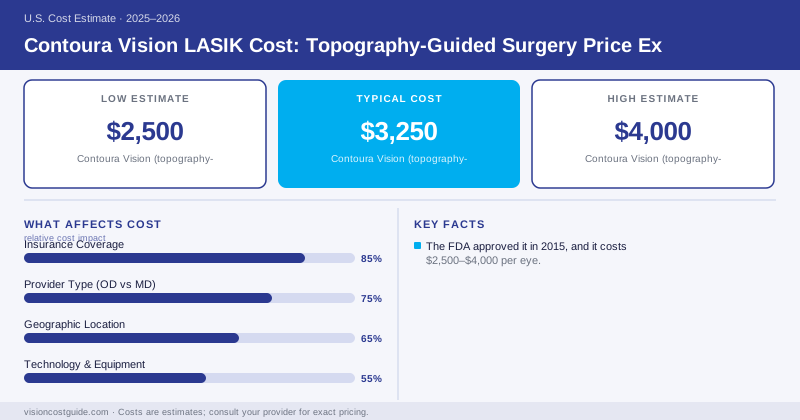
The $3,200 quote for Contoura LASIK isn’t a markup gimmick — here’s what the extra few hundred dollars over standard LASIK actually buys. Contoura Vision is topography-guided LASIK, which maps thousands of points across your cornea and treats its unique shape, not just your glasses prescription. The FDA approved it in 2015, and it costs $2,500–$4,000 per eye.
If standard LASIK corrects your prescription, Contoura aims to correct your prescription plus your cornea’s individual irregularities.
Contoura LASIK Cost
| LASIK Type | Cost Per Eye | Both Eyes |
|---|---|---|
| Conventional / standard LASIK | $2,000–$3,000 | $4,000–$6,000 |
| Wavefront-guided LASIK | $2,200–$3,500 | $4,400–$7,000 |
| Contoura Vision (topography-guided) | $2,500–$4,000 | $5,000–$8,000 |
Contoura typically runs $200–$700 more per eye than conventional LASIK. You’re paying for the topographic mapping technology and the more detailed treatment plan it generates.
How Contoura Differs
Standard LASIK treats based on your refraction — the numbers from your glasses prescription. Contoura adds a topographer that measures up to 22,000 elevation points across your cornea, capturing tiny irregularities a prescription alone misses. The laser then sculpts a treatment tailored to your actual corneal surface.
The pitch is sharper, higher-quality vision — not just “20/20,” but potentially better contrast and reduced night-vision aberrations. Some patients end up seeing better than they ever did in glasses.
Contoura’s FDA approval study produced standout numbers: a large majority of treated eyes reached 20/20 or better, and a meaningful share achieved 20/16 — sharper than “perfect” 20/20. Patient-reported outcomes for night-driving glare and light sensitivity also improved in many cases. If your goal is the crispest possible result and you have the budget, topography-guided treatment is one of the more evidence-backed premium LASIK upgrades.
Who Benefits Most from Contoura
The upgrade tends to pay off for:
- Patients with mild corneal irregularities that conventional LASIK wouldn’t address
- People bothered by night glare or halos in their current glasses or contacts
- Anyone chasing maximum visual quality rather than just functional vision
- Higher prescriptions where small corneal irregularities have a bigger visual impact
For a simple, low prescription with a perfectly regular cornea, conventional LASIK may deliver an equally good result for less money.
Contoura is not a fix for everyone, and it’s not the same as treating keratoconus or severe irregularity — those conditions often disqualify you from LASIK entirely and require different procedures. Make sure your candidacy exam screens your corneal thickness and shape. A surgeon pushing Contoura on a borderline-thin cornea is a red flag; the safer route there is often PRK.
Contoura vs. Wavefront vs. PRK
These premium LASIK flavors confuse people. The short version:
- Contoura (topography-guided) — maps the corneal surface; great for surface irregularities and visual quality
- Wavefront-guided — maps the eye’s full optical system including internal aberrations
- PRK — surface treatment without a flap, the choice for thin corneas regardless of mapping technology
Some surgeons combine approaches. Ask which your eyes specifically call for.
Paying for Contoura
As elective surgery, Contoura isn’t covered by insurance. HSA and FSA dollars apply pre-tax, and nearly every LASIK center offers CareCredit financing with interest-free promotional periods. If you’re still deciding whether laser vision correction is worth the spend at all, our analysis of whether LASIK pays off runs the numbers.
Bottom Line
Contoura Vision LASIK costs $2,500–$4,000 per eye — a modest premium over standard LASIK for a treatment built around your cornea’s individual shape. Its FDA trial results back up the promise of sharp, high-quality vision. If you want the best possible outcome and you’re a good candidate, it’s one of the more justifiable LASIK upgrades on the market.
Frequently Asked Questions
Contoura Vision topography-guided LASIK costs $2,500–$4,000 per eye, typically $200–$700 more per eye than conventional LASIK.
It can be. In FDA trials, a notable share of Contoura patients achieved 20/20 or better vision, and many saw 20/16 or sharper, thanks to its detailed corneal mapping.
No. Like all LASIK, Contoura is elective and not covered by insurance, though HSA and FSA funds and financing can be used.