Most patients learn they need a cornea transplant after months of progressive vision loss — keratoconus getting worse, Fuchs’ dystrophy clouding their central vision, a corneal scar that won’t resolve. By the time it’s on the table, surgery isn’t elective anymore. So the cost question becomes: what’s this actually going to cost me, and will insurance cover it?
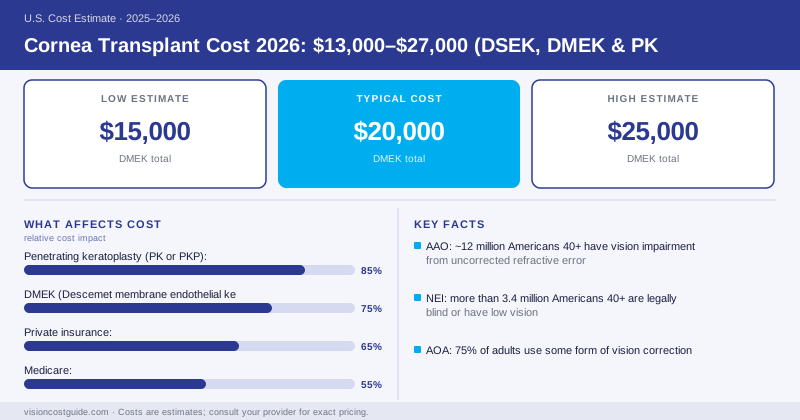
Short answer: $13,000–$27,000 total, and yes — Medicare and most private insurance cover cornea transplants as medically necessary procedures.
The Three Main Types of Cornea Transplant
The type of transplant matters a lot for both cost and recovery. Not all cornea diseases require replacing the entire cornea.
Penetrating keratoplasty (PK or PKP): The full-thickness transplant. A circular button of the entire cornea — all five layers — is removed and replaced with donor tissue. Used for deep scarring, advanced keratoconus with hydrops, or conditions affecting the full corneal thickness. Longest recovery (12–18 months), highest astigmatism risk, but applicable to a wider range of diagnoses.
DSEK (Descemet’s stripping endothelial keratoplasty): Replaces only the back two layers of the cornea — the Descemet membrane and endothelium. Used for Fuchs’ dystrophy and endothelial failure. Faster recovery (3–6 months), less surgically induced astigmatism, but technically demanding. The graft can partially or fully detach in the early postoperative period, sometimes requiring repositioning.
DMEK (Descemet membrane endothelial keratoplasty): Even thinner than DSEK — just the Descemet membrane and endothelium, with no stromal tissue. Fastest visual recovery, lowest rejection rate, best visual outcomes for Fuchs’ — but technically the most challenging to perform. Not every center offers it.
Full Cost Breakdown
| Cost Component | Typical Range | Notes |
|---|---|---|
| Surgeon fee | $2,000–$5,000 | Varies by procedure type; DMEK commands premium |
| Anesthesia | $1,000–$2,500 | General or IV sedation depending on patient/surgeon preference |
| Facility fee (hospital or ASC) | $5,000–$10,000 | Hospital ORs cost more than ambulatory surgery centers |
| Donor cornea tissue fee | $3,500–$7,000 | Set by eye banks; includes processing, testing, shipping |
| Preoperative workup | $300–$600 | Specular microscopy, corneal topography, pachymetry |
| PK (full-thickness) total | $14,000–$27,000 | Higher facility and surgical complexity |
| DSEK total | $13,000–$22,000 | Most widely performed endothelial transplant |
| DMEK total | $15,000–$25,000 | Premium for technical complexity; lower rejection rate |
| Antirejection drops (year 1) | $600–$2,400 | Topical corticosteroids, often indefinitely tapered |
| Follow-up visits (year 1) | $800–$2,500 | 8–12 visits standard for monitoring |
Donor Tissue: Where That $3,500–$7,000 Goes
The donor cornea fee surprises many patients. It doesn’t go to the donor’s family — corneal tissue donation is always non-compensated in the U.S. The fee covers the eye bank’s costs: screening the donor for transmissible diseases, processing and culturing the tissue, evaluating endothelial cell density, overnight shipping to the surgical center, and maintaining the infrastructure that makes safe tissue available within 24–48 hours of surgery scheduling.
The Eye Bank Association of America reports that approximately 85,000 corneal transplants are performed in the U.S. each year, making it one of the most commonly performed tissue transplants. Domestic tissue is almost always readily available — wait times are short compared to solid organ transplants.
The acronym RSVP covers the four classic corneal graft rejection symptoms:
- Redness that develops suddenly
- Sensitivity to light
- Vision decrease (blurring that’s new or worsening)
- Pain
If any of these develop, call your surgeon the same day — not tomorrow. Early treatment of a rejection episode with intensive corticosteroid drops can reverse it in most cases. Waiting even 24–48 hours significantly worsens outcomes. The AAO recommends lifelong awareness of rejection symptoms, not just in the first year.
Insurance and Medicare Coverage
Cornea transplants are covered by medical insurance — not vision insurance. This is an important distinction. Your vision plan (VSP, EyeMed, etc.) won’t cover this. Your medical plan will.
Private insurance: Most plans cover keratoplasty with prior authorization. Common diagnoses that qualify include keratoconus (H18.6x), Fuchs’ endothelial dystrophy (H18.51), and bullous keratopathy (H18.1x). Out-of-pocket costs depend on your deductible and out-of-pocket maximum — most patients pay $1,500–$5,000 with decent commercial coverage.
Medicare: Covers surgeon fee, facility, anesthesia, and donor tissue under Part B. After the Part B deductible ($257), you pay 20% of the Medicare-approved amounts. A Medigap supplement eliminates most of that 20%.
Uninsured: The full sticker price of $13,000–$27,000. Some academic medical centers have financial assistance programs — ask the billing department before assuming you’re stuck with full price.
Cornea transplant is a medical insurance claim, not a vision insurance claim. If you file with your vision plan, it’ll be denied. Make sure your surgeon’s billing team files under medical benefits, specifically under the appropriate keratoplasty CPT codes (65750 for PKP, 65756 for DSEK, 65757 for DMEK). Misrouting to vision benefits is a common billing error that can delay payment for months.
Recovery Timeline and What It Costs
Recovery is where the total cost picture gets more complete. The surgery itself is one bill — but the year-plus afterward adds up.
Months 1–3: Weekly to biweekly visits, aggressive steroid drops, possible suture adjustments for PK. Expect $500–$1,500 in visit co-pays and $150–$400/month in medications.
Months 3–12: Monthly visits, tapered steroids. Vision continues improving. $300–$600 in visit costs, $50–$150/month in continuing drops.
Year 2+: Biannual visits, minimal ongoing medication for most DMEK/DSEK patients. PK patients with retained sutures may need additional suture removal procedures.
DMEK patients typically see functional vision (20/20–20/40) within 3 months. PK patients often wait 12–18 months and need spectacle or rigid contact lens correction during that period while the cornea stabilizes.
The Bottom Line
A cornea transplant costs $13,000–$27,000 all-in. Medicare and private medical insurance cover it. The donor tissue fee ($3,500–$7,000) is a legitimately large component — and it reflects the eye bank infrastructure that makes safe, tested tissue available quickly rather than after months on a waiting list.
If you have Fuchs’ dystrophy, keratoconus, or a corneal scar affecting your central vision, and your specialist recommends transplant, don’t let the price be the deciding factor before you’ve checked your insurance coverage. For most insured patients, out-of-pocket costs are $1,500–$5,000 — for surgery that can restore vision from legal blindness to 20/25.
Cost estimates based on AAO clinical data on corneal transplantation, Eye Bank Association of America statistics on U.S. keratoplasty volume (~85,000 annually), and Medicare reimbursement schedules. Actual out-of-pocket costs depend on insurance plan, surgical technique, and facility type.
Frequently Asked Questions
Yes. Medicare Part B covers cornea transplants (keratoplasty) as a medically necessary procedure. You'll pay the Part B deductible ($257 in 2026) plus 20% coinsurance after it's met. The surgeon's fee, facility fee, and donor tissue processing fee are all coverable under Part B. Medicare Advantage plans typically mirror this coverage but may require prior authorization. Out-of-pocket costs for Medicare beneficiaries generally range from $1,000 to $3,500 depending on your supplemental coverage.
Recovery varies significantly by transplant type. Full-thickness PK transplants require 12–18 months to stabilize vision, with sutures that stay in 1–2 years. DSEK and DMEK partial-thickness transplants recover faster — 3–6 months for vision to stabilize. Recovery costs include frequent follow-up visits (typically 8–12 in the first year at $100–$250 each), antirejection eye drops ($50–$200/month for 1–2 years), and potential suture adjustment or removal procedures ($300–$600 each). Total recovery-year expenses add $2,000–$5,000 beyond the surgery itself.
Corneal graft rejection occurs in about 10–20% of cases depending on the transplant type and underlying diagnosis, according to the AAO. Most rejection episodes are reversible with aggressive topical corticosteroid treatment if caught early — which is why lifelong vigilance for rejection symptoms (sudden redness, light sensitivity, decreased vision, pain) is essential. Treating a rejection episode costs $500–$2,000 in emergency visits and intensified medications. A failed graft requiring retransplantation adds the full surgical cost again. DMEK grafts have lower rejection rates than PK, which is one reason partial-thickness techniques have become preferred when anatomically appropriate.