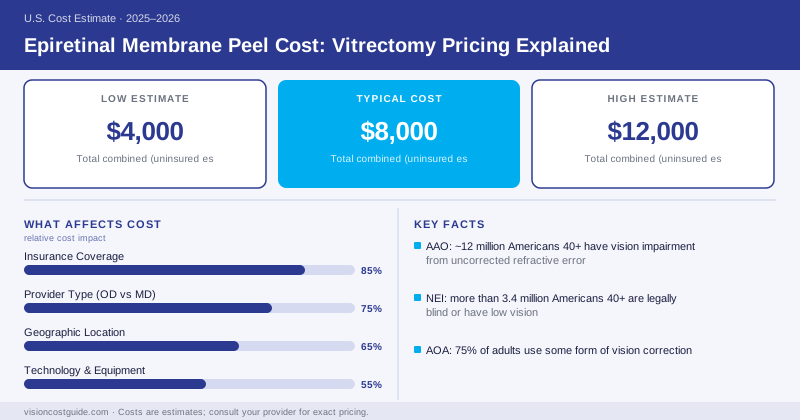
In the early stages, an epiretinal membrane might cost you nothing at all beyond an annual monitoring visit. Once vision distortion becomes significant, that same condition can mean a $4,000-$12,000 surgical bill. The gap between those two numbers is entirely about timing and severity — not about which doctor you choose.
An epiretinal membrane (sometimes called macular pucker or cellophane maculopathy) is a thin layer of scar tissue that forms on the retina’s surface, contracting over time and wrinkling the macula underneath it — causing blurred or distorted central vision, straight lines appearing wavy, and sometimes double vision in one eye.
What Actually Makes Up the Surgical Bill
| Component | Typical Cost | Notes |
|---|---|---|
| Monitoring visits (pre-surgery) | $150-$400/visit | OCT imaging included |
| Surgeon’s fee (vitrectomy + membrane peel) | $1,800-$4,500 | Varies by region, complexity |
| Ambulatory surgery center or hospital facility fee | $1,500-$5,000 | Often the largest single line item |
| Anesthesia fee | $400-$1,200 | Local with sedation, typically |
| Post-op visits (included in global period usually) | Included or $0-$150 each | 90-day global period standard |
| Total combined (uninsured estimate) | $4,000-$12,000 | Wide range reflects facility variation |
Why the Facility Fee Often Costs More Than the Surgeon
Unlike many outpatient procedures where the physician’s fee dominates the bill, epiretinal membrane peel surgery — a form of vitrectomy performed under an operating microscope with specialized instrumentation — often has a facility fee that rivals or exceeds the surgeon’s fee itself. This is because vitrectomy requires a fully equipped operating room or ambulatory surgery center, sterile vitreoretinal instrument sets, and a longer procedure time (typically 30-60 minutes) than simpler eye procedures. Where the surgery is performed — a hospital-based OR versus a dedicated ambulatory surgery center — is one of the biggest cost variables patients can actually influence by asking their surgeon about options.
Why Many Cases Don’t Need Surgery at All
Not every epiretinal membrane requires treatment. Mild membranes causing minimal or no symptoms are typically just monitored with periodic OCT imaging ($150-$400 per visit) rather than treated surgically, since surgery carries real risks (cataract formation, retinal detachment, infection) that aren’t worth taking for a membrane that isn’t meaningfully affecting vision.
Retina specialists generally recommend surgery only once a membrane is causing functionally significant symptoms — typically when visual acuity has dropped to a level that interferes with reading, driving, or daily tasks, or when metamorphopsia (visual distortion, like straight lines appearing bent) is bothersome enough to affect quality of life. There’s no fixed acuity number that automatically triggers surgery; it’s a discussion between patient and surgeon about how much the distortion is actually affecting daily function versus the risks of the procedure itself. This means two patients with visually identical OCT scans might reasonably make different decisions about surgery timing.
What the Surgery Involves
The procedure combines a pars plana vitrectomy (removing the gel-like vitreous from the eye) with a membrane peel (using microsurgical forceps to gently grasp and peel the scar tissue off the retinal surface). It’s typically done under local anesthesia with sedation rather than general anesthesia, as an outpatient procedure. Surgeons frequently perform a cataract-preventing step or address cataracts simultaneously, since vitrectomy accelerates cataract formation in nearly all patients within a few years.
Insurance Coverage
Epiretinal membrane peel surgery is a medically necessary retinal procedure, not cosmetic, and is covered by medical insurance including Medicare when documented vision impairment justifies the surgery. Expect standard surgical cost-sharing: your deductible, then coinsurance (commonly 20% under Medicare Part B and many private plans) applied across the surgeon’s fee, facility fee, and anesthesia separately — meaning your out-of-pocket total depends heavily on where you are in your annual deductible.
Recovery and Follow-Up Costs
Most patients heal over several weeks, with vision improvement continuing gradually over months — full visual recovery timelines vary and not everyone regains 20/20 vision, though most patients see meaningful improvement in distortion and clarity. Post-operative visits during the standard 90-day global surgical period are typically included in the original surgical fee rather than billed separately.
Get a second opinion from a retina specialist before committing to surgery for a mildly symptomatic membrane — since surgical risks (retinal detachment, cataract progression, infection) are real, and many membranes remain stable for years without meaningfully worsening. Surgery timing should be driven by your actual functional symptoms, not fear of a delayed decision.
Bottom Line
Ask your surgeon directly where the procedure will be performed and get separate estimates for the surgeon, facility, and anesthesia fees — the facility choice alone can shift your total bill by thousands of dollars.