Does episcleritis actually need treatment at all? For most people, no — the majority of cases resolve completely on their own within 1-3 weeks, with or without any medication, making the true cost of episcleritis for most patients exactly $0 beyond the initial diagnostic visit that rules out its more serious cousin.
Episcleritis is inflammation of the episclera — a thin layer of tissue between the conjunctiva and the sclera — causing a localized red patch, mild discomfort, and sometimes tearing, but typically without the severe pain, vision changes, or systemic disease associations that make scleritis a much bigger deal.
Cost Comparison: Episcleritis vs. What It Gets Confused With
| Condition | Typical Treatment | Typical Cost |
|---|---|---|
| Episcleritis (mild, self-limited) | Observation, artificial tears | $0-$15 |
| Episcleritis (nodular or recurrent) | Topical NSAID or mild steroid drops | $30-$80 |
| Diagnostic visit (ruling out scleritis) | Eye exam | $100-$250 |
| Episcleritis with systemic association (10-15% of cases) | Additional bloodwork if recurrent | $200-$600 |
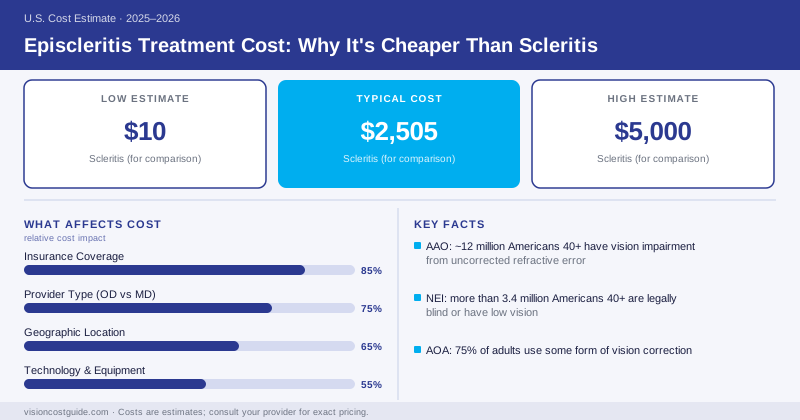
| Scleritis (for comparison) | Oral NSAIDs, steroids, sometimes immunosuppressants | $10-$5,000+/month |
The Critical First Step: Confirming It’s Not Scleritis
Because episcleritis and scleritis look similar to an untrained eye — both cause redness in the white of the eye — but require completely different treatment approaches and carry very different risk profiles, the single most valuable thing your eye doctor does at the initial visit ($100-$250) is distinguish between the two. The distinguishing exam finding: episcleritis blanches (turns pale/white temporarily) when a drop of phenylephrine is applied, while scleritis does not, since the deeper scleral blood vessels aren’t affected by the topical vasoconstrictor. Pain character matters too — episcleritis is typically mild and doesn’t wake patients at night, while scleritis pain is classically severe and boring.
Getting this distinction right at the first visit prevents both under-treating a dangerous scleritis case and over-treating a benign episcleritis case.
Why Most Cases Need Nothing More Than Time
Simple episcleritis — the more common form, presenting as a diffuse redness in one area of the eye — typically resolves on its own within 1 to 3 weeks without any specific treatment. Cold compresses and preservative-free artificial tears ($6-$15) can improve comfort during this window but don’t meaningfully speed resolution; they’re comfort measures, not curative treatment.
A less common subtype, nodular episcleritis, presents as a distinct raised bump rather than diffuse redness, tends to be more uncomfortable, and takes somewhat longer to resolve — sometimes several weeks to a couple of months. For this subtype, or for recurrent simple episcleritis, a topical NSAID drop or a short course of a mild topical steroid can meaningfully speed resolution and improve comfort, at a modest cost of $30-$80. This is still far short of scleritis-level treatment, but a reasonable step up from pure observation.
When Episcleritis Signals Something Else
While roughly 70% of episcleritis cases are idiopathic (no identifiable cause) and isolated, an estimated 10-15% are associated with an underlying systemic condition such as rheumatoid arthritis, inflammatory bowel disease, or gout — generally a smaller proportion than the systemic associations seen with scleritis, but still worth investigating in cases that recur frequently or are accompanied by joint pain, gastrointestinal symptoms, or other systemic signs. Recurrent episcleritis warrants a conversation with your doctor about basic bloodwork, adding $200-$600 to the cost of an otherwise inexpensive condition.
Insurance Coverage
The initial diagnostic visit and any prescribed drops are covered under standard medical insurance benefits at your normal specialist copay. Given how inexpensive episcleritis treatment typically is in absolute dollar terms, insurance coverage is a relatively minor factor in the overall cost picture compared to conditions like scleritis.
If eye redness is accompanied by significant pain (not mild irritation), vision changes, or light sensitivity, don’t assume it’s episcleritis and wait it out — get evaluated. These features point toward scleritis or another more serious condition that needs different, prompter treatment.
Bottom Line
Episcleritis is, in almost every practical sense, the “cheap” inflammatory eye condition — most cases need nothing but time. The value in seeing a doctor is confirming it isn’t scleritis, which is a genuinely different and more expensive problem wearing a similar-looking disguise.