In 2022, the FDA approved the EVO ICL — and suddenly LASIK had a serious rival for people whose eyes LASIK can’t safely treat. The headline difference is price: EVO ICL costs $3,000–$5,000 per eye, while LASIK runs $2,000–$3,500. But cheaper upfront doesn’t always mean cheaper for your situation. For high prescriptions or thin corneas, the pricier option may be the only safe one.
Here’s how the two stack up on cost and everything that surrounds it.
EVO ICL vs. LASIK: Cost Comparison
| Procedure | Cost Per Eye | Both Eyes |
|---|---|---|
| LASIK | $2,000–$3,500 | $4,000–$7,000 |
| EVO ICL | $3,000–$5,000 | $6,000–$10,000 |
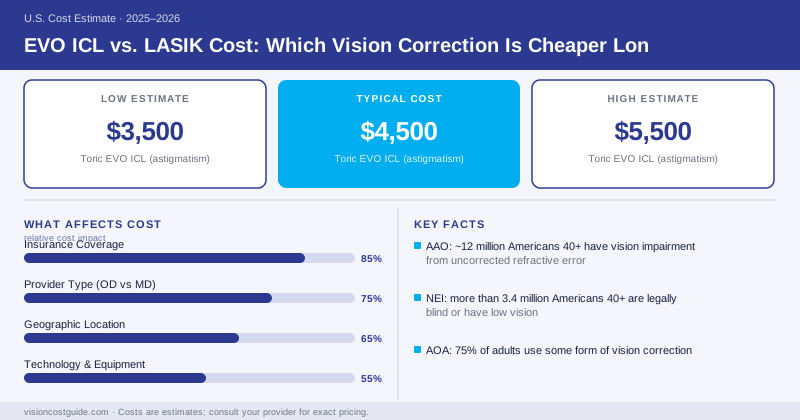
| Toric EVO ICL (astigmatism) | $3,500–$5,500 | $7,000–$11,000 |
LASIK wins on upfront price by roughly $1,000–$2,000 per eye. The EVO ICL’s higher cost reflects the implantable collamer lens itself, a manufactured medical device placed inside your eye.
The Core Difference: Reshape vs. Implant
LASIK reshapes your cornea permanently with a laser. The EVO ICL leaves your cornea untouched and instead places a soft collamer lens behind your iris, in front of your natural lens — like a permanent contact lens that lives inside the eye. The EVO version has a central port that lets fluid flow naturally, eliminating the need for the iridotomy older ICLs required.
That difference drives everything about which procedure fits whom.
The EVO ICL isn’t a luxury upgrade — it’s the right answer for specific eyes. The ASCRS and AAO recognize ICLs as the go-to option for high myopia (severe nearsightedness), thin corneas that can’t support a LASIK flap, and chronic dry eye that LASIK would worsen. ICL clinical studies report very high patient satisfaction, and because the lens is removable, it’s reversible in a way LASIK can never be. For a healthy, thick cornea with a moderate prescription, though, LASIK delivers a comparable result for less money.
When ICL Beats LASIK
Choose the EVO ICL when:
- Your prescription is very high — ICL corrects severe nearsightedness beyond LASIK’s safe range
- Your corneas are too thin for a LASIK flap, where the alternative is otherwise PRK
- You have significant dry eye — ICL doesn’t disrupt corneal nerves the way LASIK can
- You want reversibility — the lens can be removed or swapped if your vision changes
When LASIK Beats ICL
Choose LASIK when:
- Your prescription is low to moderate and your cornea is healthy and thick
- You want the lowest upfront cost
- You prefer a procedure with no implanted device and decades of long-term data
- Recovery speed matters — LASIK vision returns within a day or two
Our broader LASIK vs. PRK comparison covers the corneal-laser side, while our implantable collamer lens guide digs deeper into ICL specifics.
The ICL is intraocular surgery — the surgeon enters the eye to place the lens — so it carries a different risk profile than corneal LASIK, including small risks of cataract, elevated eye pressure, or the need for repositioning. These risks are low in modern EVO ICL with experienced surgeons, but they’re real. Choose a surgeon who performs ICL implantation regularly, and make sure your candidacy exam confirms you have adequate space inside the eye for the lens.
Long-Term Cost Considerations
Upfront, LASIK is cheaper. Over decades, both eliminate ongoing glasses and contact spending, so lifetime savings are similar — the ICL just starts from a higher base. The ICL’s removability is a hedge: if your prescription shifts substantially or you later develop cataracts, the lens can be removed and replaced, sometimes folding the correction into cataract surgery down the line.
Both are elective, so neither is insurance-covered. HSA/FSA funds and CareCredit financing apply to each.
Bottom Line
LASIK costs less upfront — $2,000–$3,500 per eye versus the EVO ICL’s $3,000–$5,000 — and it’s the efficient choice for healthy, thick corneas with moderate prescriptions. But for high prescriptions, thin corneas, or dry eyes, the EVO ICL isn’t just an alternative, it’s often the only safe option, with the bonus of being reversible. Let your candidacy exam, not the price tag alone, make the call.
Frequently Asked Questions
Yes. EVO ICL runs $3,000–$5,000 per eye versus $2,000–$3,500 for LASIK, largely because the implantable lens itself is a costly component.
Neither is universally better. ICL suits thin corneas, high prescriptions, and dry eyes; LASIK suits moderate prescriptions with healthy, thick corneas. Your eyes decide.
Yes. Unlike LASIK, which permanently reshapes the cornea, the EVO ICL can be surgically removed or replaced, which is a major advantage for some patients.