Jenny grabbed the brand-name box off the pharmacy shelf every spring for years — $24 for a small bottle that lasted about three weeks — until a pharmacist pointed out the generic version two shelves down, same active ingredient, same concentration, for $9. That’s the entire eye allergy drops cost story in miniature: the active ingredient usually matters far more than the brand on the box.
Price Comparison by Drop Type
| Drop Type | Example Brands | Typical Cost | Active Ingredient Class |
|---|---|---|---|
| Generic ketotifen (OTC) | Store-brand “allergy eye relief” | $8-$14 | Antihistamine/mast cell stabilizer |
| Brand ketotifen (OTC) | Zaditor, Alaway | $15-$24 | Antihistamine/mast cell stabilizer |
| Olopatadine 0.2% (OTC) | Pataday Once Daily | $16-$22 | Antihistamine/mast cell stabilizer |
| Olopatadine (Rx strength) | Pazeo | $80-$180 without insurance | Antihistamine/mast cell stabilizer |
| Cetirizine ophthalmic (OTC) | Zerviate | $20-$30 | Antihistamine |
| Alcaftadine (Rx) | Lastacaft | $100-$200 without insurance | Antihistamine/mast cell stabilizer |
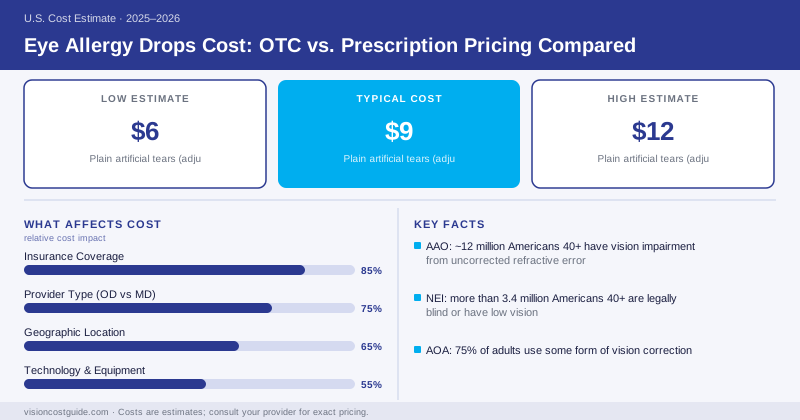
| Plain artificial tears (adjunct) | Refresh, Systane | $6-$12 | Lubricant only, no antihistamine |
Why the OTC Switch Happened — and What It Means for Your Wallet
Several eye allergy medications that once required a prescription — including olopatadine (Pataday) and ketotifen (Zaditor/Alaway) — have moved to over-the-counter status over the past decade or two, meaning the exact same active ingredient that used to cost a copay-plus-prescription-markup now sits on the shelf for $15-$24 without needing a doctor’s visit at all. This is genuinely good news for your budget: for the majority of people with typical seasonal or environmental eye allergies, an OTC drop provides equivalent relief to what used to require a prescription.
Generic vs. Brand: Where the Real Savings Are
Store-brand generic ketotifen costs roughly half of brand-name Zaditor or Alaway for the identical active ingredient at the identical concentration — the FDA requires generic ophthalmic drops to demonstrate bioequivalence to their brand counterparts. Unless a specific brand’s inactive ingredients (preservatives, base solution) cause irritation for you personally, there’s no clinical reason to pay the brand premium.
Confusingly, some prescription-strength versions of the same drug you can buy OTC — like Pazeo (a higher-concentration olopatadine) versus OTC Pataday — cost significantly more, often $80-$180 without insurance, despite being chemically similar to the cheaper OTC option. Unless your allergist or ophthalmologist has a specific clinical reason for prescribing the higher-concentration version (typically more severe or treatment-resistant allergic conjunctivitis), ask whether the OTC formulation would work just as well for your symptoms before filling an expensive prescription.
When a Prescription Actually Makes Sense
For allergic conjunctivitis severe enough that OTC options aren’t providing adequate relief, or for specific diagnoses like vernal or atopic keratoconjunctivitis (more severe, chronic forms of ocular allergy), a prescription-strength drop or a different medication class — such as a topical corticosteroid for short-term severe flares, or a topical NSAID — may be genuinely necessary and worth the higher cost. This is a smaller subset of allergy sufferers than the general seasonal-itchy-eyes population that OTC drops serve well.
Cost Per Use, Not Just Per Bottle
A bottle of eye allergy drops looks like a bigger expense than it actually is per use — most bottles (2.5-5mL) last several weeks with once or twice daily dosing, working out to well under a dollar per day even for the pricier OTC brand options, and closer to 30-50 cents per day for generic ketotifen.
Insurance Coverage
Since most effective eye allergy drops are now available OTC, insurance coverage is largely irrelevant to the cost calculation for most patients — you’re paying cash regardless. FSA and HSA funds can typically be used for OTC eye allergy drops, which is worth remembering at tax time. Prescription-strength options, when medically necessary, are typically covered by standard prescription drug benefits with a copay.
Avoid decongestant-only “redness reliever” drops (like Visine’s original formula) for allergy symptoms — they constrict blood vessels to reduce redness temporarily but don’t treat the underlying allergic reaction, and using them regularly can cause rebound redness that’s worse than your original symptoms. Choose a drop labeled specifically as an antihistamine or “allergy eye drop” instead.
Bottom Line
Start with generic OTC ketotifen or olopatadine at $8-$22 — it resolves the large majority of seasonal eye allergy symptoms. Only escalate to a prescription option if OTC drops genuinely aren’t cutting it after a fair trial.