Most people assume all glaucoma eye drops cost roughly the same, since they’re all just “eye drops” prescribed for the same disease. Wrong — and the difference isn’t small. A generic prostaglandin analog can run $10-$30/month, while a brand-name combination drop for the same patient’s glaucoma can exceed $200/month for what is, functionally, a similar level of pressure control for many patients.
Glaucoma affects an estimated 3 million Americans according to the American Academy of Ophthalmology, and daily eye drops that lower intraocular pressure (IOP) are the first-line treatment for the majority of them, taken indefinitely to prevent progressive, irreversible optic nerve damage.
Cost by Drug Class
| Drug Class | Generic Cost | Brand-Name Cost | Example Brands |
|---|---|---|---|
| Prostaglandin analogs (first-line) | $10-$30/month | $80-$180/month | Xalatan, Lumigan, Travatan Z, Zioptan |
| Beta blockers | $10-$25/month | $50-$120/month | Timoptic, Betoptic |
| Alpha agonists | $15-$35/month | $60-$150/month | Alphagan P |
| Carbonic anhydrase inhibitors | $15-$40/month | $70-$160/month | Trusopt, Azopt |
| Rho kinase inhibitors (newer class) | Limited generic availability | $150-$300/month | Rhopressa |
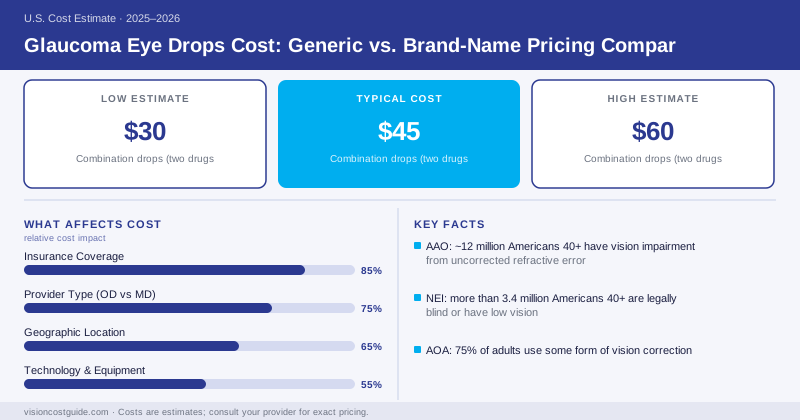
| Combination drops (two drugs in one bottle) | $30-$60/month | $150-$250/month | Combigan, Cosopt, Rocklatan |
Why Prostaglandins Are Usually Tried First
Prostaglandin analogs (latanoprost, bimatoprost, travoprost, tafluprost) are the standard first-line glaucoma medication for most patients because they lower eye pressure effectively with just one dose per day, have a well-established long-term safety record, and — critically for your budget — generic latanoprost has been available for years and costs as little as $10-$30/month at most pharmacies, sometimes less with a discount pharmacy program or manufacturer coupon.
The Combination Drop Trap
When a single medication isn’t lowering pressure enough, doctors often add a second drug rather than switching entirely. Combination drops (like Combigan, combining a beta blocker and alpha agonist, or Rocklatan, combining a prostaglandin and rho kinase inhibitor) offer the convenience of one bottle instead of two — but that convenience frequently comes at a significant premium compared to buying the two generic components separately.
If you’re prescribed a brand-name combination drop, ask your doctor and pharmacist whether the same two active ingredients are available as separate generic drops. In many cases, using two separate generic bottles — even with the minor inconvenience of two daily applications instead of one — costs a fraction of the combination brand product, sometimes $30-$50/month total versus $150-$250/month for the combination version. This is one of the single highest-leverage cost conversations you can have with your prescribing doctor.
Why the Newest Drug Class Costs the Most
Rho kinase inhibitors (netarsudil/Rhopressa, and the combination product Rocklatan) represent the newest mechanism of action approved for glaucoma in recent years, offering an option for patients who haven’t responded adequately to older drug classes. Because they’re newer to market with limited or no generic competition yet, they carry the highest price tag of the major drop categories, at $150-$300/month. These are typically reserved for patients who need an additional or alternative mechanism after first-line options haven’t achieved target pressure.
Manufacturer and Discount Programs
Because glaucoma treatment is lifelong and brand-name options can be expensive, most manufacturers offer copay assistance programs for commercially insured patients (though not typically for Medicare patients, due to federal anti-kickback rules), and pharmacy discount programs like GoodRx frequently beat insurance copays for generic glaucoma drops. Always compare your insurance copay against a GoodRx or similar discount price before assuming insurance is the cheaper path — for many generic glaucoma medications, it isn’t.
Insurance and Medicare Coverage
Glaucoma medications are covered under prescription drug benefits (Medicare Part D or commercial pharmacy benefits), with cost-sharing that varies by your plan’s formulary tier — generics are typically tier 1 (lowest copay), while newer brand-name drugs like Rhopressa or Rocklatan often sit on higher, more expensive tiers requiring prior authorization in some plans.
Never stop or skip glaucoma eye drops because of cost without talking to your doctor first. Glaucoma has no symptoms until significant, irreversible optic nerve damage has occurred, and inconsistent drop use is one of the most common reasons for treatment failure and preventable vision loss. If cost is a barrier, ask your doctor about generic alternatives, patient assistance programs, or discount pharmacy pricing before simply not filling a prescription.
Bottom Line
Ask specifically whether a generic version exists for your prescribed drop, and whether a combination product could be replaced with two cheaper generic bottles. For a lifelong daily medication, these questions can save hundreds of dollars a year without sacrificing pressure control.