What does it actually cost to treat an “eye migraine” — the shimmering, zigzag visual disturbance that sometimes shows up with no headache at all? For most people having a single, isolated episode, the honest answer is nothing. The cost conversation only really starts once episodes become frequent or a doctor needs to rule out something more serious.
“Eye migraine” is a catch-all term people use for two distinct things: a migraine with visual aura (shimmering lights, zigzag lines, blind spots preceding or accompanying a headache) and a retinal migraine (temporary vision loss in one eye, a rarer and more specifically ocular event). Both are neurological, not eye-disease-based, despite the name.
Treatment Costs by Situation
| Situation | Approach | Typical Cost |
|---|---|---|
| First-time isolated episode | Rest, wait it out | $0 |
| Confirming diagnosis (rule out retinal detachment/TIA) | Eye exam + possible neurology referral | $150-$500 |
| Occasional episodes (acute treatment) | OTC pain reliever or triptan (Rx) | $0-$40 per episode |
| Frequent episodes | Preventive daily medication (beta blocker, CGRP inhibitor) | $10-$40/month (generic) to $600+/month (CGRP) |
| Imaging to rule out other causes | MRI/CT if red flags present | $500-$3,000 (often insurance-covered) |
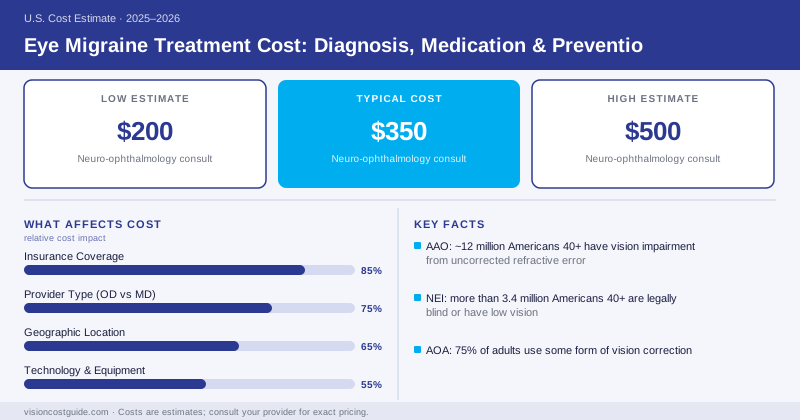
| Neuro-ophthalmology consult | Specialist evaluation for recurrent cases | $200-$500 |
Why the First Episode Usually Costs Nothing
A single, brief episode of visual aura — typically lasting 5-30 minutes, resolving completely, with no headache pain or with a mild headache following — is common enough that many people never see a doctor about it at all, and appropriately so if it happens once and fully resolves. Roughly 25-30% of people who experience migraines report visual aura at some point, and it can also occur without any headache pain whatsoever (called an “acephalgic migraine” or “silent migraine”).
When It’s Worth Paying for an Evaluation
The important exception: any new visual symptom — especially one affecting only one eye, or one that doesn’t fully resolve within an hour — deserves a prompt evaluation, because retinal migraine symptoms can closely mimic more dangerous conditions including retinal detachment, transient ischemic attack (mini-stroke), or actual stroke. An eye doctor or neurologist visit ($150-$500) to distinguish a benign migraine aura from these more serious conditions is money well spent the first time symptoms appear, particularly for anyone over 50 or with cardiovascular risk factors.
Migraine visual aura typically has a distinctive pattern: it builds gradually over several minutes (not sudden), often starts as a small shimmering or zigzag spot that slowly expands across the visual field, and affects both eyes simultaneously even though it feels like it’s happening “in front of” the eyes (because it’s generated in the brain’s visual cortex, not the eye itself). A sudden, painless curtain or shadow affecting only one eye’s vision, by contrast, is a classic warning sign of retinal detachment and needs same-day evaluation, not a wait-and-see approach. If you’re not sure which pattern you’re experiencing, treat it as urgent and get evaluated the same day.
Preventive Treatment for Frequent Episodes
If eye migraines occur frequently enough to disrupt daily life — commonly defined as 4 or more migraine days per month — a doctor may prescribe daily preventive medication. Generic options like beta blockers (propranolol) or certain anticonvulsants cost $10-$40/month and are the standard first-line approach. Newer CGRP inhibitor medications (Aimovig, Ajovy, Emgality) target migraine prevention more specifically but cost $600-$900/month without insurance, though most insurance plans now cover them for documented chronic migraine after first-line options have been tried.
Acute Treatment During an Episode
For occasional episodes, over-the-counter pain relievers manage any accompanying headache at minimal cost. Prescription triptans (sumatriptan and similar) are used for migraine pain specifically and cost $10-$40 for a generic supply with insurance, considerably more without. Notably, no medication shortens or stops the visual aura itself once it starts — treatment targets the headache pain, not the visual symptom, which resolves on its own regardless.
Seek same-day medical evaluation for any sudden vision change — flashes, floaters, a curtain or shadow, or vision loss — especially if it affects only one eye or doesn’t fully resolve within an hour. These same symptoms can indicate retinal detachment or stroke, both time-sensitive emergencies where delayed treatment for cost reasons can result in permanent vision loss.
Bottom Line
A one-time visual aura episode that fully resolves usually costs nothing to manage. Frequent episodes are worth a real workup — the diagnostic visit is inexpensive insurance against missing something more serious, and effective preventive treatment exists at both generic and premium price points.