Q: How much does eye muscle surgery cost without insurance?
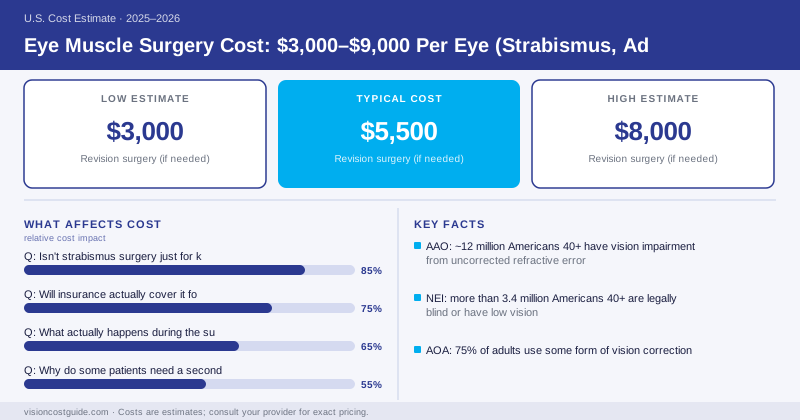
A: Expect $3,000–$9,000 per eye, depending on how many muscles need adjustment and whether it’s a first surgery or a revision.
| Cost Component | Price Range | Notes |
|---|---|---|
| Single muscle surgery (one eye) | $3,000–$6,000 | Most common for mild-to-moderate misalignment |
| Multiple muscle surgery (one eye) | $5,000–$9,000 | For larger deviations |
| Bilateral surgery (both eyes) | $6,000–$15,000 | Common when misalignment affects both eyes |
| Adjustable suture technique | +$500–$1,500 | Allows fine-tuning alignment after surgery |
| Revision surgery (if needed) | $3,000–$8,000 | Required in 10–20% of adult cases |
Q: Isn’t strabismus surgery just for kids?
A: No — that’s the most common misconception about this procedure. The American Academy of Ophthalmology notes strabismus affects roughly 4% of children in the United States, but eye misalignment can persist into adulthood, recur years after childhood surgery, or develop new in adulthood from stroke, thyroid eye disease, trauma, or nerve palsies. Adult strabismus surgery is a routine, well-established procedure — not an unusual or experimental one.
Q: Will insurance actually cover it for an adult?
A: In most cases, yes. Strabismus surgery is billed as medically necessary when it causes double vision, eye strain, abnormal head positioning to compensate, or documented functional vision problems — regardless of the patient’s age. Insurers typically require documentation of these functional symptoms rather than approving surgery for purely cosmetic misalignment concerns, though many patients have both a functional and a cosmetic motivation and the functional documentation is what unlocks coverage.
Eye muscle surgery costs $3,000–$9,000 per eye, and adult strabismus is far more common than most people assume — recurrence after childhood surgery and new-onset misalignment from medical conditions like thyroid eye disease both happen regularly. Insurance typically covers it when documented functional symptoms like double vision are present.
Q: What actually happens during the surgery?
A: The surgeon adjusts the tension of one or more of the six muscles controlling eye movement, either by moving the muscle’s attachment point on the eye (recession, to weaken the muscle) or shortening it (resection, to strengthen it). It’s performed under general or local anesthesia as an outpatient procedure, typically taking 30–90 minutes depending on how many muscles are adjusted.
Q: Why do some patients need a second surgery?
A: Eye alignment doesn’t always land perfectly on the first attempt, particularly with larger or more complex deviations. Adjustable suture techniques — where the surgeon can fine-tune muscle tension in the hours after surgery while the patient is awake — reduce, but don’t eliminate, the need for revision. Revision rates in adults run roughly 10–20%, higher than in straightforward childhood cases, since adult strabismus often involves more complex or longstanding misalignment patterns.
Q: What’s recovery like?
A: Most patients experience redness and mild discomfort for 1–2 weeks, with full stabilization of the new alignment sometimes taking a few months as the eyes adapt. Double vision can temporarily worsen or shift in the days immediately after surgery before settling into the corrected position — a normal, if unsettling, part of the healing process that your surgeon should prepare you for in advance.
Q: Are there non-surgical alternatives?
A: For some cases, prism glasses can correct double vision without surgery, and Botox injections into the eye muscles offer a temporary, reversible option, particularly for recent-onset misalignment following stroke or nerve palsy where spontaneous improvement is still possible. Both cost considerably less per session ($150–$600) but require ongoing treatment rather than a single fix.
New-onset double vision or eye misalignment in an adult should always be evaluated promptly — it can be a sign of an underlying neurological or thyroid condition (like a stroke, aneurysm, or Graves’ disease) that needs its own diagnosis and treatment, not just a cosmetic eye muscle fix.
Bottom Line
At $3,000–$9,000 per eye, adult eye muscle surgery is a well-established, frequently insurance-covered procedure for correcting misalignment that causes double vision or functional strain — not just a leftover childhood condition. If you have documented symptoms, don’t assume you’re paying full cash price before you’ve actually checked.