Dana, 41, noticed her lower eyelid twitching every afternoon during a stressful work quarter. It lasted for three weeks, drove her to Google at 2 a.m. more than once, and then vanished entirely after she cut her coffee intake in half and started sleeping seven hours a night. Total cost of treatment: $0. That’s the outcome for most people with an eyelid twitch — but not everyone, and it’s worth knowing where the line is.
Cost by Cause and Severity
| Cause/Type | Treatment Approach | Typical Cost |
|---|---|---|
| Eyelid myokymia (stress, caffeine, fatigue) | Lifestyle changes, rest | $0 |
| Dry eye-related twitching | Artificial tears, lubricating drops | $10-$30 |
| Persistent myokymia (weeks+) | Eye doctor exam to rule out other causes | $100-$250 |
| Benign essential blepharospasm | Botox injections | $300-$600 per session, every 3-4 months |
| Hemifacial spasm | Botox injections or neurology referral | $300-$800 per session |
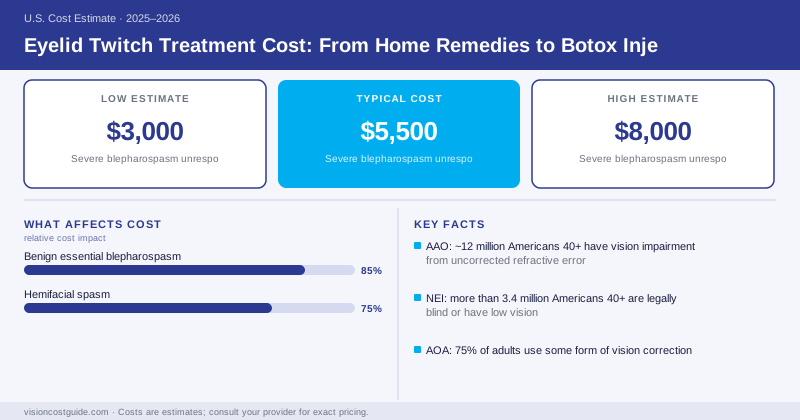
| Severe blepharospasm unresponsive to Botox | Myectomy surgery | $3,000-$8,000 |
The Twitch Most People Have Is Free to Fix
Eyelid myokymia — the common, benign eyelid twitch nearly everyone experiences at some point — is an involuntary, repetitive spasm of the orbicularis oculi muscle, typically triggered by fatigue, stress, excess caffeine or alcohol, or dry eyes. It usually affects one eyelid, comes and goes over days to weeks, and resolves completely without any medical treatment once the trigger (usually sleep deprivation or caffeine) is addressed. No prescription, procedure, or specialist fixes this faster than simply removing the trigger.
When It’s Actually Something Else
If a twitch persists for more than a few weeks, spreads beyond the eyelid to other facial muscles, or is severe enough to cause the eyelid to fully close involuntarily, it may be one of two distinct conditions rather than ordinary myokymia:
Benign essential blepharospasm is a neurological movement disorder causing involuntary, forceful eyelid closure, sometimes severe enough to functionally blind a person during episodes. It requires diagnosis by a neurologist or ophthalmologist and does not resolve with lifestyle changes.
Hemifacial spasm involves involuntary contractions on one side of the face, often starting around the eye, caused by a blood vessel compressing the facial nerve. This also requires specialist evaluation.
For both benign essential blepharospasm and hemifacial spasm, botulinum toxin injections (Botox, Xeomin, or Dysport) directly into the affected eyelid and facial muscles are the established first-line treatment — not a cosmetic afterthought. Injections cost $300-$600 per session and are repeated every 3-4 months as the effect wears off. Because these conditions are neurological rather than cosmetic, many medical insurance plans cover Botox for diagnosed blepharospasm when billed under the correct medical necessity code, unlike cosmetic Botox for wrinkles, which is never covered.
Surgery: The Option of Last Resort
For the minority of blepharospasm patients whose symptoms don’t respond adequately to Botox over time, a myectomy — surgical removal of some of the eyelid’s overactive muscle — is available. This costs $3,000-$8,000 depending on extent and surgeon, is more invasive with a longer recovery, and is reserved for cases where repeated injections have stopped providing adequate relief.
Ruling Out Dry Eye as a Hidden Cause
Chronic dry eye is an underrecognized trigger for persistent eyelid twitching, since the ocular surface irritation triggers reflexive muscle spasm. Before assuming a twitch is stress-related and waiting it out, or before pursuing specialist referral for suspected blepharospasm, a comprehensive eye exam checking for dry eye is a reasonable and inexpensive first step — often resolving the twitch with $10-$30 in artificial tears rather than more expensive interventions.
See an eye doctor or neurologist if your eyelid twitch lasts more than a few weeks, causes the eyelid to fully close, spreads to other parts of your face, or is accompanied by other facial weakness or drooping. These are signs of a condition beyond ordinary myokymia and warrant prompt evaluation rather than a wait-and-see approach.
Bottom Line
Most eyelid twitches cost nothing to resolve — cut caffeine, sleep more, treat dry eye. If it persists for weeks or worsens, the jump to Botox treatment for a diagnosed neurological cause is a legitimate, often insurance-covered next step, not an overreaction.