Most people with Fuchs’ dystrophy get their first clue in the bathroom mirror. The vision is blurry, foggy, almost waterlogged-looking — but only in the morning. By noon it’s mostly cleared up. That’s the hallmark: morning corneal edema that improves as the day goes on. It seems manageable at first. It isn’t, long-term.
Fuchs’ endothelial corneal dystrophy is the most common corneal dystrophy in the United States. The Eye Bank Association of America (EBAA) reports that Fuchs’ dystrophy is the leading indication for corneal transplantation, accounting for approximately 37% of all keratoplasty procedures performed in the U.S. annually. That’s more than 20,000 corneal transplants per year from a single condition.
The disease is progressive and there’s no cure — but the treatment landscape has changed dramatically. You have real options at every stage, and the costs vary enormously depending on where you are in the disease.
How Fuchs’ Dystrophy Progresses (and What Treatment Costs at Each Stage)
Fuchs’ dystrophy damages the endothelial cells lining the back of the cornea — the pump cells that keep the cornea clear by continuously moving fluid out of the tissue. As these cells die off (and they don’t regenerate), the cornea becomes waterlogged. The progression is slow, often over decades.
Early stage: Mild blurring on waking, improved by afternoon. Some glare. Normal daily function mostly preserved.
Middle stage: Blurring persists longer into the day. Halos around lights become significant. Driving, especially at night, becomes difficult. Reading stamina decreases.
Late stage: Constant corneal edema. Painful epithelial bullae (fluid blisters on the corneal surface). Severe vision impairment. Surgery becomes the only meaningful option.
| Treatment Stage | Cost | When It’s Used |
|---|---|---|
| Hypertonic saline drops (Muro 128 5%) | $15–$40/month | Early stage; reduces morning edema temporarily |
| Sodium chloride ointment (bedtime) | $10–$25/month | Early stage; pulls fluid out overnight |
| Glasses with anti-reflective coating | $200–$600 | All stages; reduces glare discomfort |
| Hair dryer trick (blows warm air at eye) | $0 | Early stage; speeds morning corneal dehydration |
| DSAEK (Descemet Stripping Automated Endothelial Keratoplasty) | $5,000–$13,000 | Moderate to severe; established procedure |
| DMEK (Descemet Membrane Endothelial Keratoplasty) | $6,000–$15,000 | Moderate to severe; preferred over DSAEK |
| Post-transplant immunosuppressive drops | $50–$200/month | 6–12+ months post-surgery |
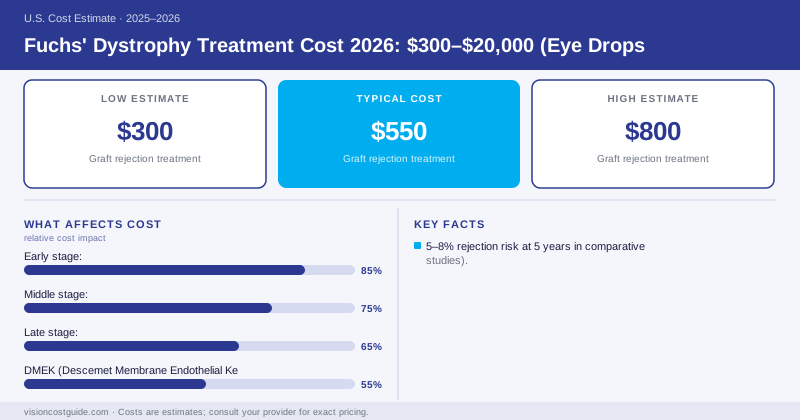
| Graft rejection treatment | $300–$800 (episode) | If rejection occurs (5–10% of cases at 5 years) |
Stage 1: Hypertonic Saline — The $30/Month Phase
Early-stage Fuchs’ management is cheap. Hypertonic saline drops (Bausch + Lomb Muro 128, or generic equivalents) draw fluid out of the swollen corneal tissue osmotically. They don’t fix anything — the endothelial cells keep dying — but they reduce morning edema enough to improve comfort and functional vision.
The standard regimen is drops 3–4 times daily plus a hypertonic ointment at bedtime. Total cost: $25–$65/month. These are over-the-counter products. No prescription required. Not covered by insurance as OTC items, but inexpensive enough that it’s rarely a hardship.
The hairdryer trick — holding a hairdryer on low heat 12–18 inches from the face for 30–60 seconds after waking — works by evaporating the surface moisture on the cornea and temporarily improving clarity. It sounds odd. Ophthalmologists routinely recommend it. It’s free.
This conservative management works well for years in many patients. It buys time, not a cure.
Early-stage Fuchs’ patients often drive safely once the morning edema clears — typically by late morning. But as the disease progresses, nighttime driving becomes dangerous well before daytime vision is severely impaired. Glare and halos from headlights and streetlights can be incapacitating. If you have Fuchs’ dystrophy, discuss driving fitness honestly with your ophthalmologist at every annual visit. Don’t wait for a scare to have that conversation.
Stage 2: Surgery — DSAEK vs. DMEK
When conservative management can no longer maintain functional vision — typically when best-corrected visual acuity drops to 20/50 or worse, or quality of life is severely impacted — endothelial keratoplasty becomes the standard of care.
The two main options are DSAEK and DMEK. Both replace only the diseased endothelial layer, not the entire cornea (that older procedure, penetrating keratoplasty or PK, is rarely used for Fuchs’ today).
DSAEK (Descemet Stripping Automated Endothelial Keratoplasty): Replaces endothelial cells plus a thin layer of donor stromal tissue. Thicker graft (~100–200 microns). Well-established with long-term outcome data going back to the mid-2000s. Visual recovery typically takes 3–6 months to reach stable correction.
DMEK (Descemet Membrane Endothelial Keratoplasty): Replaces only the Descemet membrane and endothelial layer — a tissue layer about 10–15 microns thick. Much thinner graft. Faster visual recovery (weeks to a few months for many patients). Lower rejection rate than DSAEK (approximately 1% vs. 5–8% rejection risk at 5 years in comparative studies). Technically more demanding for the surgeon.
Most corneal specialists today prefer DMEK for Fuchs’ dystrophy. The EBAA reports that DMEK now accounts for the majority of endothelial keratoplasty procedures performed in the U.S. The cost difference between the two procedures is modest given DMEK’s advantages.
What’s Included in the Surgery Cost?
The quoted price for keratoplasty typically includes:
- Surgeon fee
- Operating room and facility fee
- Anesthesia (local with sedation is standard)
- Donor cornea processing fee (the EBAA-member eye bank processes and prepares the tissue)
Not typically included: pre-operative testing, post-operative visits, and post-operative medications. These add several hundred to a few thousand dollars over the recovery period.
The donor cornea itself comes from an eye bank at no charge to patients who are uninsured or unable to pay — the Eye Bank Association of America and member banks maintain tissue availability programs. However, the surgical facility and surgeon fees still apply. If you’re uninsured and facing corneal transplant costs, ask your corneal specialist about financial assistance programs; many academic medical centers offer sliding-scale fees for essential vision-restoring procedures.
Graft Rejection: The Long-Term Risk
Corneal transplant rejection — where the immune system attacks the donor tissue — is the main long-term risk after keratoplasty. With DMEK, the 5-year rejection rate is approximately 1–3%; with DSAEK, it’s historically been higher, around 5–8%.
Rejection typically presents as sudden worsening vision, redness, light sensitivity, and pain. It’s an emergency. Prompt treatment with intensive topical steroids (prednisolone acetate every 1–2 hours for days) can reverse most rejection episodes if caught early. Cost of a rejection episode: $300–$800 in medications, plus urgent specialist visits.
If rejection isn’t reversed and the graft fails, a repeat transplant is needed. Repeat keratoplasty carries higher risks and costs — and each repeat graft is harder to succeed than the last.
The Insurance Question
Both DMEK and DSAEK for Fuchs’ dystrophy are covered by Medicare, Medicaid, and commercial insurance when the criteria are met:
- Documented Fuchs’ dystrophy diagnosis
- Best-corrected visual acuity demonstrating functional impairment (typically 20/50 or worse)
- Conservative management already attempted
Prior authorization is required. Your corneal specialist’s office should handle this — ask them specifically about documentation requirements for your insurer.
Out-of-pocket costs with Medicare: typically 20% of the Medicare-approved amount after the Part B deductible, unless you have a Medigap supplement. For working-age patients with commercial insurance, costs depend on your deductible and out-of-pocket maximum.
The Bottom Line
Fuchs’ dystrophy moves slowly, and so can your treatment. For early-stage disease, $30/month in OTC saline drops plus annual monitoring is entirely appropriate. As the disease progresses toward constant edema and functional vision loss, DMEK surgery — covered by insurance when medically necessary — offers genuinely excellent outcomes. Most patients achieve 20/25 or better vision within three to six months of a successful DMEK procedure.
Don’t wait until you can’t drive at night to discuss surgery with a corneal specialist. The best time to evaluate surgical candidacy is while you still have decent vision — so you can make a planned, informed decision rather than an emergency one.
Cost estimates based on Eye Bank Association of America annual reports, EBAA 2023 Eye Banking Statistical Report, AAO corneal dystrophy preferred practice guidelines, and published DMEK/DSAEK outcomes literature. Individual costs vary by clinic, facility type, and insurance plan.
Frequently Asked Questions
DMEK (Descemet Membrane Endothelial Keratoplasty) typically costs $6,000–$15,000 all-in, while DSAEK (Descemet Stripping Automated Endothelial Keratoplasty) runs $5,000–$13,000. The price difference is relatively small given DMEK's technical complexity — DMEK uses a paper-thin donor tissue layer and offers faster visual recovery with lower rejection risk, which is why most corneal specialists have shifted to preferring it. Both are covered by medical insurance when Fuchs' dystrophy has progressed to functional visual impairment.
Yes. Corneal transplantation for Fuchs' dystrophy is classified as medically necessary when it has caused significant visual impairment that impacts daily function. Medicare, Medicaid, and most commercial insurers cover DMEK and DSAEK for qualifying patients. Out-of-pocket costs typically include the surgeon's fee above the Medicare allowance, deductibles, and post-operative medication copays. Pre-authorization is required; your ophthalmologist will need to document best-corrected visual acuity and failure of conservative management.
After DMEK or DSAEK, patients typically need topical immunosuppressive drops (prednisolone acetate or fluorometholone) for 6–12 months to prevent rejection — these cost $50–$200/month depending on the medication and insurance. Annual follow-up visits with a corneal specialist run $200–$500 each. If rejection does occur — which happens in about 5–10% of cases over 5 years — treatment with intensive steroid drops adds $300–$800 in medication costs for the rejection episode. Most successful grafts last 15–20+ years with proper follow-up.