Marketing wants you to believe a $70 pair of amber lenses will sharpen your aim and cut your reaction time. It won’t. But gaming glasses aren’t a total scam either — for marathon sessions, the right pair genuinely eases that gritty, tired-eye feeling. You’ll spend $25 to $70 for non-prescription pairs and $120 to $250 if you need a prescription baked in.
Let’s separate the real benefit from the esports hype.
What’s actually going on with your eyes
When you game for hours, you blink less and your eyes lock onto a fixed distance. The Vision Council found that more than 80% of U.S. adults spend two-plus hours daily on screens, and a large share report dry, tired, strained eyes afterward. Gamers sit at the extreme end of that curve.
That strain — the American Optometric Association calls it digital eye strain — is what gaming glasses target. Not your kill-death ratio.
| Option | Typical Cost |
|---|---|
| Non-Rx gaming/blue-light glasses | $25–$70 |
| Single-vision Rx + AR coating | $120–$200 |
| Anti-fatigue gaming lenses | $150–$250 |
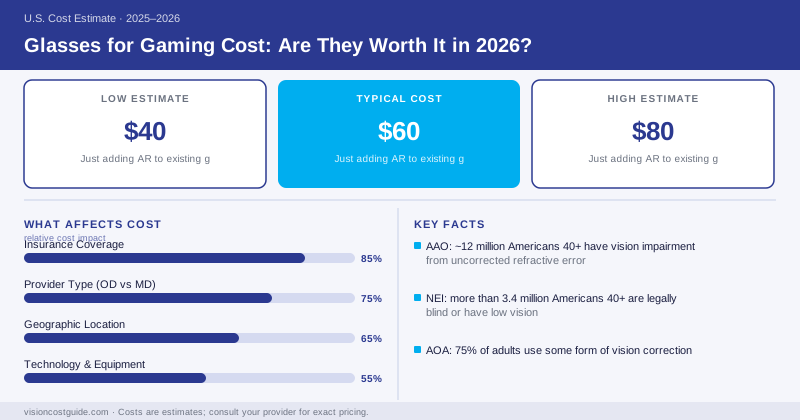
| Just adding AR to existing glasses | $40–$80 |
Gaming glasses don’t improve performance — there’s no evidence for that. What a good pair does is reduce eye fatigue during long sessions through anti-reflective coating and the correct monitor focus. For comfort, a $120 prescription pair or a $40 AR upgrade beats a $70 amber-tint gimmick.
The blue-light question
Most gaming glasses sell themselves on blue-light filtering. Be honest with your wallet here: the AOA has stated there’s not enough evidence that blue light from screens damages your eyes, and major reviews haven’t found that blue-light lenses reduce eye strain better than clear ones.
If you want the same anti-fatigue benefit, our blue-light glasses guide breaks down where the money’s better spent. The short version — pay for the coating and the focus, not the tint.
Don’t buy gaming glasses expecting a competitive advantage. No peer-reviewed study shows they improve reaction time, aim, or focus. Anyone marketing them as a performance upgrade is selling hype. Buy them for comfort during long sessions, nothing more.
If you have a prescription
This is where gaming glasses earn real value. If you already need vision correction, a single-vision pair tuned to your monitor distance — about 20 to 26 inches — keeps the whole screen crisp without your eyes straining to focus. That’s a legitimate $120 to $200 purchase.
The fix overlaps heavily with our computer vision syndrome guide, since the underlying cause is identical: long hours at a fixed near-to-intermediate distance.
Cheaper, free ways to feel better
Before you spend anything, try the 20-20-20 rule the AOA recommends: every 20 minutes, look at something 20 feet away for 20 seconds. It’s free and it works. Pair it with these:
- Update your prescription. New eyeglasses often fix “gaming fatigue” that was really just an outdated Rx.
- Get an eye exam ($50 to $200) to rule out an underlying focusing problem.
- Add AR coating to glasses you already own for $40 to $80 instead of buying a dedicated pair.
- Use FSA/HSA for any prescription lenses.
Bottom line
Gaming glasses are comfort gear, not performance gear. If you don’t need a prescription, a $40 AR upgrade or the 20-20-20 rule does most of the work for free. If you do need correction, a $120 to $200 single-vision pair tuned to your monitor is a smart buy. Either way, ignore the reaction-time claims.
Frequently Asked Questions
Non-prescription gaming glasses run $25 to $70. Prescription gaming glasses with anti-reflective coating cost $120 to $250.
There's no solid evidence they boost reaction time or aim. What they can do is reduce screen-fatigue symptoms during long sessions through anti-reflective coating and the right focal distance — comfort, not a competitive edge.
Mostly eye strain. The American Optometric Association says evidence that blue-light filtering protects your eyes is weak. The real relief comes from AR coating, correct focus for monitor distance, and taking breaks.