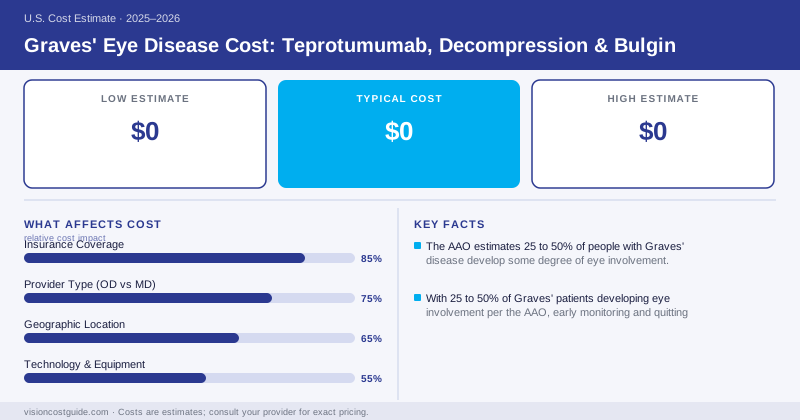
Your eyes started looking like they were bulging, you’ve got constant grittiness, maybe double vision, and you were recently diagnosed with an overactive thyroid. Those dots connect into Graves’ eye disease — the eye-specific side of the autoimmune thyroid condition. The AAO estimates 25 to 50% of people with Graves’ disease develop some degree of eye involvement.
This is the rare eye condition where treatment can range from nearly free monitoring to one of the most expensive drugs in ophthalmology. Here’s the full spread.
What Graves’ Eye Disease Does
In Graves’ eye disease (also called thyroid eye disease or Graves’ orbitopathy), the immune system inflames and expands the muscles and fat behind the eye. That swelling shoves the eyes forward (proptosis), can misalign them (double vision), and in severe cases compresses the optic nerve, threatening vision itself.
| Phase | What’s Happening | Typical Focus |
|---|---|---|
| Active/inflammatory | Swelling, redness, progression | Calm inflammation, protect vision |
| Stable/burned-out | Inflammation settled, deficits remain | Surgical rehabilitation |
That active-versus-stable distinction drives everything. You treat inflammation during the active phase and reconstruct during the stable phase.
Diagnostic and Monitoring Costs
You’ll often see both an ophthalmologist (frequently an oculoplastic specialist) and an endocrinologist.
| Diagnostic Step | Cost Without Insurance |
|---|---|
| Ophthalmologist/oculoplastic visit | $250–$500 |
| Thyroid blood panel (TSH, T3/T4, TRAb) | $150–$400 |
| Orbital CT or MRI | $1,000–$3,000 |
| Visual field and optic nerve testing | $150–$400 |
Mild, stable cases may need nothing more than monitoring plus lubricating drops, keeping costs near $500–$1,000 a year.
Medical Treatments
Graves’ eye disease has the widest cost range of almost any eye condition. A mild case might cost only a few hundred dollars a year in monitoring and artificial tears. But an active, moderate-to-severe case can qualify for teprotumumab (Tepezza), whose eight-infusion course lists at $300,000–$450,000 — making it one of the priciest drugs in all of eye care. Insurance covers it for qualifying patients with prior authorization, and copay assistance can slash out-of-pocket cost. The key driver is disease severity and whether it’s still active.
- Artificial tears and lubricating gels: $10–$50/month — first-line for mild dryness and grittiness
- Selenium supplements: $10–$20/month — modest benefit in mild active disease per some studies
- Oral or IV corticosteroids: $200–$3,000 per course — calm acute inflammation
- Teprotumumab (Tepezza): $300,000–$450,000 for the full eight-infusion course — the first FDA-approved drug for this disease, for active moderate-to-severe cases
- Orbital radiotherapy: $5,000–$15,000 — sometimes used for active inflammatory disease
Surgical Rehabilitation (Stable Phase)
Once the disease burns out, surgery corrects what the inflammation left behind. Patients often need these in a specific order: decompression first, then eye-muscle surgery, then eyelid surgery.
| Surgery | Cost Without Insurance |
|---|---|
| Orbital decompression | $15,000–$40,000 |
| Strabismus (double-vision) surgery | $8,000–$20,000 |
| Eyelid retraction repair | $4,000–$10,000 |
Orbital decompression is the big one — the surgeon removes bone to give the swollen tissue room, pulling the bulging eye back. It overlaps in complexity with the surgical care described for thyroid eye disease and other orbital conditions.
Smoking dramatically worsens Graves’ eye disease and reduces how well treatments work — quitting is the single most effective free thing you can do for your eyes here. Also, sudden vision loss, worsening double vision, or color vision changes can mean the swelling is compressing your optic nerve, which is a true emergency. Don’t wait for your next scheduled appointment; that’s an eye emergency needing same-day care to save your sight.
How to Keep Costs Down
Quit smoking — it’s free and it genuinely changes outcomes. Get your thyroid well-controlled with your endocrinologist, since stable thyroid levels help the eyes. For expensive drugs like teprotumumab, pursue prior authorization and manufacturer copay assistance early. Because all of this bills to medical insurance and not vision insurance, confirm in-network specialists. And keep up with monitoring eye exam visits so optic-nerve compression is caught before it costs you vision.
Bottom Line
Mild Graves’ eye disease may cost just $500–$1,000 a year in monitoring and lubricants. Active moderate-to-severe disease can mean a teprotumumab course listing at $300,000–$450,000, while stable-phase orbital surgery runs $15,000–$40,000. Insurance covers qualifying cases with prior authorization, and copay assistance helps. With 25 to 50% of Graves’ patients developing eye involvement per the AAO, early monitoring and quitting smoking are the cheapest, highest-impact steps you can take.
Frequently Asked Questions
Graves' disease is the autoimmune thyroid disorder; Graves' eye disease (also called Graves' orbitopathy or thyroid eye disease) is the eye-specific manifestation where the muscles and tissue behind the eye swell, causing bulging, double vision, and irritation. About 25–50% of people with Graves' disease develop eye involvement, per AAO estimates. The eye disease is managed by an ophthalmologist, often alongside an endocrinologist treating the thyroid.
Teprotumumab is the first FDA-approved drug specifically for thyroid eye disease, given as eight IV infusions over about six months. The full course commonly runs $300,000–$450,000 at list price. Insurance covers it with prior authorization for qualifying active, moderate-to-severe cases, and manufacturer copay assistance can dramatically reduce out-of-pocket cost for eligible patients.
Yes — it's a medical condition billed to medical insurance, not your vision plan. Monitoring, steroids, teprotumumab, and orbital surgery are all covered under medical benefits, though high-cost drugs and surgery require prior authorization. Out-of-pocket varies enormously depending on whether you just monitor or need infusions and surgery. Vision plans like VSP don't cover any of it.