Marcus lost his central vision to retinitis pigmentosa at 29. He’d assumed a guide dog would be his biggest expense in adapting to blindness — something in the range of a used car, maybe more. He was wrong. His dog, Scout, cost him $0 upfront. What surprised him instead were the travel costs to get to training, and the ongoing vet bills nobody mentioned at the intake interview.
That gap between assumption and reality is the whole story with guide dogs. Here’s what actually gets billed to you, and what doesn’t.
The Real Number: $40,000-$50,000 to Produce One Dog
Breeding, raising, and training a single guide dog costs an estimated $40,000-$50,000, according to figures published by major guide dog schools including Guide Dogs for the Blind and The Seeing Eye. That covers a puppy raiser’s year of socialization, professional obedience and guide-work training, veterinary care, and a multi-week residential training period where the dog is matched to its handler.
Nonprofit guide dog schools absorb essentially all of that cost. Qualified blind and visually impaired applicants typically receive a trained dog, ongoing veterinary support in many cases, and follow-up training at no charge. This isn’t a loan or subsidized rate — it’s fully donor-funded at the major U.S. schools.
What You’ll Actually Pay Out of Pocket
| Expense | Typical Cost | Who Usually Covers It |
|---|---|---|
| The dog itself (breeding + training) | $40,000-$50,000 | Nonprofit school (free to recipient) |
| Application and intake process | Free | N/A |
| On-campus training program (2-4 weeks) | Free, including room and board | School |
| Travel to training campus | $200-$800 | Applicant (some schools reimburse) |
| Ongoing food and grooming | $500-$1,000/year | Owner |
| Routine veterinary care | $300-$800/year | Owner (some schools subsidize) |
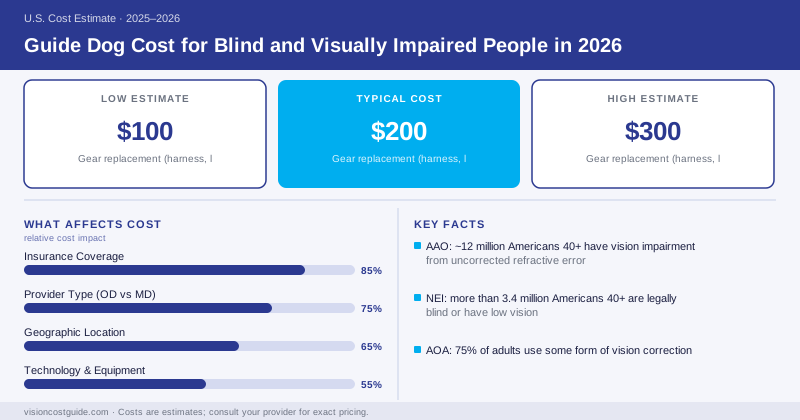
| Gear replacement (harness, leash) | $100-$300 every few years | Owner |
| Retirement care if dog stays with handler | Variable | Owner |
The National Federation of the Blind estimates more than 7 million Americans live with significant vision loss, yet only a small fraction use guide dogs — most rely on a white cane or sighted guide techniques instead, partly because a guide dog is a major lifestyle commitment, not because of cost.
Why It’s Free (and What That Means for Wait Times)
U.S. guide dog schools are structured as nonprofits funded by individual donors, corporate sponsors, and foundation grants — not government programs. That funding model is precisely why there’s no invoice for the dog itself. It’s also why demand outpaces supply: application-to-placement timelines commonly run 6 months to 2 years depending on the school, your availability, and how well your lifestyle and mobility needs match an available dog.
If you’re pursuing employment or education goals, your state vocational rehabilitation agency may help fund travel to a guide dog school, and in some cases equipment or follow-up services, as part of an Individualized Plan for Employment. This funding stream is separate from the school’s own scholarships and worth asking about even if you don’t think you qualify — VR counselors can usually tell you in one conversation.
Guide Dog vs. White Cane: The Real Cost Comparison
A white cane and orientation and mobility training costs a small fraction of what a guide dog program requires in time and lifestyle commitment, even though the cane itself is nearly free. A guide dog isn’t “better” than a cane in a cost sense — it’s a different mobility tool suited to different needs, walking paces, and environments. Many blind individuals use both: a cane at home, a dog for complex urban travel.
The Hidden Cost Nobody Mentions: Time
The biggest true cost of guide dog ownership isn’t dollars. It’s the multi-week residential training commitment, ongoing daily care responsibilities, and the emotional cost of eventual retirement or loss of a working partner after 8-10 years of service. Prospective handlers should weigh this alongside the dollar figures.
Be wary of any organization charging a substantial fee for a “guide dog” — legitimate accredited U.S. guide dog schools, all members of the International Guide Dog Federation, do not charge recipients for the dog itself. If an organization asks for thousands of dollars upfront for a working guide dog, verify its accreditation before proceeding.
Bottom Line
The dog is free. The logistics around getting one — travel, time off work, ongoing care — are the real budget line items. Start by contacting an accredited school directly; intake counselors will walk you through exactly what your specific situation will cost before you commit to anything.