Most parents assume a school vision screening is the same thing as an eye exam. It isn’t, and the gap between them can cost a child years of clear vision during exactly the window when it matters most for learning.
The American Optometric Association recommends a comprehensive eye exam at 6 months of age, again at 3 years old, and once more before starting first grade, followed by exams every one to two years through childhood. That’s a fundamentally more thorough evaluation than the vision chart most kids encounter at school, which typically only screens for distance visual acuity and misses depth perception issues, eye teaming problems, focusing difficulties, and early signs of eye disease entirely.
What a Comprehensive Kids’ Eye Exam Costs
| Exam Type | Cost Without Insurance | What’s Included |
|---|---|---|
| School vision screening | Free | Basic distance acuity chart only |
| Comprehensive pediatric eye exam | $75–$200 | Full refraction, eye health, focusing/teaming assessment |
| Comprehensive exam with dilation | $100–$250 | Adds detailed retinal/eye health evaluation |
| Follow-up exam (existing patient) | $60–$150 | Shorter visit, prescription/health recheck |
| Specialized testing (if issues found) | $100–$300 | Vision therapy evaluation, amblyopia workup, etc. |
Vision insurance, when available through a parent’s plan, typically covers a substantial portion of the comprehensive exam cost — often reducing out-of-pocket to a standard copay of $10–$40.
Why the Difference Actually Matters for Learning
Roughly 1 in 4 school-age children has an undiagnosed vision problem significant enough to affect classroom performance, according to figures commonly cited by the American Optometric Association — a number school screenings alone routinely miss because they’re designed to catch only the most obvious distance-vision problems, not the eye-teaming, focusing, and tracking skills required for sustained reading and close work. A child struggling to read isn’t always a reading problem; sometimes it’s an undiagnosed vision problem masquerading as one.
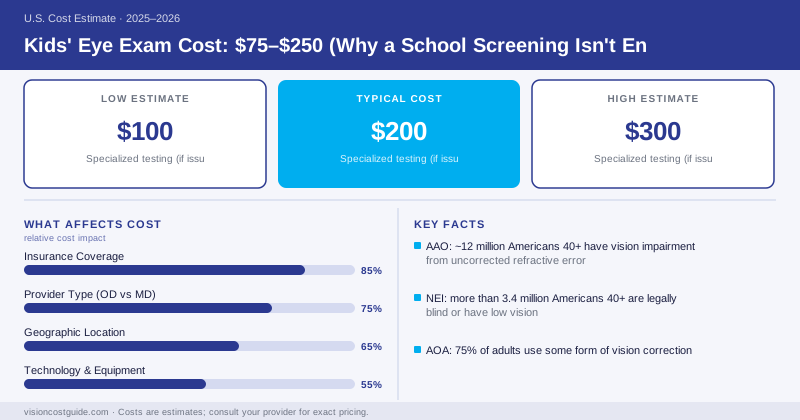
A comprehensive pediatric eye exam costs $75–$250 without insurance, and it evaluates far more than a free school screening — including eye teaming, focusing ability, and eye health, not just distance vision. If your child passed their school screening but still struggles with reading or complains of eye strain, a comprehensive exam can catch problems the screening was never designed to find.
What Gets Missed by Screenings Alone
School and pediatrician-office screenings are excellent at catching one specific thing: reduced distance visual acuity, the kind correctable with glasses for nearsightedness. What they typically don’t assess: amblyopia (lazy eye) in its early, most treatable stage, strabismus (eye misalignment), convergence insufficiency (difficulty focusing both eyes together up close), or early signs of eye disease found only through a dilated or health-focused exam. Each of these is far easier and cheaper to treat the earlier it’s caught — amblyopia in particular has a narrowing treatment window as children get older.
Insurance and Cost-Saving Options
Beyond standard vision insurance, several assistance programs exist specifically for children’s eye care. InfantSEE, a public health program supported by the optometric community, provides a free comprehensive eye assessment for infants under one year old regardless of insurance status. Many states also offer school-based vision programs or Medicaid coverage specifically targeting pediatric eye exams — worth checking with your pediatrician’s office or state health department if cost is a barrier.
When to Skip the Wait for a Scheduled Exam
Don’t wait for the next scheduled comprehensive exam if your child shows squinting, sitting unusually close to screens or books, frequent eye rubbing, head tilting, or complaints of headaches after reading. These are common signs of an underlying vision problem that a school screening likely won’t catch, and earlier evaluation generally means simpler, less expensive treatment.
Don’t rely on a passed school vision screening as confirmation that your child’s eyes are healthy. Screenings are a useful first filter, not a substitute for a comprehensive exam — especially for conditions like amblyopia, where the treatment window narrows considerably after early childhood.
Bottom Line
At $75–$250 without insurance, a comprehensive pediatric eye exam costs more than a free school screening, but it catches a far broader range of problems — many of which directly affect how a child learns to read and perform in the classroom. Don’t let a passed screening delay the real exam.